US government shutdown after Congress fails to vote

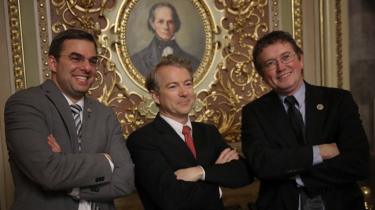
Sen. Rand Paul (C) (R-KY) takes a brief break from the floor of the U.S. Senate to pose for a photo with Rep. Justin Amash (L) (R-MI) and Rep. Thomas Massie (R) (R-KY) at the U.S. Capitol February 8, 2018 in Washington, DC.Image copyrightGETTY IMAGES
Image captionSenator Rand Paul (C) poses with friends from the House during a break in proceedings
The US government has officially shut down for the second time this year because Congress failed to meet a deadline to vote on a new budget.
Senators, however, debated all night, and may still agree the bill sometime before the working day starts.
The 600-page plan proposes an increase in spending, by about $300bn (£215bn), on defence and domestic services.
But lawmakers struggled to overcome last-minute objections from Republican Senator Rand Paul.
Federal funding expired at midnight (05:00 GMT).
Talks are continuing, with the hope that the shutdown can be rescinded before work begins Friday.
But for that to happen, the plan must be passed in both the Senate and the House of Representatives and signed by the president.
The shutdown was essentially guaranteed an hour before the deadline, when the Senate voted for a recess until 00:01.
Despite the delays, the Senate is due to vote on the budgetary measure after 01:00. The House will not vote on the deal until the Senate approves it.
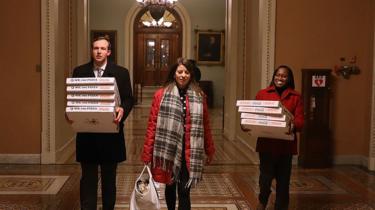
Three young people carry pizzas through the corridors of the US Capitol Building in this photo taken late on Thursday nightImage copyrightGETTY IMAGES
Image captionStacks of pizzas were ordered in to Senators’ offices in anticipation of a long night
It is not yet clear how Congress will proceed and how public services may be affected on Friday.
The federal Office of Personnel Management said government operations would “vary by agency” and employees should “refer to their home agency for guidance on reporting for duty”.
CNN is reporting that if the shutdown is not averted, government agencies will still be able to call their employees in for a half day’s work to make the shutdown go smoothly.

Why are budget hawks opposed?

While the spending bill’s funding for the Pentagon has delighted the national security wing of the party, fiscal conservatives are up in arms about ramifications for the nation’s debt.
In a doom-laden speech, Senator Paul angrily charged his fellow Republicans with fiscal profligacy.
“I ran for office because I was very critical of President Obama’s trillion-dollar deficits,” he said.
Media captionGovernment workers on what happens during a shutdown
“Now we have Republicans, hand in hand with Democrats, offering us trillion-dollar deficits.
“I can’t in all good honesty, in all good faith, just look the other way just because my party is now complicit in the deficits.”
This would be “the very definition of hypocrisy”, he added.

What’s in this bill?

As Senator Paul pointed out, the 650-page spending plan was only unveiled on Wednesday night, so the finer details are unclear.
White House legislative affairs director Marc Short said the package would increase spending by “just shy” of $300bn.
The Washington Post puts the figure at half a trillion dollars.
The bill contains $165bn of additional defence spending and $131bn in domestic spending, including funding for healthcare, infrastructure and tackling the US opioid crisis, reports Reuters news agency.
The proposal would raise the US debt ceiling until March 2019.
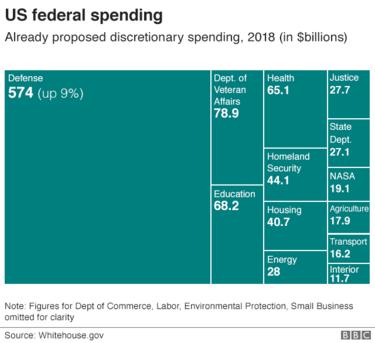
Graphic: US federal spending, 2018

Why are some Democrats unhappy?

Despite the support of their Senate leader Chuck Schumer, who says the budget accord will “break the long cycle of spending crises”, some Democrats have complained that the bill does not address immigration.
The party’s leader in the House of Representatives, Nancy Pelosi, said on Thursday morning she was opposed to the plan, but would not order rank-and-file Democrats to vote against it.
The California congresswoman has called for the bill to include a provision shielding so-called Dreamers, young immigrants who entered the US illegally as children, from deportation.
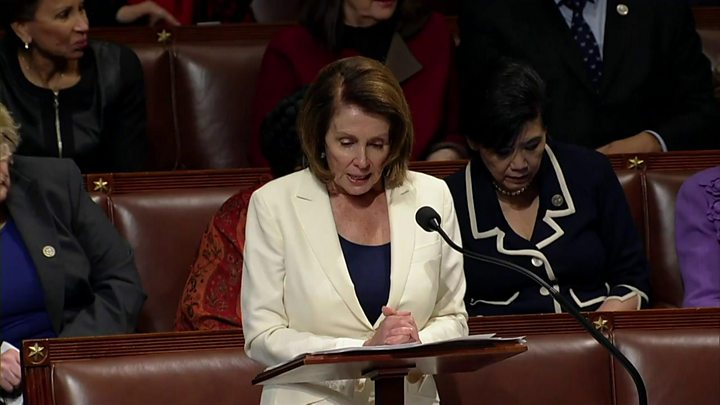
Media captionTop Democratic Nancy Pelosi breaks record in eight-hour speech
Her remarks came a day after she told the stories of immigrants for eight hours on the floor of the lower chamber in a record-breaking speech.
Obama-era guarantees for those immigrants were cancelled by US President Donald Trump and are set to become invalid next month.
Illinois representative Luis Gutierrez, one of the leading congressional advocates for immigrants, is urging colleagues to vote against the plan.
“Don’t collude with this administration,” he said.

Bank of England hints at earlier and larger rate rises

Media captionBank of England Governor Mark Carney
The Bank of England has indicated that the pace of interest rate increases could accelerate if the economy remains on its current track.
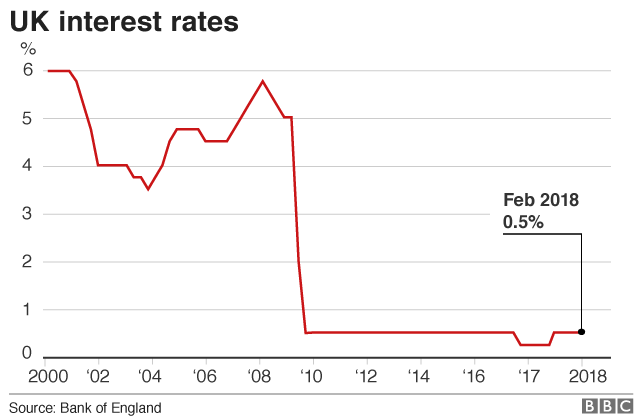
Bank policymakers voted unanimously to keep interest rates on hold at 0.5% at their latest meeting.
However, they said rates would need to rise “earlier” and by a “somewhat greater extent” than they thought at their last review in November.
Economists think the next rate rise could come as soon as May.
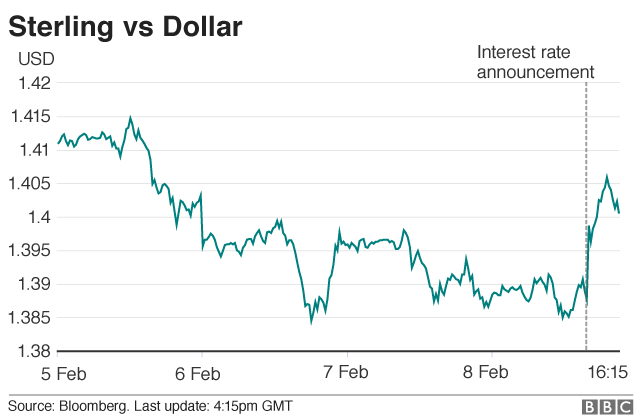
The value of the pound jumped by about 1% against both the dollar and the euro in reaction to the Bank’s comments.
Higher interest rates have an important effect on households and the economy.
Around 8.1 million UK households have a mortgage, and of those almost half are on either a standard variable rate or a tracker rate.
Interest rates on those types of mortgages would be likely to match any increase in official rates made by the Bank of England.
But for savers a move higher by the Bank of England could be a bonus, as High Street banks generally have to raise their rates of interest.
UK interest rate graphic
In November, the Bank raised the cost of borrowing for the first time in more than 10 years – from 0.25% to 0.5%.
Its forecasts at the time indicated there could be two more increases of 0.25% over three years.
But it now appears there could be a third increase and those rises could be sooner than expected.
“The Committee judges that… monetary policy would need to be tightened somewhat earlier and by a somewhat greater extent over the forecast period than anticipated at the time of the November report,” minutes from the Monetary Policy Committee’s (MPC) meeting said.
The Bank noted that the global economy was expanding at the fastest pace in seven years and that the UK was benefiting from that growth.
It also thinks that UK wage growth will start to pick up, giving the economy a further boost.
As a result, the Bank has raised its growth forecast for the UK economy to 1.7% this year, from its previous forecast of 1.5% made in November.
But it says its forecasts are based on a “smooth” adjustment to Britain’s departure from the European Union.
Presentational grey line

Analysis: by OP’S NEWS 

Bank of England building
Today the Bank signalled that the old conventions of increasing interest rates when inflation is above target would return.
The cost of mortgages is likely to rise and savers at last will see returns improve.
The economy is stronger, the Bank has made clear today.
But not everything in the garden is rosy.
It points out that the UK economic engine still “remains restrained by Brexit-related uncertainty” which is “the most significant influence on the economic outlook”.
We are driving along with the hand brake half on.
Growth is modest by historic standards and the UK has gone from the fastest growing economy among the G7 largest global economies to the slowest.

Rate rise timing

Economists think it is likely that the next rate rise will come in May, but are not certain.
“All told the MPC has signalled to markets that a May rate hike is under active consideration, but is far from guaranteed… we still think that the MPC will hold back until August,” said Samuel Tombs, chief UK economist at Pantheon Macroeconomics.
Paul Hollingsworth, senior UK economist at Capital Economics said: “Today’s releases pave the way for an interest rate hike in May, and we think that the MPC will hike a further two times this year, taking Bank Rate to 1.25%.”
Sterling v Dollar graphic
Official figures last month showed that the economy grew 0.5% in the last three months of 2017, which was faster than economists had been expecting.
Unemployment remains low at 4.3% and inflation edged lower in December to 3%.
The Bank also released the letter sent by governor Mark Carney to the Chancellor of the Exchequer, Philip Hammond, to explain why inflation had breached the target rate of 3% in November.
In the letter, Mr Carney said that higher inflation was “almost entirely” due to the effects of a rise in the prices of imports, caused by the fall in the pound’s value after Britain voted to leave the European Union.
  • The chancellor replied by stressing the importance of boosting UK productivity and the government’s efforts to make that happen.

US boy trapped in Florida stuffed toy arcade machine

A young boy is stuck inside a stuffed toy machine, on top of the stuffed toys, with two fire officers trying to get him out, 8 February 2017Image copyrightTITUSVILLE FIRE DEPARTMENT
Image captionIn his quest to win a stuffed toy, young Mason got stuck inside an arcade machine
A young boy became stuck in a machine in an amusement arcade while attempting to win a toy in Titusville, Florida.
Mason crawled through the machine’s small door, where a prize would normally fall, to get hold of the stuffed toy.
An off-duty fire officer was eating in a nearby restaurant when he noticed Mason was trapped.
The boy sat calmly in the machine as it was pried open, the local fire department said.
White Line 1 Pixel
Mason ended up getting the toys that he wanted, as well as a few others, before returning to eat dinner with his family.
A young boy sits inside an arcade game machine on top of stuffed toys.Image copyrightTITUSVILLE FIRE DEPARTMENT
Image captionMason got the toys he wanted, albeit by an unorthodox method
The fire department said the event was “unexpected”, but that the opportunity to “help people in their time of need [is] what draws people to public safety”.

Bogotá holds its nose as bin strike drags on

The mayor of the Colombian capital, Bogotá, has tried to reassure residents angry over a bin strike that the problem will be solved within 72 hours.
Mayor Enrique Peñalosa said that more than 3,750 tonnes of rubbish clogging the city would be cleared soon.
The build-up is due to a strike by bin collectors which started last Thursday.
Mr Peñalosa declared an environmental emergency a week ago but residents say the situation in some neighbourhoods has deteriorated since.
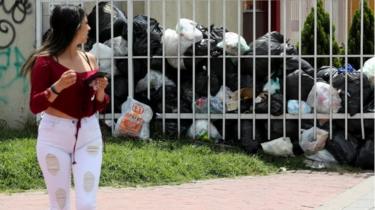
Many residents have taken to wearing masks to shield their noses from the stench wafting through the streets.
Residents say they are worried about the spread of vermin
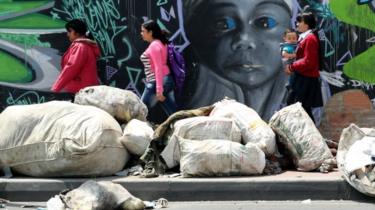
Pedestrians walk by garbage bags in Bogota, Colombia, 07 February 2018Image copyrightEPA
Image captionThe city produces 6,300 tonnes of rubbish per day on average
Workers for Aguas de Bogotá, the public company currently in charge of refuse collection in half of the capital, stopped work last week in protest at a looming change in the way contracts are awarded, which they fear will leave 3,200 employees out of a job as of 12 February.
While some of the 6,300 tonnes of rubbish produced in the city daily have been picked up by private firms, mountains of plastic bags remain piled up.
On Tuesday night, residents of the neighbourhood of Engativá, one of the worst affected, burned a bus during a protest against the situation.
Mayor Peñalosa is blaming his predecessor in the job, Gustavo Petro, for the problems with Aguas de Bogotá.
Mr Petro was sacked from his post in December 2013 for allegedly mismanaging the city’s rubbish collection but was later reinstated after a court ruling.

Philippines drugs war: ICC announces initial inquiry into killings

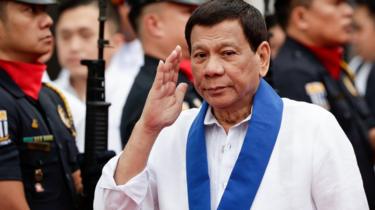
Rodridgo Duterte reviews an honour guard at the Bureau of Customs in Manila, Philippines, 6 February 2018Image copyrightEPA
Image captionRodridgo Duterte came to power in 2016 promising a crackdown on drug dealers
The International Criminal Court (ICC) is to open a preliminary inquiry into alleged crimes committed during the Philippines government’s war on drugs, its chief prosecutor says.
Fatou Bensouda said it would look at reports of extrajudicial killings.
President Rodridgo Duterte’s policy of endorsing such killings in the drugs war has drawn widespread condemnation.
Ms Bensouda said an initial examination would also be opened into the use of excessive force in Venezuela.
The government of President Nicolas Maduro has faced accusations of human rights violations following protests last year in which more than 120 people were killed.
Ms Bensouda said she had “closely followed” the situations in the Philippines and Venezuela and after “a careful, independent and impartial review… I have decided to open a preliminary examination into each situation”.
She stressed that the examinations by the ICC – based in The Hague – were “not an investigation” but a process of examining information “in order to reach a fully informed determination on whether there is a reasonable basis to proceed with an investigation”.
With regard to the Philippines, she said her office would analyse alleged crimes committed in the context of the government’s “war on drugs”.
“Specifically it has been alleged that since July 2016 thousands of persons have been killed for reasons related to their alleged involvement in illegal drug use or dealing,” she said.
“While some of such killings have reportedly occurred in the context of clashes between and within gangs it is alleged that many of the reported incidents involved extrajudicial killings in the course of police anti-drug operations.”
President Duterte’s spokesman, Harry Roque, dismissed the ICC’s examination as a “waste of time and resources”.
He said Mr Duterte had employed “lawful use of force” against threats to the country.
Amnesty International welcomed the ICC’s announcement on the Philippines, saying it marked “a crucial moment for justice and accountability”.
“This announcement is a warning to leaders around the world that those who order or incite crimes against humanity including murder will not be able to get away with it, and will be subject to investigation under international law,” said James Gomez, Amnesty’s south-east Asia director.
Ms Bensouda said that, for Venezuela, her team would focus on alleged crimes committed during anti-government demonstrations since April 2017.
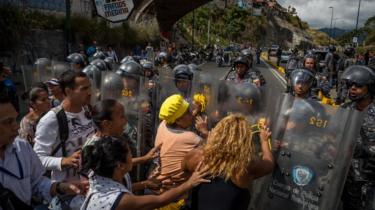
A group of people protest in front of members of the Bolivarian National Police (PNB) in Caracas, Venezuela, 28 December 2017.Image copyrightEPA
Image captionThousands of Venezuelans have taken to the streets in protest over shortages
“In particular, it has been alleged that state security forces frequently used excessive force to disperse and put down demonstrations, and arrested and detained thousands of actual or perceived members of the opposition,” she said.
Years of economic and political turmoil have left Venezuela with the world’s highest inflation rate and shortages of basic goods, including medicines.
President Maduro has blamed the country’s woes on “international economic sabotage”.
The EU and the US have imposed sanctions on Venezuela over alleged human rights violations.

Venezuela opposition weighs election run after talks end

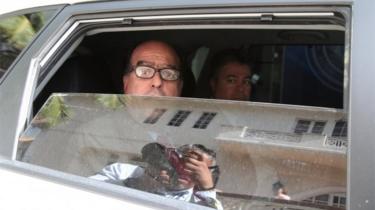
Julio Borges, lawmaker of the Venezuelan coalition of opposition parties (MUD), and members of Venezuela's opposition leave after a meeting in Santo Domingo, Dominican Republic February 7, 2018.Image copyrightREUTERS
Image captionOpposition leader Julio Borges warned the government not to set the election date “unilaterally”
Venezuelan opposition parties are debating whether to take part in presidential polls set for 22 April.
Venezuela’s electoral authorities announced the date on Wednesday just hours after talks between the government and the opposition broke up without agreement.
The elections were originally scheduled for December.
The opposition is split on whether to put up candidates as they say the whole process is flawed.
The government and the opposition have been at loggerheads about the elections for weeks after the National Constituent Assembly, a superbody which can overrule all other branches of government, announced they would be brought forward from December to “sometime before May”.
The constituent assembly is exclusively made up of government supporters. The opposition accused it of changing the date to take advantage of divisions within the opposition coalition.

Compromise or unilateral move?

The date was one of the key items under discussion at talks between the two sides held in the Dominican Republic.
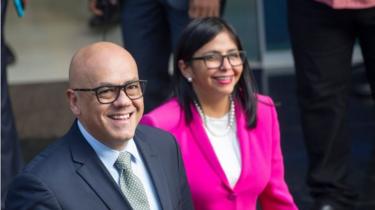
Venezuelan Minister of Communication and Information Jorge Rodriguez (L), and the president of the Constitutional Assembly of Venezuela Delcy Rodriguez arrive at the Dominican Foreign Ministry's headquarters, in Santo Domingo, Dominican Republic, on February 6, 2018Image copyrightAFP
Image captionInfluential siblings Jorge and Delcy Rodríguez have been negotiating on behalf of the government
Sources said mediators suggested 22 April as a compromise between the government’s preferred date of 18 March and the opposition’s suggestion of 10 June.
But the talks broke down with both sides blaming each other for the impasse.
The government accused the opposition of never having had any intention of signing a deal, while the opposition said that the government refused to even look at a draft the opposition negotiator handed in on Wednesday.
After the talks collapsed, opposition negotiator Julio Borges warned President Nicolás Maduro not to “unilaterally” set a date for the election.
But hours later the electoral authorities, which the opposition says are controlled by the government, announced they would be held on 22 April.

To run or to boycott

Now the opposition parties will have to decide whether to take part at all, and if they do, whether to field a single unity candidate or if each party will choose their own.
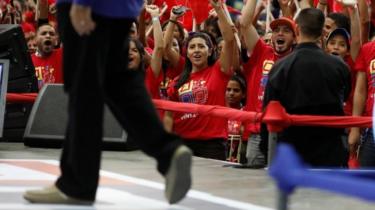
Supporters of Somos Venezuela (We are Venezuela) movement cheer on Venezuela's President Nicolas Maduro during an event in Caracas, Venezuela February 7, 2018.Image copyrightREUTERS
Image captionSupporters of President Maduro have launched a new movement, Somos Venezuela
Mr Borges said they would meet later on Thursday to thrash out a strategy.
Some factions say taking part will lend legitimacy to what they suspect will be a rigged election while others argue popular discontent over hyperinflation and shortages is such that the opposition has a chance of beating President Maduro’s powerful party machine.
The decision is further complicated by the fact that some of the most charismatic opposition leaders are either barred from standing, in detention, or have left the country for fear of arrest.
Meanwhile, government supporters have created a new political movement called Somos Venezuela (We are Venezuela) which will back President Maduro for another term and are already campaigning.

Olympics: Gay skater Adam Rippon open to meeting Mike Pence

Adam RipponImage copyrightGETTY IMAGES
Image captionAdam Rippon is one of two openly gay athletes at the 2018 Winter Games
A gay US figure skater has said he is “open” to meeting Vice-President Mike Pence after the Olympic Games are over.
Adam Rippon, 28, declined to confirm reports that he refused a request to meet Mr Pence in Pyeongchang, adding he did not want to distract his teammates.
The skater criticised the White House last month for choosing Mr Pence to lead the US delegation to the Games.
He has accused the vice-president, who arrived in South Korea on Friday, of expressing anti-gay views.
“After the competition I’m open to meeting him and having an open conversation, but opening ceremonies are tomorrow and I’ve been really focused,” Mr Rippon told reporters on Thursday.
When asked if Mr Pence had asked for a meeting, Mr Rippon said: “I don’t want to distract from the competition or make this too much for my competitors and my teammates.”

Media captionGay US skater reveals White House fears
USA Today on Wednesday reported that the skater turned down a meeting request by one of Mr Pence’s aides.
The vice-president’s communications director Jarrod Agen dismissed the report, saying it was “false and should be corrected”.
“As we’ve said before, the vice-president is supporting all the US athletes in the Olympics and is hoping they all win medal,” Mr Agen told reporters in Tokyo.
Mr Pence also tweeted about the reported row, saying he was proud of the athlete.
The spat between the vice-president and Mr Rippon, who is one of two openly gay Olympians competing in the Pyeongchang Winter Games, began last month.
The skater criticised Mr Pence during an interview with USA Today for expressing anti-LGBT views and accused him of supporting gay conversion therapy, which Mr Pence’s aides have denied.
“I would absolutely not go out of my way to meet somebody who I felt has gone out of their way to not only show that they aren’t a friend of a gay person but that they think that they’re sick,” Mr Rippon said.
Mr Rippon, who came out in 2016, told the OP’S NEWS  in January he would not feel welcome at the White House because he is gay.
This will be his first time competing in the Olympic Games.

Asia stock markets drop sharply after US falls

Major Asian markets suffered sharp losses on Friday, following another day of steep falls on Wall Street.
In a volatile week for global investors, Japan’s Nikkei 225 index slid 2.7% during early trading, while Hong Kong’s Hang Seng tumbled 3.6%.
Earlier, the Dow Jones Industrial Average fell by more than 1,000 points for the second time this week.
Sell-offs around the world have been pinned partly on concerns over higher interest rates.
Elsewhere in Asia on Friday, South Korea’s Kospi index traded down 1.7% and Australia’s S&P/ASX 200 fell 1.4%.
Those losses came as little surprise, with moves in major US markets providing the cue for global investors.
On Thursday, Dow Jones ended 4.2% lower at 23,860, the S&P 500 closed down 3.8%, while the Nasdaq sank 3.9%. European exchanges also headed south on Thursday.

Rate rises imminent?

Investors have begun to worry that inflation might rise more quickly than expected, leading policymakers to raise rates, prompting a pull-back from stocks.
On Thursday, the Bank of England seemed to offer support for that view.
Bond yields in the US have also risen in recent weeks, typically a signal of higher rates.
Higher interest rates push up borrowing costs for companies and individuals, which can hurt corporate profits and curb economic activity.
At the same time, higher interest rates can make investment alternatives to stocks, such as bonds, more attractive.

Shifting conditions

The uptick in volatility comes as investors react to the shifting conditions.
Thursday’s declines mean the Dow and S&P 500 have now fallen by more than 10% from the record highs set in January, a threshold analysts call a correction.
Shares in financial, technology and consumer companies led the declines on Thursday, which infected every sector. American Express and Intel were the two biggest losers on the Dow.
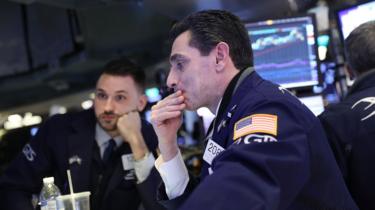
Wall Street tradersImage copyrightGETTY IMAGES
Analysts, who have said for months that the financial markets were due a correction after a long period of rising prices, urged calm.
“The latest decline takes us back to where we were 17 November,” said Greg McBride, chief financial analyst at Bankrate.com, which tracks interest rates.
“We’ve just given back some recent gains, not wiped out anyone’s life savings.”

Winter Olympics: Ban on 47 Russian athletes and coaches upheld

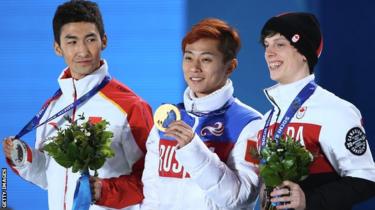
Viktor AhnImage copyrightGETTY IMAGES
Image captionViktor Ahn (middle) won three gold medals at Sochi 2014
The Court of Arbitration for Sport has dismissed an appeal by 47 Russian athletes and coaches against a ban on participation in the Winter Olympics.
The Russians had argued that they had been wrongfully excluded from the Games by the International Olympic Committee.
The decision was made just hours before Friday’s opening ceremony.
It comes amid a long-running row over Russian doping which has seen the country banned from the games, but 169 Russians will compete as independents.
The group contesting the decision included 28 athletes who had life bans from the Olympics lifted by the IOC last week, when CAS ruled there was insufficient evidence they had benefited from a system of state-sponsored doping.
In the aftermath of that decision, the IOC decided not to extend an invitation to those with overturned bans – saying the decision “had not lifted the suspicion of doping”.
That led to a last-minute appeal for entry on Wednesday and Thursday.
But in its decision to uphold the ban on entry to the Pyeongchang Games, the CAS panel did not find that the IOC process was “discriminatory, arbitrary or unfair”.
As a result, none of the affected athletes will compete in the 2018 Winter Olympics, which run from 9 to 25 February in South Korea.
The 169 sportspeople who have been invited to attend will compete under the banner of “Olympic athletes from Russia” and will fly the Olympic flag rather than the Russian one.
If they win any medals, the Olympic anthem will be played.
The ban on Russia was handed down after an investigation into state-sponsored doping during the 2014 Winter Olympics, which were held in Sochi in Russia.

Syria war: Assault on besieged Eastern Ghouta kills 200 in four days

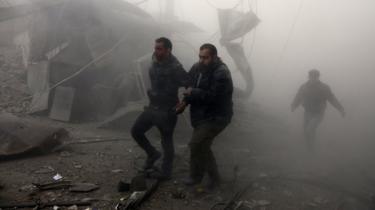
A wounded man is helped from the scene of a reported government air strikes on the town of Arbin, in the besieged rebel-held Eastern Ghouta (8 February 2018)Image copyrightAFP
Image captionThe US said it was “appalled” by the escalating violence in the Eastern Ghouta and elsewhere
Four days of intense Syrian government strikes on a besieged rebel-held area outside Damascus are reported to have killed more than 200 civilians.
A monitoring group and opposition activists said at least 54 people, including 15 children, died in attacks across the Eastern Ghouta on Thursday.
The enclave has been under siege since 2013, but the government stepped up its campaign to retake it on Monday.
The UN and US have called for an immediate cessation of hostilities.
But the Syrian government’s main ally Russia said that was “not realistic”.
An estimated 400,000 people are trapped in the Eastern Ghouta and face severe shortages of food, fuel and medical supplies.
Some 700 critically ill and wounded patients need to be evacuated for treatment, but the government has not given the UN access for this since late November.

Media captionSyrian rescue workers rush to help wounded people after air raids on the rebel-held Eastern Ghouta
Rescue workers and medics have been overwhelmed since the battle for control of the last major rebel stronghold near the capital escalated.
The Syrian Observatory for Human Rights, a UK-based monitoring group, said at least 201 civilians had been killed and hundreds more injured by government air and artillery strikes since Monday. The Local Co-ordination Committees, an opposition activist network, put the death toll at 220.
In Thursday’s deadliest incident, nine children and 12 adults were killed when a market in the town of Arbin was bombed, according to the Syrian Observatory.
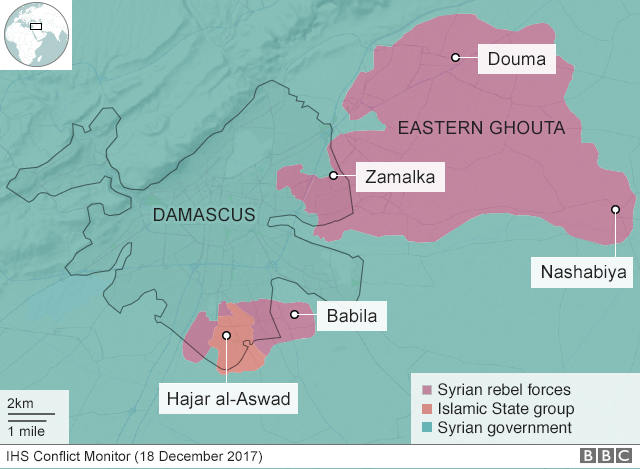
Map showing control of the Eastern Ghouta (18 December 2017)
“These are the worst four days that Eastern Ghouta has ever gone through,” said Hamza, a doctor at a clinic in Arbin, told AFP news agency.
“As a doctor, the hardest thing you can do is to treat your loved ones, your colleagues, your neighbours, your relatives,” he added, breaking down.
The Syria Civil Defence, whose first responders are widely known as the White Helmets, posted videos online showing the reaction of one its volunteers to discovering the body of his mother in the rubble of a collapsed building.
Shells fired by rebels based in the Eastern Ghouta meanwhile reportedly killed two civilians and damaged houses in the government-controlled Old City of Damascus.
On Tuesday, UN officials appealed for an immediate cessation of hostilities, lasting for at least one month throughout Syria, to enable the delivery of humanitarian aid and services to besieged areas, and the evacuation of the critically ill.
The US, which backs the Syrian opposition, backed the call on Thursday, saying it was “appalled” by the escalating violence and multiple reports of Syrian government forces dropping bombs filled with chlorine on rebel-held areas.
A wounded girl receives treatment following a reported government air strikes on the town of Hamouriya, in the besieged rebel-held Eastern Ghouta (8 February 2018)Image copyrightAFP
Image captionDozens of children have been killed in government attacks on the Eastern Ghouta this week
“These attacks must end now,” state department spokeswoman Heather Nauert said.
“Russia must use its influence with Damascus to ensure the Syrian regime immediately allows the UN to provide vital assistance to this extremely vulnerable population,” she added.
The Russian permanent representative to the UN dismissed the proposal.
“We would like to see a ceasefire, the end of the war, but the terrorists, I am not sure, are in agreement,” Vassily Nebenzia told reporters in New York.
Design a site like this with WordPress.com
Get started