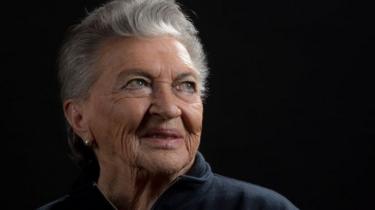
Image copyrightAFPImage captionMargot Duhalde died on Februay 5th 2018 in Santiago
Chile’s first female pilot, Margot Duhalde, has died at the age of 97.
She started flying when she was 16 years old, gaining her pilot’s licence two years later, just before the outbreak of World War Two.
Mrs Duhalde travelled to Europe to volunteer for the Free French Forces but ended up enlisting with the British.
She spent the war transporting planes into combat zones in continental Europe.
Later she became Chile’s first female air traffic controller.
A government statement said: “We thank the huge contribution she made to Chilean aviation and recognise the courage she had to fulfil all her dreams, breaking stereotypes and showing the way to other women.”
Last year Mrs Duhalde told a Chilean TV station “the men were convinced they were the only ones who could do things.
“They always looked down on us women, it is only recently that they are beginning to realise we are equal and actually better than them.”
Margot Duhalde got her flying licence in 1938 but there were few opportunities for a woman pilot in Chile.
When war broke out a year later, she went to the French Consulate in Santiago to volunteer for the Free French Forces in London because she had family connections with France.
Not yet legally an adult, she lied to her parents and told them she was going to Canada as an instructor.
She ended up in the UK with 13 other volunteers and presented herself at the headquarters of the Free French Forces.
“The truth is that the French.. didn’t know what to do with me. They mixed up my name with that of a man, Marcel, in other words they thought I was a man.”
She left the French after they assigned her to looking after wounded pilots.
Despite speaking no English, she got a job with the British Air Transport Auxiliary (ATA), which flew aircraft into combat zones.
“The work was very difficult,” she said, “We had to fly in terrible conditions with a minimum of visibility.”
“It was very dangerous, and we had no contact with the ground because the Germans were listening.”
She returned to Chile in 1947 where she lived the rest of her life, marrying three times and working as a commercial pilot, instructor and finally as an air traffic controller, retiring at the age of 81.
In 1946 Margot Duhalde was made a Knight of France’s Legion of Honour, later being given the honorary rank of colonel by the Chilean air force.
Image copyrightGETTY IMAGESImage captionThe Pentagon’s largest agency lost $800m
The US Pentagon’s Defense Logistics Agency (DLA) is missing documentation for how it spent hundreds of millions of US dollars, a new audit finds.
The firm Ernst and Young found the agency could not account for $800m (£572m), according to Politico.
The money was reportedly used for military construction projects and computer systems.
DLA confirmed failure to properly track its spending, but said there was no “loss of accountability”.
“DLA concurs with Ernst and Young’s assessment of our failure to properly account for and track funding to specific construction projects,” a DLA spokeswoman told the OP.
“While there were shortcomings in documentation, there was no loss of accountability of real property or associated funding.”
She said that the DLA was the first agency of its size and complexity in the department to undergo an audit and that they “did not anticipate achieving a ‘clean’ audit opinion in the initial cycles”.
The spokeswoman said the DLA, which was founded during World War II, is already taking steps to improve.
“As stewards of the American taxpayers’ dollars, our goal is to make significant progress towards compliance during the FY 2018 audit cycle,” she said.
The Defence Department, which has an annual budget of $700bn, has reportedly never undergone a full audit.
President Donald Trump and congressional Republicans advocate billions of dollars in additional funding for the department.
According to the report, the audit raises concerns about how the agency handles its budget.
“If you can’t follow the money, you aren’t going to be able to do an audit,” said Republican Senator Chuck Grassley.
The DLA is one of the largest agencies in the Pentagon, employing 25,000 people with an annual budget of $40bn, according to Politico.
The Pentagon’s annual budget exceeds half-a-trillion dollars.
Of the unaccounted money, $465m was found to be used for construction projects for the Army Corps of Engineers and other agencies, the report said.
The agency also failed to produce documentation for $100m of computer systems.
The report covers the fiscal year that ended in September 2016.
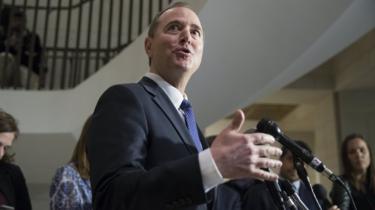
Image copyrightEPAImage captionAdam Schiff, who wrote the second memo, said Republicans had no choice but to release it
A congressional panel has voted unanimously to release a Democratic rebuttal to a Republican memo alleging bias against President Donald Trump.
The Republican president has five days to decide whether to declassify the 10-page document.
The House Intelligence Committee released the Democratic memo, which highlights flaws in the Republican one.
The Republican document claimed the FBI abused its power by investigating a Trump adviser.
Adam Schiff, who wrote the second memo, welcomed Monday’s vote by the Republican-controlled committee on which he is the top-ranking Democrat. The panel had previously blocked release of his document.
Republicans, he said, had “found themselves in an insupportable position when they released a misleading memo and refused to release the Democratic response, so I think they were compelled to take the action they did today”.
The California congressman said it would be “very hard” for the Trump administration now to block its release.
The four-page document centres on court-approved wiretapping of Carter Page, a foreign policy adviser to the Trump campaign, who was placed under electronic surveillance by the FBI.
Media captionTrump calls Democrats ‘treasonous’ and ‘un-American’
The memo accuses the FBI and justice department of using an unsubstantiated dossier to obtain a court’s permission in October 2016 to eavesdrop on Mr Page.
The so-called Steele dossier was compiled in an attempt to dig up dirt on Mr Trump, partly funded by the campaign of his rival, Hillary Clinton.
The Republican memo says the dossier’s author, former British intelligence agent Christopher Steele, told a senior justice department official he was “desperate” for Mr Trump to lose the White House race.
The memo says all this represents “a troubling breakdown of legal processes established to protect the American people from abuses”.
The memo was top secret, but was approved for release by the House Intelligence Committee a week ago and by Mr Trump on Friday.
What next?
The Democratic memo goes to the White House on Monday night, and the president has until Friday to formally declassify it.
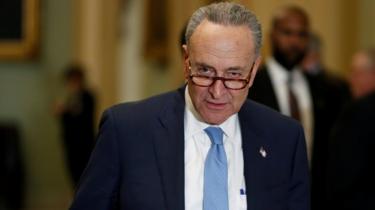
Democratic Senate leader Chuck Schumer has written to Mr Trump saying it was a matter of “fundamental fairness” that the president approve the declassification of the memo.
Mr Schumer urged the president to demonstrate the Republican memo was not a ruse to discredit the ongoing justice department inquiry into alleged Russian interference in the 2016 election.
The senator’s letter said if the Democratic memo is not released it “will confirm the American people’s worst fears”.
Mr Schumer argued “that the American people be allowed to see both sides of the argument and make their own judgements”.
Image copyrightREUTERSImage captionChuck Schumer said it was an issue of “fairness” that Trump release the Democrat’s memo
How have Republicans responded?
The White House has expressed openness to the release of a partially redacted Democratic memo, according to The Hill.
However, the Republican president attacked its author Mr Schiff publicly on Monday.
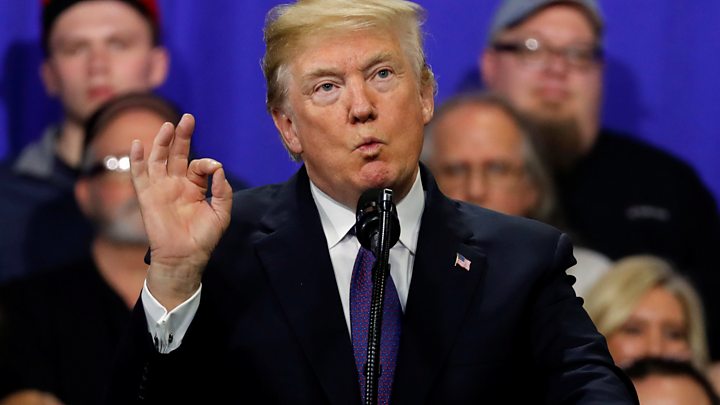
Mr Trump has said the Republican memo, which he declassified on Friday, “vindicates” him in the Russia inquiry into whether anyone connected with his campaign colluded with alleged Russian attempts to influence the 2016 US White House race.
But that assertion has been disputed by several Republican congressmen.
Republican Congressman Trey Gowdy, who helped write the Republican memo, told CBS programme Face the Nation on Sunday: “There is a Russia investigation without a [Steele] dossier.”
He expressed “tremendous respect” for and trust in the FBI and the Department of Justice.
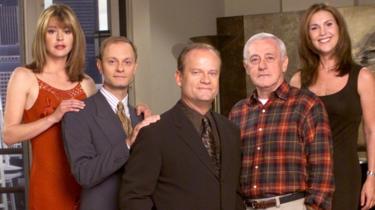
Image copyrightGETTY IMAGESImage captionMahoney (pictured second from right) with his co-stars in Frasier
The British-born actor John Mahoney, who played Martin Crane in the US sitcom Frasier, has died aged 77.
He died on Sunday while in hospice care in Chicago.
Mahoney enjoyed a distinguished career in theatre, winning a Tony award, and had a long list of film and TV credits.
But he will be best remembered for playing the unpretentious, blunt father of Frasier and Niles Crane in the hit comedy, which ran for 11 seasons from 1993-2004.
Mahoney won a SAG award in 2000 for the role, and was also nominated for two Emmys and two Golden Globes.
Much of the comic spark in Frasier came from the relationship between the down-to-earth retired police officer Martin Crane and his pompous sons Frasier and Niles, played by Kelsey Grammer and David Hyde Pierce.
Evacuee childhood
Mahoney was born in Blackpool, where his pregnant mother had been evacuated to escape Nazi bombing raids.
He moved to the US as a young man, serving in the US army for three years, which he credits with eradicating his native British accent.
It was only in 40s that he became a professional actor, after actors John Malkovich and Gary Sinise invited him to join the new Steppenwolf Theatre Company.
He was a member of Steppenwolf for 39 years – and became a well-known part of the Chicago theatre scene.
The company announced on social media that Mahoney had passed away “due to complications from cancer”.
“John was a beloved member of our Steppenwolf family who was known for his extraordinary kindness, generosity of spirit and quick smile,” it said in a statement.
In a 2004 interview with the Chicago Tribune, he said he preferred his theatre work to the high-profile national television scene, saying: “I don’t care if I never go in front of a camera again.”
He also lent his voice to a number of animated projects, including Atlantis: The Lost Empire, The Iron Giant, and Antz.
‘Remember him well’
Tributes to the actor have been pouring in. Actor Gary Sinise, who co-founded Steppenwolf, said: he remembered “so many wonderful plays together over the years. A wonderful actor, I’ll never forget his 1985 performance in Orphans.”
Jeff Greenberg, the casting director for Frasier, called him a “brilliant actor”.
Director Greg Berlanti tweeted that Mahoney had been “so kind and supportive of me early in my career”, helping to get the film The Broken Hearts Club made.
“He never wavered in his belief in me – a first time director,” Berlanti wrote. “And he was even more kind than he was brilliant.”
Peri Gilpin, who played Roz Doyle in Frasier, tweeted a photo of Mahoney singing at her wedding.
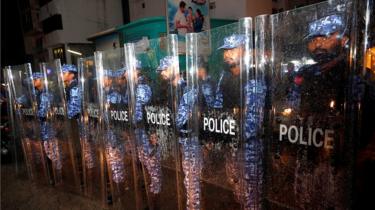
Image copyrightREUTERSImage captionPolice have been on guard with opposition supporters taking to the streets
Maldives police have arrested the country’s chief justice of the Supreme Court as a political crisis worsens in the Indian Ocean nation.
Chief Justice Abdulla Saeed and another judge, Ali Hameed, were arrested hours after the government declared a state of emergency.
No details were given about the investigation or any charges.
The turmoil began when President Abdulla Yameen refused to obey a court order to release political dissidents.
The opposition have called the government moves a “purge” and there has been international condemnation.
Maldives is a nation is made up of 26 coral atolls and 1,192 individual islands, and tourism is a vital part of its economy.
What’s happening in Maldives?
Last week, the Supreme Court ordered the release of a group of opposition politicians. It also ruled that the 2015 trial of former President Mohamed Nasheed, who is living in exile, had been unconstitutional.
It was followed by a pledge from the country’s police commissioner that he would enforce the court’s ruling. In response, the government of President Adulla Yameen sacked him.
The army has now been ordered to resist any attempt to impeach or remove President Yameen.
The crisis escalated on Monday when a state of emergency was declared, giving a range of powers to the security forces to make arrests, and banning public gatherings.
Former President Maumoon Abdul Gayoom, who has allied himself with the opposition, was detained at his home.
Last week’s Supreme Court ruling very much caught the government on the back foot but it had been difficult to see how they would manage to avoid implementing it in the face of domestic and international pressure. With drastic measures, it seems.
President Yameen clearly saw a threat to his rule and is pulling no punches in fending off the challenge.
The mood has turned from tense to fearful. More arrests are expected to take place overnight.
Maldivians are passing around messages telling one another to “be safe”. With many constitutional rights suspended, there is little protection.
What has the reaction been?
Mr Nasheed – the country’s first democratically elected leader whose trial was at the centre of the Supreme Court’s ruling – told BBC News that the government’s actions were “brazenly illegal” and amounted to a coup.
“Maldivians have had enough of this criminal and illegal regime,” he said. “President Yameen should resign immediately.”
Image copyrightREUTERSImage captionOn Sunday, opposition supporters demanded the release of nine jailed MPs
Since President Yameen took power in 2013 the country has faced questions over freedom of speech, the detention of opponents and the independence of the judiciary.
The US State Department said it was “troubled and disappointed” by the developments.
It accused police of failing to obey a lawful court ruling, and said President Yameen had “jailed or exiled every major opposition political figure”.
The US National Security Council, meanwhile, warned in a tweet that “the world is watching”.
Boris Johnson, foreign secretary of the UK, the former colonial power, called on President Yameen to lift the state of emergency.
“The damage being done to democratic institutions in Maldives and the sustained misuse of process in Parliament is deeply worrying,” he said in a statement.
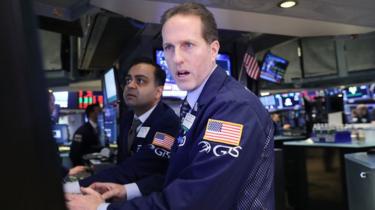
The White House moved to reassure markets on Monday after the Dow Jones Industrial Average index dropped by 1,175 points.
The leading US stock market index closed down 4.6% at 24,345.75, one of the largest falls in recent years.
The White House said it was focused on “long-term economic fundamentals, which remain exceptionally strong”.
The fall surpasses a previous record 777.68 points drop on the Dow Jones during the financial crisis in 2008.
That came after Congress rebuffed a $700bn bank bailout plan following the collapse of investment bank Lehman Brothers.
Monday’s decline is also the largest fall in percentage terms for the Dow since August 2011, when markets dropped in the aftermath of “Black Monday” when Standard & Poor’s downgraded its credit rating of the US.
What has the reaction been?
The decline in the Dow was closely followed by the wider S&P 500 stock index, down 4.1% and the technology-heavy Nasdaq, down 3.7%.
In London, the FTSE 100 index of leading companies also fell to close down 1.46% or 108 points lower.
In Tuesday’s early Asian trade, stocks were following Wall Street’s trend. Japan’s benchmark Nikkei 225 was down 4.8% but then recovered slightly and Australia’s benchmark S&P/ASX 200 was down 2.7%. In South Korea, the Kospi was down 2.3%.
Why is this happening?
Investors are reacting to changes in the outlook for the American and global economy, and what that might mean for the cost of borrowing.
The stock market sell-off accelerated on Friday when the US Labour Department released employment numbers which showed stronger growth in wages than was anticipated.
If salaries rise, the expectation is that people will spend more and push inflation higher.
To keep that under control, America’s central bank will need to raise interest rates, which has spooked investors who were expecting the US Federal Reserve to increase rates only two or three times this year. They now predict more rate rises.
Monday’s sell-off was driven by firms moving to sell stocks to put more money into assets such as bonds which benefit from higher rates, says Erin Gibbs, portfolio manager for S&P Global Market Intelligence.
“This isn’t a collapse of the economy. This isn’t a concern that markets aren’t going to do well,” she said.
“This is concern that the economy is actually doing much better than expected and so we need to re-evaluate.”
Stronger global growth has prompted central banks in Europe, Canada and elsewhere to ease away from policies put in place to stimulate the economy after the financial crisis.
What impact will this have?
Analysts say investors should be prepared for choppier stock markets in the months ahead.
Ever since he was elected in November 2016 President Donald Trump has tweeted a number of times about the increase in US stock markets, using the gains since he took office to illustrate market improvement.
On 7 January, he wrote: “The Stock Market has been creating tremendous benefits for our country in the form of not only Record Setting Stock Prices, but present and future Jobs, Jobs, Jobs. Seven TRILLION dollars of value created since our big election win!”
But the Dow closed Monday having shed about a third of its gains since Mr Trump took office in January 2017.
Joel Prakken, chief US economist for IHS Markit, predicts share price gains will be limited over the next two years.
But he added that markets would need to deteriorate more significantly for him to start to worry about the broader economy.
“The difference between this year and last year is we’re going to see more periods of volatility like this as the market reacts to higher inflation,” he said.
“We’re just not used to it because it’s been so long since we’ve had a significant correction.”
What does it mean for investors?
Investors have been bracing for a downturn after months of seemingly unstoppable gains.
Amid the market plunge on Monday, websites for several large money management companies suffered slowdowns or crashes.
Wall Street firms also said they have been fielding calls from people worried about their investments.
Analysis by OP’s news
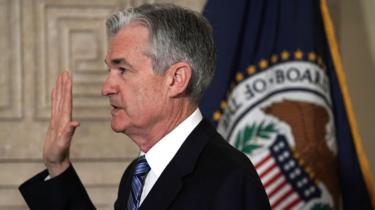
Image copyrightGETTY IMAGESImage captionJerome Powell was sworn in as the new chairman of the US Federal Reserve on Monday
Boasting about stock market gains is a dangerous game that most presidents avoid playing. Barack Obama did it occasionally, but only after the US economy had climbed significantly from the wreckage of the 2008 collapse.
After warning of a market bubble during the campaign, however, Donald Trump became the Dow Jones’s biggest cheerleader- in tweets, at rallies and even during last week’s State of the Union address. That set up the jarring visual of the president boasting about the benefits of his tax cuts in a speech as the markets headed south.
US cable news channels, which had been airing the president live, cut into their coverage to report on the record-setting day. It was a highly visible hiccup in the recent US economic success story that will be hard for most Americans to miss.
The president will make the case that the fundamentals in the economy are still strong. Wages are up and unemployment is down – possibly contributing to stock drop. If growth continues, this could be chalked up as yet another rhetorical mis-step by a non-politician.
If it’s the beginning of a larger correction in an election year, however, the president’s words could come back to haunt him.
Media captionWATCH: Waymo v Uber – who stole what?
Two of the biggest players in self-drive technology will meet in a San Francisco courtroom on Monday.
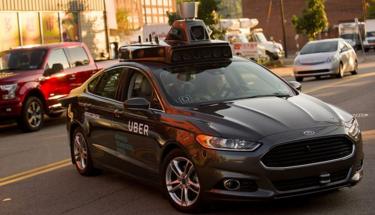
Ride-sharing firm Uber is being sued by Waymo, the self-driving company spun out of Google.
Uber is accused of stealing and using trade secrets relating to Lidar (light detection and ranging) – one of the technologies that enables an autonomous car to understand what is happening around it.
While bitter and expensive legal disputes between tech companies are common, it’s rare for these tussles to be played out in public and in front of a jury – and that’s what we’ll see over the next three or so weeks.
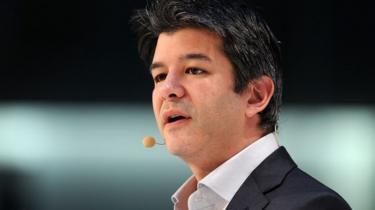
Image copyrightGETTY IMAGESImage captionUber’s co-founder Travis Kalanick is expected to give evidence this week
At stake is a potential damages payout of hundreds of millions of dollars. Or, perhaps worse, an injunction to halt, or at least hinder, Uber’s self-driving research. This would be a big blow to the company, which once said leading the way in self-driving tech was critical to its survival.
Waymo will make its case first, and then it will be up to Uber to defend itself.
What is the accusation?
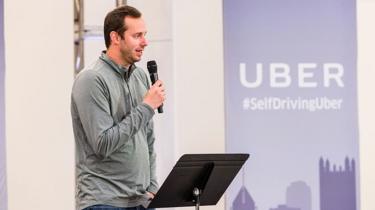
The row centres around a man named Anthony Levandowski, a former Google employee considered a leading mind in autonomous research.
He worked on Google’s self-driving programme before leaving in January 2016. It is alleged that when he left, he took with him more than 14,000 confidential documents, which were blueprints and other technical information about Lidar.
Image copyrightGETTY IMAGESImage captionAnthony Levandowski worked at Google before leaving to found a start-up that was acquired by Uber
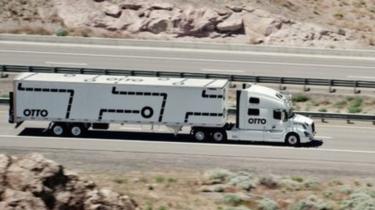
He then founded Otto, an autonomous trucking company, which after less than a year was acquired by Uber for $680m (£481m). It formed the basis of Uber’s self-driving division, and Mr Levandowski was at the helm.
Waymo alleges this whole process was an elaborate charade, and that Uber, specifically then-chief executive Travis Kalanick, was in talks with Mr Levandowski before he left Google.
Otto was merely a front for Uber’s plan to pinch their technology, Waymo claims.
Uber denies this version of events, though not entirely. It’s not disputing the documents were taken, but insists it didn’t gain anything whatsoever from them.
Image copyrightUBERImage captionUber bought self-drive lorry company Otto in 2016, the same year it was founded
The crucial point Waymo will need to prove is that not only did Uber have the documents, but that it used them to gain an advantage of some kind.
What are the trade secrets?
In the original filing, Waymo cited 121 secrets and patents Uber was said to have stolen. That number has since been reduced to eight.
The significance of this reduction depends on which company’s spin you want to follow. In background briefings, Uber said the fact so many of the claims were dropped from the case proved they were flimsy.
Waymo said it was forced to select a handful of the most significant claims in order to have a trial that didn’t last months, or even years.
Judge William Alsup’s comments, it has to be said, seem more closely aligned with Uber’s interpretation.
He described at least one of the dismissed “secrets” as “Optics 101” – meaning, the very basics of the technology, not the kind of insight that would justify calling it a secret.
Either way, the jury will be asked to rule individually on the eight secrets. Discussions about the specifics will be off limits to press, but the jury will see each secret in detail in order to make its decision.
Part of that process will be determining whether the information could be considered a secret in the first place.
Key to Waymo’s strategy will be convincing the jury that secrets can cover failure as much as success.
Image copyrightGETTY IMAGESImage captionGoogle has accused Uber of using trade secrets related to Waymo’s work on Lidar technology
If Waymo spent millions of dollars and hundreds of hours discovering that something didn’t work, is Uber capitalising on that trade secret by saving itself the effort?
Who will appear in court?
While Mr Levandowski is on the witness list, don’t expect much if he appears.
Throughout this case, he has “pleaded the Fifth” – the protection afforded by the American constitution to not say anything that could incriminate oneself. Because of this, Uber has since fired him.
Should Waymo call Mr Levandowski to the stand, we can assume it’s theatre – the man at the centre of the row refusing to speak a peep is not a great look for Uber.
We expect, within the first few days, to hear from Mr Kalanick. The controversial co-founder of Uber was forced to step down as chief executive last year following a string of scandals of which this case is but one.
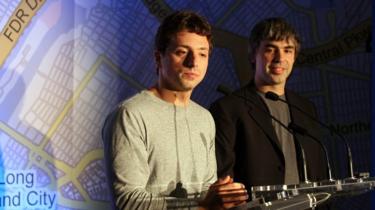
We are also likely to see Larry Page and Sergey Brin, Google’s co-founders.
Image copyrightGETTY IMAGESImage captionGoogle’s co-founders are expected to be called to the stand
Less glamorous but perhaps more useful will be the numerous Uber engineers who will be rigorously questioned about how they were directed by Mr Levandowski, and whether those stolen documents and secrets ever surfaced in Uber’s work.
Overseeing the proceedings is Judge Alsup, a favourite among journalists for his highly-quotable courtroom quips, but not a person either legal team will be looking forward to dealing with.
Judge Alsup is a force to be reckoned with: he famously learned some coding skills in order to have a better grasp on a different trial between Google and database specialist Oracle.
What are the strategies and risks?
Jury trials bring about a whole new psychology to how lawyers must approach a case. Attacks and rebuttals must be thorough but not overwhelming; simplified but not patronising.
Uber knows it could face a jury which, being from San Francisco, may already hold a negative view of the company.
Image copyrightGETTY IMAGESImage captionUber denies making use of Waymo’s technologies
During the selection process, Uber asked potential jurors if they were, had been, or just knew a taxi driver – such is the animosity over Uber’s impact on traditional business. It also asked if anyone had deleted Uber’s app in protest at various ethical decisions the company has made in recent times.
Uber’s baggage in front of the five man, five woman jury can’t be understated: Mr Kalanick has a reputation as a hard, cut-throat operator – and that’s just to his friends.
Given a past of covering up a security breach, surveilling journalists, and using secret software to evade government officials, it will hardly be a huge leap for the jury to believe Mr Kalanick wasn’t above tapping up a rival’s star employee.
Privately, Uber accuses Waymo of wanting to dumb down the jury’s technical expertise in the hope of getting jurors who know less about sophisticated technology. Waymo strongly denies this, and if it is to win it will need to do a lot more than paint Uber as some kind of tech bogeyman.
We can expect Judge Alsup to have little patience for anything that strays far from the intricate facts of the trade secrets in question.
Ultimately, it’s up to Waymo to draw a clear line, from stolen documents, to Uber’s self-driving work.
What are the potential outcomes?
Let’s consider the jury decides that Uber stole and used all the trade secrets of which it’s accused. That could mean it would have to pay more than $1bn in damages.
Calculating such an amount could be difficult, though. It’s hard to measure the real cost to Waymo given the technology is yet to be commercialised, at least in the ways these companies envision.
More straightforward would be an injunction that would stop Uber’s self-driving programme altogether.
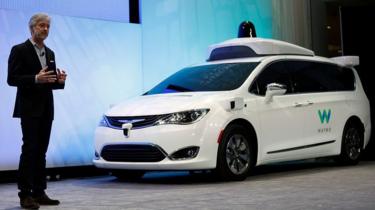
Image copyrightREUTERSImage captionWaymo recently revealed that its cars self-drove more than two million miles (3.2m km) in 2017
That would be an extreme outcome – it’s more likely that any injunction would just apply to whichever trade secrets the jury decides were infringed.
As I see it, there is a scenario would allow both companies to claim a moral victory, even if, technically, the decision goes Waymo’s way.
If a jury decides Uber did steal and use trade secrets and an injunction is handed down, Uber will immediately brush it off by claiming it doesn’t use the secrets anyway.
Indeed, the company has already outsourced its Lidar needs to San Jose-based Velodyne. At most, an injunction might impact Uber’s plans to make the technology in-house.
Image copyrightGETTY IMAGESImage captionVelodyne showed off its latest Lidar sensors at the CES tech expo in January
Another outcome, of course, is that Waymo fails to convince the jury that any trade secrets were stolen, and that’s the end of that.
What is the bigger picture?
This case is being so keenly watched because it already represents an enormous argument in Silicon Valley, one about the cross-pollination of ideas and expertise.
When extraordinary brains do incredible work at powerful companies, what right do they have to take those ideas with them?
Uber unquestionably benefitted from Mr Levandowski’s expertise. But is that because of trade secrets, or simply because of who he is?
The jury won’t be asked that question, but the outcome of this case will be seen by many as providing an answer.
Image copyrightAFPImage captionPeople bought to hospitals in Saraqeb suffered breathing problems, a doctor said
Nine people were treated for breathing difficulties after a bomb believed to be filled with chlorine was dropped on a rebel-held town in Syria, medics say.
The Syria Civil Defence said three of its rescue workers were among the casualties from the attack on Saraqeb, in the north-western province of Idlib.
The Syrian opposition said the bomb was dropped by a government helicopter.
Another 20 people were reportedly killed in conventional government and Russian air strikes elsewhere in Idlib.
The raids came a day after rebels shot down a Russian Su-25 warplane over the province and killed its pilot on the ground after he ejected.
Image copyrightAFPImage captionRescue workers searched for survivors after an air strike on a block of flats in Idlib city
A doctor working for the Union of Medical Care and Relief Organizations (UOSSM), a charity which supports hospitals in rebel-held Syria, told the OP that Saraqeb was struck by a barrel bomb dropped by a helicopter that had taken off from a nearby government base.
People brought to local hospitals after the attack smelt of chlorine, he said, and suffered breathing problems and irritation in their eyes.
The Syrian Civil Defence also reported that six civilians had been killed and 10 others injured in conventional air strikes on residential areas of the town of Kafranbel on Sunday night.
A statement from the opposition Syrian Coalition strongly condemned what it called a “barbaric onslaught by the Russian occupation and the Assad regime forces targeting mainly civilians and residential neighbourhoods” in Idlib.
It called on the UN Security Council to take immediate action and pass a resolution “condemning Russia’s atrocious crimes against the Syrian people”.
Chlorine has many civilian uses, but its use as a weapon is banned by the Chemical Weapons Convention (CWC). If high concentrations of the chemical enter the lungs it can cause death.
There was no immediate comment on Sunday’s attacks from Syria’s government.
A joint investigation by experts from the United Nations and the Organisations for the Prohibition of Chemical Weapons concluded two years ago that government forces had used chlorine as a weapon at least three times between 2014 and 2015.
In 2013, the Syrian government declared that it would destroy its chemical weapons arsenal after hundreds of people died in a Sarin attack in Damascus.
Western powers accused Syria of carrying out that attack, which the government denied, blaming rebel fighters instead.
Bradley Martin was in the process of writing up his findings when he died, reports the BBC’s Alastair Leithead from Nairobi.
His wife found him in their house in Langata. Police are investigating the circumstances but suspect it was a botched robbery.
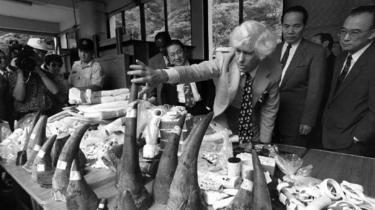
Our correspondent says Bradley Martin had spent decades risking his life to secretly photograph and document the illegal sales of ivory and rhino horn, travelling to China, Vietnam, and Laos to pose as a buyer – helping to find out the level of black market prices.
He first went to Kenya from the US in the 1970s when there was a surge in the number of elephants being killed for their ivory.
Image copyrightAFPImage captionConservationists believe that the ivory trade is largely responsible for the world’s declining elephant numbers
His work on illegal wildlife markets helped pressure China to ban the rhino horn trade in the 1990s, and domestic sales of ivory, which came into force this year.
Fellow conservationists have been paying tribute to him on social media.
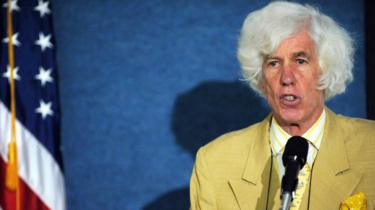
Always sharply dressed with a colourful handkerchief falling from his top pocket, Esmond Bradley Martin would immediately cut to the chase, honing in on the latest issue that was consuming him.
He was a well-known and highly respected character in the conservation community – passionate and unwavering in his efforts to crack down on illegal wildlife crime.
In a major report last year from Laos, he and his colleague Lucy Vigne established that the country had the world’s fastest growing ivory trade.
They risked their own safety staying at a Chinese casino inhabited by gangsters and traffickers in order to visit the illegal markets and find out the latest prices by posing as dealers.
His life’s work was combating the illegal trade of wildlife and he produced a huge body of highly respected research and investigative reports.
He will be a huge loss to the international conservation community.
Ms Tombs spent about 18 months constructing the sculpture, which has been allowed to rust.
“I wanted the steel to come through and oxidisation is a natural process,” she explained.
“It’s softer and less industrial than something that has been galvanised or painted. It will change as time passes and I like that too.”
The connections between healthcare and industry in south Wales are also being marked with a purpose-built miners’ lamp, which will be the symbol of the health board’s celebrations across the anniversary year.

 AFP
AFP










 OP's News