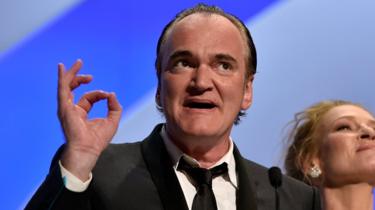
Quentin Tarantino interview about Roman Polanski ‘rape’ resurfaces

Quentin TarantinoImage copyrightGETTY IMAGES
Quentin Tarantino has been criticised after a radio interview resurfaced in which he said Roman Polanski having sex with a 13-year-old girl wasn’t rape.
In the 2003 interview, the Pulp Fiction director downplayed the incident – dismissing the idea that it was rape.
Tarantino told DJ Howard Stern the 13-year-old “wanted to have it” and was “down to party with Roman”.
Polanski admitted unlawful sex with a minor in 1977 and served 42 days in prison before fleeing the US.
Tarantino has not responded to a request for comment.
Earlier, he apologised for the crash Uma Thurman suffered while on set of the 2003 film Kill Bill.
In the interview for The Howard Stern Show, Tarantino discussed the Polanski case at length with Stern and his co-host Robin Quivers.
As part of a plea bargain, Polanski pleaded guilty to unlawful sexual intercourse with a minor – an offence that was previously known as statutory rape.
“He didn’t rape a 13-year-old,” Tarantino told Stern. “It was statutory rape. That’s not quite the same thing… He had sex with a minor, all right. That’s not rape.
“To me, when you use the word rape, you’re talking about violent, throwing them down.”

Roman PolanskiImage copyrightREUTERS
Image captionRoman Polanski has been in exile from the US for more than 40 years
Co-host Robin Quivers told Tarantino that Polanski’s victim had been given psychoactive drugs and alcohol before being assaulted. The director still denied the sexual encounter could be deemed a rape.
Tarantino replied: “No, that was not the case at all. She wanted to have it and dated the guy.”
Later in the exchange, Tarantino told Stern he accepted the act was illegal, and that he’d “beat the hell” out of a man who had sex with his 13-year-old daughter, if he had one.
He went on: “I don’t believe that’s rape. I believe it’s against the law. I don’t believe it’s rape. Not at 13 – not for these 13-year-old party girls.”
Quivers told Tarantino that Polanski could have avoided the situation by not socialising with 13-year-olds, to which the director responded: “He likes girls.”
On Twitter, many have been shocked at the comments. Anthony Rapp, who says Kevin Spacey made sexual advances on him when he was 14, called the interview “gruesome”.
Melissa Silverstein, the founder of Women and Hollywood – a group that advocates for gender diversity and equality, called the comments “horrible”:
British television presenter Julia Bradbury said Tarantino’s comments were part of the reason why women are “fearful speaking out against men who abuse them”.
Last year, the woman who was assaulted by Polanski asked an LA court to end the case against him, saying she had forgiven the Oscar-winning director.

Polish courts and the Swiss authorities have rejected requests for him to be extradited to the US.

Novartis: Bribery allegations against 10 former Greek ministers

The Novartis logo is seen on the side of its plant in Stein, SwitzerlandImage copyrightREUTERS
Image captionSwiss pharmaceutical company Novartis is at the centre of the investigation
Greek prosecutors have named eight former ministers and two former prime ministers in connection with a major corruption investigation.
Investigators allege the pharmaceutical company Novartis paid doctors to prescribe its drugs at high prices.
Prosecutors said the former politicians received bribes, but did not name them.
Those allegedly involved held office from 2006-2015. Novartis said it is cooperating with the investigation.
Prosecutors believe the alleged price-fixing could have cost the state billions during a financial crisis which imposed hardship on many families.
AMNA news agency reported that about €50m (£43m) was paid to politicians, and said the prosecutor’s case included testimony from 20 people.
Greek media has named those allegedly linked to the investigation, all of who have denied knowledge or involvement in the scheme.
Among them are former prime minister Antonis Samaras (2012-2015) and caretaker prime minister Panagiotos Pikramenos (May-June 2012).
Mr Samaras told the Associated Press the allegations were “slander” and he would file a lawsuit against the sitting prime minister, Alexis Tsipras, in response.
The Greek parliament has now been given a case file containing details of the investigation to decide if the former ministers should be prosecuted.

Maldives Supreme Court does U-turn after arrests

Media captionTrouble in paradise: Maldives crisis explained
The Maldives Supreme Court has performed a U-turn on its decision to free nine convicted politicians, hours after the arrest of two of its judges.
The court’s remaining three judges have issued a statement saying the order has been revoked “in light of the concerns raised by the president”.
President Abdulla Yameen has declared a state of emergency to investigate a “coup” against him.
The opposition has called for other countries to intervene in the crisis.
President Yameen ordered the arrest of Chief Justice Abdulla Saeed and another judge, Ali Hameed, on Monday.
On Tuesday, the president gave a televised address saying: “I had to declare a national emergency because there was no other way to investigate these judges.”
The remaining judges then issued a statement saying they were rescinding the original order.

How did we get here?

Last week’s original, unanimous court ruling quashed the convictions of nine opposition figures and ordered the release of those behind bars. It said they should all be re-tried.
Among them was exiled ex-President Mohamed Nasheed. The court said his 2015 trial had been unconstitutional.
The ruling also declared that 12 MPs stripped of their seats should be reinstated, a which would see the opposition’s parliamentary majority restored.
The move took the nation by surprise and the government responded by suspending parliament.
Under emergency rule, security forces are now freer to make arrests, and public gatherings are banned.
The army has been ordered to resist any attempt to impeach or remove President Yameen.
Former President Maumoon Abdul Gayoom, who has allied himself with the opposition, was also detained at his home. Mr Gayoom is the current president’s half-brother.

What has the reaction been?

There has been international condemnation of the government’s moves, with the US expressing concern.
Mr Nasheed has specifically appealed for intervention from India, to help release prisoners, and from the US, to curb leaders’ financial transactions.
Mr Nasheed became the first democratically elected president of the Maldives in 2008. He was forced to stand down following an army rebellion four years later, and was tried under anti-terror laws in 2015.
He now lives in exile in Sri Lanka.

What does this mean for tourists?

The Indian Ocean island nation is made up of 26 coral atolls and 1,192 islands, and tourism is a vital part of its economy.
The political crisis comes during the country’s peak tourism season, when tens of thousands of foreigners visit the Maldives’ beaches.
China, the US, India and the UK are among those issuing warnings to travellers in the Maldives.
The UK’s Foreign Office said British nationals in the capital, Male, should “exercise caution and avoid any protests or rallies”, but that outlying islands and resorts – and the international airport – were not affected.

Tourism was worth $2.7bn (£1.9bn) to the Maldivian economy in 2016. It is the biggest industry in the country – home to just 400,000 people – and could be hit hard if the crisis worsens and puts people off travelling.

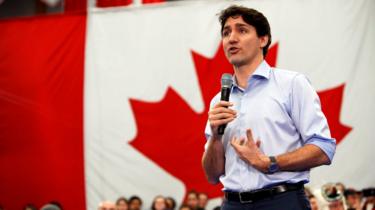
Canada PM Trudeau faces PC backlash over ‘peoplekind’ comment

PM Justin Trudeau has been hosting town halls across CanadaImage copyrightREUTERS
Image captionPM Justin Trudeau has been hosting town halls across Canada
Canadian Prime Minister Justin Trudeau is facing a backlash for correcting a woman who used the term “mankind”.
During a town hall event in Edmonton, Alberta, last week, Mr Trudeau interrupted the young woman and urged her to say “peoplekind” instead.
Critics accused the prime minister of “mansplaining”, “virtue-signalling” and making up words.
But his spokesman said Mr Trudeau was “a proud feminist” whose policies reflect “commitments to equality”.
A young woman stood up during last Thursday’s town hall and praised Mr Trudeau for having a gender-balanced cabinet.
The audience member, mentioning her membership of a feminist Korean church, said the country needed an economy filled with women.
She then asked the prime minister about his policy on volunteerism and religious organisations.
The young woman ended her question by saying: “Maternal love is the love that’s going to change the future of mankind.”
Mr Trudeau waved his hand and said: “We like to say peoplekind, not necessarily mankind. It’s more inclusive.”
The young woman said: “Exactly, yes, thank you.”
Members of the crowd cheered and applauded.
“We can all learn from each other,” Mr Trudeau said.
The clip has garnered plenty of online commentary, with conservative commentators overseas picking up on the interaction.
Some argued that the word “peoplekind” does not exist in the English language.
Conservative federal politician Michelle Rempel apologised online to the woman who was interrupted by Mr Trudeau.
Others accused the PM of being condescending or overzealous in his political correctness.
But Mr Trudeau also has his defenders. Some have noted the PM asked for the woman’s time to be respected after her meandering remarks elicited groans from audience members.
The woman also interrupted Mr Trudeau to invite him to bible study.
It is not the first time Mr Trudeau has been criticised for political correctness.
He has previously provoked conservative eye-rolling for self-proclaimed feminism and support for making the lyrics to Canada’s national anthem gender-neutral.

South Africa: ANC holds ‘fruitful’ talks with President Zuma

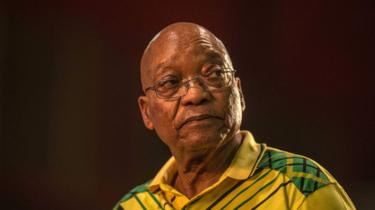
Jacob Zuma, South Africa's presidentImage copyrightAFP / GETTY IMAGES
Image captionJacob Zuma has resisted calls to quit over corruption allegations
South Africa’s governing party, the ANC, has postponed a top-level meeting that was expected to decide on President Jacob Zuma’s future.
Instead the ANC released a statement saying it had held “fruitful and constructive discussions” with him.
Mr Zuma is under growing pressure from members of own party to resign amid corruption allegations.
Earlier on Tuesday, parliament took the extraordinary step of postponing Thursday’s state of the nation address.
South Africa’s Times Live website quoted unnamed sources as saying Mr Zuma was prepared to quit, if the right terms can be negotiated.
The formal National Executive Committee (NEC) meeting has been set for 17 and 18 February, the ANC’s party leader, Cyril Ramaphosa, said in a statement.
The high-level group has the power to remove the president from office without his agreement.
Opposition parties are demanding that a vote of no-confidence be held to remove him.
Mr Zuma, 75, was replaced as party leader by Mr Ramaphosa, his 65-year-old deputy, in December. Mr Ramaphosa is set to succeed him as president.

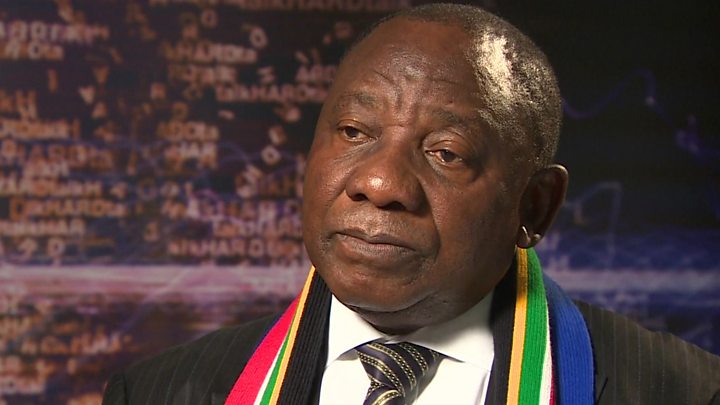
Media captionCyril Ramaphosa recently told the BBC’s Zeinab Badawi that Jacob Zuma was “feeling anxious”
Earlier on Tuesday, the Nelson Mandela Foundation urged Mr Zuma to step down.
South Africa had seen “systematic looting” under Mr Zuma’s rule, and he “must go sooner rather than later”, the foundation said in a statement.

What was expected from the meeting?

The ANC had said it would make a final decision on Mr Zuma’s future at Wednesday’s NEC meeting.
If the ANC had decided to withdraw all their support, President Zuma would not have a majority in parliament, making it hard for him to resist.
Emergency party talks were held in Johannesburg on Sunday. Those attending were said to be largely, but not entirely, in agreement.
Mr Zuma also met top ANC leaders on Sunday. They are said to have failed to convince him to stand aside then.
Other unconfirmed reports from Sunday’s meeting say Mr Zuma asked for protection from prosecution for himself and his family.

Why was his speech cancelled?

The state of the union address – always made by the sitting president – is the main political event of the year in South Africa.
Parliament cancelled it out of concern over “calls for disruption”, according to Speaker of the National Assembly Baleka Mbete.

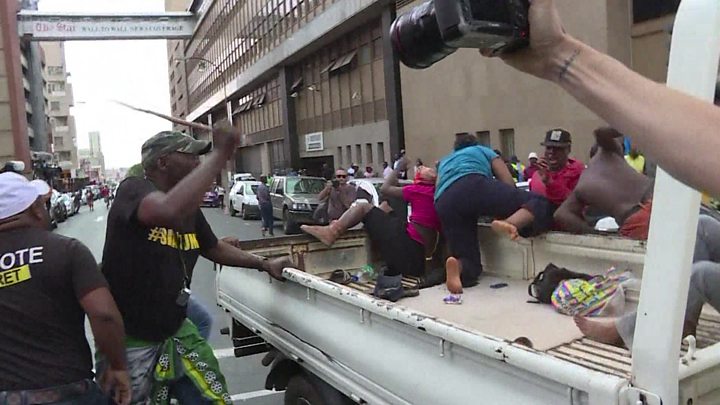
Media captionZuma and Ramaphosa supporters clash in Johannesburg
Mr Zuma’s office said in a statement that “the president has requested the postponement due to certain developments”.

What lies ahead?

South Africa’s elections are scheduled for 2019 and Mr Zuma cannot run again as there is a two-term limit.
Many in the ANC want him gone as soon as possible so they can rebuild the party’s standing. Mr Ramaphosa has associated himself with an anti-corruption drive.
In the 2016 local elections, the ANC lost ground to opposition groups, Democratic Alliance and the Economic Freedom Fighters.

Why is there a push to remove him?

Mr Zuma’s presidency has been overshadowed by allegations of corruption.
In recent years his links to the wealthy India-born Gupta family, who are alleged to have influenced the government through their relationship with Mr Zuma, have caused his popularity to plummet. In South Africa, it has become known as “state capture”.
Both Mr Zuma and the Guptas deny the allegations.
Then there is also the country’s struggling economy, with the unemployment rate rising to about 28%.

In brief: The allegations against Zuma

  • 2005: Charged with corruption over multi-billion dollar 1999 arms deal – charges dropped shortly before he becomes president in 2009
  • 2016: Court orders he should be charged with 18 counts of corruption over the deal
  • 2016: Court rules he breached his oath of office by using government money to upgrade private home in Nkandla – he has repaid the money
  • 2017: South Africa’s public protector said he should appoint judge-led inquiry into allegations he profiteered from relationship with wealthy Gupta family – he denies allegations, as have the Guptas
  • 2018: Zuma approves inquiry

EU wants to restrict single market access to UK

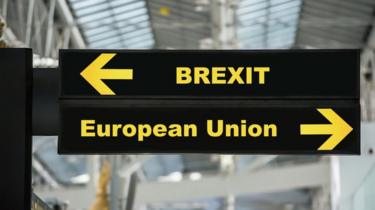
Brexit and European Union signsImage copyrightGETTY IMAGES
The European Union wants to be able to restrict the UK’s access to the single market if there is a dispute after Brexit, a leaked document suggests.
The power to suspend “certain benefits” would apply during the post-Brexit transition phase before the final arrangements come into force.
It is revealed in a draft section of the UK and EU’s withdrawal agreement, which has yet to be finalised.
The UK said the document simply reflected the EU’s “stated directives”.
The transition period is expected to begin straight after the UK officially leaves the European Union on 29 March 2019, and end on 31 December 2020.
The UK says this will allow businesses to adapt to its new relationship with the EU.
The EU says its rules should still apply during the transition period, as will rulings of the European Court of Justice.
According to a footnote in the EU papers leaked to journalists in Brussels, if referring a dispute to the EU court would take too long, the withdrawal agreement “should provide for a mechanism allowing the Union to suspend certain benefits deriving for the United Kingdom from participation in the internal market”.

Frictionless trade

It does not go into detail about what disputes could trigger the powers being used, or which parts of the single market could be suspended.
It also says the UK would be consulted about fishing quotas, and would have to pledge not to act against the EU in international organisations.
A Department for Exiting the European Union spokesman said: “This is a draft document produced by the EU that simply reflects their stated directives.”
Together with the UK’s position as set out last month, it provides a “solid foundation for the negotiations on the implementation period”.
The UK plans to continue participating in the single market – which allows frictionless trade and the free movement of people between EU members – during the transition phase, before the final trading relationship – which has yet to be negotiated – comes into force.
Negotiations are getting under way on what the transition will look like – and the UK government says it is confident of reaching agreement in time for an EU summit at the end of March.
But some Conservative MPs are unhappy at the idea of the UK following EU rules but having no say on them, and have warned that when Brexit happens in March 2019 it will be “in name only”.

Analysis by OP’S NEWS 

We’ve had position papers. We’ve had guidelines, directives and a joint report.
This is the first draft of legally-binding words that will end up in the withdrawal agreement – the Brexit treaty that will seal the UK’s departure from the EU and a document of real historical significance.
EU sources say it proves that they are getting a move on – “Please! No more position papers” – which the UK wants too.
The EU’s suggestion, in a footnote, that the UK’s access to parts of the single market will be curtailed if the European Court of Justice cannot solve any disputes within the two-ish year timeframe of the transition, will sound threatening to some.
To others it will sound like an obvious back-up plan to deal with the famously long time it takes for the ECJ to make a decision.
The Brits caution that this is a first draft for the EU27 and does not reflect any negotiations over what they prefer to call the implementation phase.

Trump: I’d love shutdown if there’s no immigration deal

Media caption‘The world is laughing at us’ says Trump
President Donald Trump has said he would “love to see” the US government shut down if Congress does not agree an immigration deal.
“If we don’t change it let’s have a shutdown. We’ll do a shutdown, and it’s worth it for our country,” he said.
Earlier in the day, his chief of staff said Mr Trump was unlikely to extend a deadline when legal protections for young immigrants expire.
The government briefly closed last month amid political gridlock.
Speaking on Tuesday to a White House law enforcement panel on gang violence, Mr Trump said: “If we don’t change the legislation, if we don’t get rid of these loopholes where killers are allowed to come into our country and continue to kill… if we don’t change it, let’s have a shutdown.
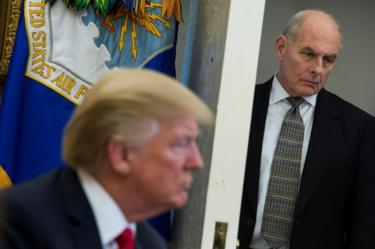
John Kelly looks on as Mr Trump holds a meeting at the White HouseImage copyrightGETTY IMAGES
Image captionJohn Kelly looks on as Mr Trump holds a meeting at the White House
“I’d love to see a shutdown if we don’t get this stuff taken care of.”
Democratic leader Senator Chuck Schumer said Mr Trump’s comment “speaks for itself”.
“We had one Trump shutdown, nobody wants another, maybe except him,” the New York senator added.
But White House spokeswoman Sarah Sanders later said that Mr Trump was “not advocating for the shutdown”.
The press secretary said the president instead “wants a long-term deal and he wants a deal on immigration”.
Presentational grey line

A delicate dance

Analysis by OP’S NEWS 
Donald Trump clearly thinks he came out on top after last month’s government shutdown. Given his recent uptick in opinion polls, with Republicans rallying to his side, that’s not an unrealistic conclusion.
Now he’s leaning into another confrontation – unless he gets his desired immigration reforms and border security funding.
That cuts against the momentum in Congress towards more temporary funding measures and, perhaps, an agreement to provide a limited extension of protection for previously covered undocumented migrants, along with more money for border security.
If Congress succeeds in kicking the can down the road far enough, the odds decrease that the president will get his desired sweeping changes to legal immigration programmes. Democrats could make gains in November’s midterm elections – particularly if Daca protection is a campaign issue – and any congressional action in 2019 could be much less to the president’s liking.
Passing big-ticket legislation in an election year is always a challenge. In 2018, even the basic tasks – like approving a budget – seem a tall order.
At the moment, Democrats and Republicans in Congress are engaged in a delicate dance. The president, however, seems determined to call the tune.
Earlier in the day Mr Trump said the death of an NFL footballer by a drink driver who had entered the country illegally underscored the need for immigration reform.
Mr Trump’s remarks come as lawmakers debate a legislative plan for so-called Dreamers – undocumented people who entered the US as children.
Two days remain before a temporary government funding bill passed last month is due for renewal.
On Tuesday evening, the House of Representatives passed a bill to keep federal agencies funded until next month. That measure now goes to the Senate.

Media captionTrump calls Democrats ‘treasonous’ and ‘un-American’
Mr Trump last year scrapped the Obama-era programme known as Deferred Action for Childhood Arrivals (Daca).
He set an expiry date of 5 March and called on Congress to find a solution.
Earlier on Tuesday, White House Chief of Staff John Kelly told reporters he doubted “very much” whether the president would extend the Daca programme if there’s no deal.
Mr Kelly added that the original programme was not legal.
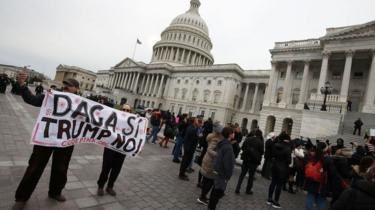
Protesters at CongressImage copyrightGETTY IMAGES
Image captionThe Deferred Action for Childhood Arrivals (Daca) will end on 5 March as Mr Trump ordered
During an impromptu interview with US media, Mr Kelly stressed that Daca permit holders would not be a priority for deportation after the deadline passes.
He also defended Mr Trump’s plan to offer permanent protections for 700,000 Daca permit holders plus 1.1 million others who could qualify.
The White House chief of staff said some of those immigrants “were too afraid to sign up, others would say were too lazy to get off their asses”.
The Trump administration last month outlined a plan for nearly two million people to become citizens, in exchange for Congress approving $25bn (£17.6bn) for a US-Mexico border wall.

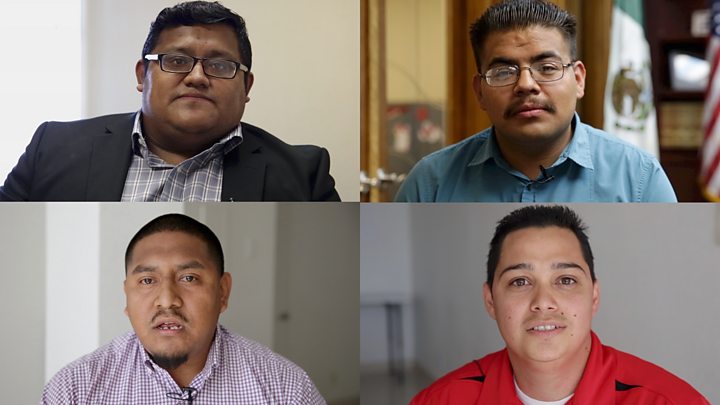
Media captionDaca recipients: ‘Life in the US is like a rollercoaster’
The White House on Monday rejected a bipartisan immigration plan that would extend Daca protections.
The proposal by Senators John McCain and Christopher Coons included funding for border security, but not for a wall.
President Trump tweeted that any deal that did not include enough funding for border security was a “waste of time”.
Last month, he hinted that the protected US residency status for Dreamers could be extended past his self-imposed deadline.
“We want to do what’s right and we’re going to do what’s right, and we’re going to solve the Daca problem,” he said at the World Economic Forum in Davos, Switzerland.

Media captionThe missing – consequences of Trump’s immigration crackdown

Brazil police arrest sect members for enslavement

People attend a mass in evangelical church in Goiania, Goias State, Brazil, on May 19, 2013.Image copyrightAFP
Image captionEvangelical churches play an important part of Brazilian life
Brazilian police have arrested 13 members of a religious sect on suspicion of enslavement, human trafficking and money laundering.
Sect leaders are accused of seizing the possessions of followers and making them work unpaid.
Police raided several businesses as part of an investigation into the sect, known as The Evangelical Community of Jesus, the Truth that Marks.
The church is estimated to have 6.000 followers.
Police are looking for nine more people including the leader of the sect, known as “Father Cícero”.
Investigators said vulnerable and fragile people who attended a church in São Paulo were persuaded to leave their families behind to start a new life in the countryside.
They were told the sect was totally egalitarian and that they had to hand over all their possessions to the community.
On the farms and in the sect’s rural businesses they would work unpaid and were supervised by sect members if they went into local towns.
“The reality is this, it’s the manipulation of the mind. The guys can totally undo your life, make you leave your family,” one follower told Brazilian news channel Globo G1.
“When I opened my eyes it was too late. And there were lots like me. And they had handed over everything.”
Police say the church’s hierarchy converted the huge profits from donations and unpaid labour into land, houses and luxury cars.

Taiwan earthquake: Deaths confirmed amid rescue effort

Media captionTaiwan eyewitness Zeena Starbuck was caught in an aftershock live on TV
A strong earthquake in Taiwan has killed at least two people and injured more than 200 others, officials say.
The powerful 6.4-magnitude tremor struck at 23:50 (15:50 GMT) about 20km (12 miles) off the island’s east coast.
Emergency responders have rescued about 150 people from hotels and residential buildings that have partially collapsed in the city of Hualien.
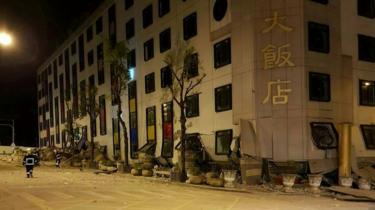
Photographs show tilting structures, scattered debris and extensive damage to roads in the area.
Among the several badly damaged buildings was a hospital, local media reports.
The lower basement and ground floor of the 10-storey Marshal Hotel gave way after the quake.
A hotel is pictured with its bottom floors crushedImage copyrightKULAS_TW
Image captionThe lower floors of the 270-room Marshal Hotel have collapsed, trapping people
One member of staff has been rescued, but another two are said to be still be trapped in the building.
“We know there are people who are trapped inside – we can see lights inside the hotel,” eyewitness Zeena Starbuck told the BBC.
“People with phones are shining their lights to let people know they’re there.”
At least two others are known to be trapped in residential properties, officials say.
About 40,000 homes are without water, and highways and bridges have been are closed.
Residents have been told to stay away from their damaged homes, and about 800 have taken shelter in community buildings.
Offices and school in the city will remain closed on Wednesday.
The army has been called in to help with emergency rescues.
Hualien has about 100,000 residents and is a popular tourist destination.
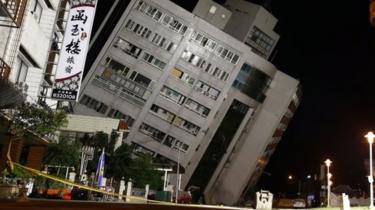
Hotel tilting after earthquake in Hualien, Taiwan, 6 FebruaryImage copyrightEPA
Image captionSeveral high-rise buildings sustained severe damage, with this one tilting heavily
People reported feeling the quake in the island’s capital, Taipei, more than 160km (100 miles) away.
Rescue efforts have been complicated by powerful aftershocks. Dozens of smaller tremors have been felt throughout the island over several days.
Taiwan sits near a junction of two tectonic plates and is regularly hit by earthquakes.
The earthquake happened on the second anniversary of a 6.4-magnitude tremor that killed 117 people.

Taiwan is an island which has for all practical purposes been independent since 1950, but which China regards as a rebel region that must be reunited with the mainland.

Elon Musk’s Falcon Heavy rocket launches successfully

Media captionThe rocket was carrying SpaceX boss Elon Musk’s red car
US entrepreneur Elon Musk has launched his new rocket, the Falcon Heavy, from the Kennedy Space Center in Florida.
The mammoth vehicle – the most powerful since the shuttle system – lifted clear of its pad without incident to soar high over the Atlantic Ocean.
It was billed as a risky test flight in advance of the lift-off.
The SpaceX CEO said the challenges of developing the new rocket meant the chances of a successful first outing might be only 50-50.
“I had this image of just a giant explosion on the pad, a wheel bouncing down the road. But fortunately that’s not what happened,” he told reporters after the event.
With this debut, the Falcon Heavy aims to become the most capable launch vehicle available.
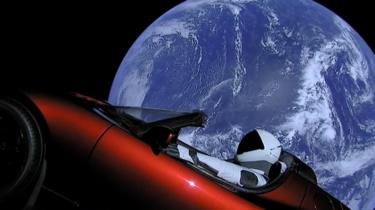
CarImage copyrightSPACEX
Image captionThe aim was to send the car and mannequin towards Mars’ orbit
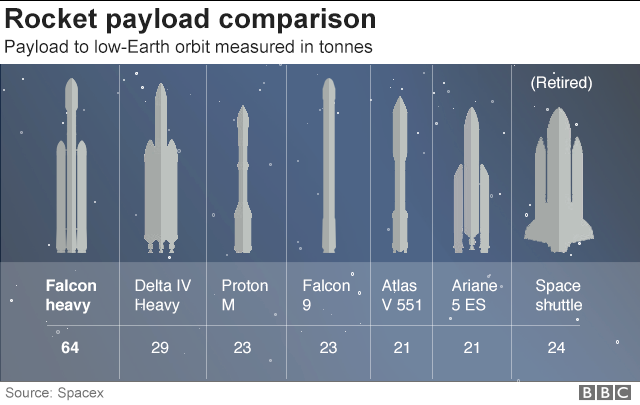
It is designed to deliver a maximum payload to low-Earth orbit of 64 tonnes – the equivalent of putting five London double-decker buses in space.
Such performance is slightly more than double that of the world’s next most powerful rocket, the Delta IV Heavy – but at one third of the cost, says Mr Musk.
For this experimental and uncertain mission, however, he decided on a much smaller and whimsical payload – his old cherry-red Tesla sports car.
A space-suited mannequin was strapped in the driver’s seat, and the radio set to play David Bowie’s classic hit Space Oddity on a loop.
Rocket graphic comparison
If all phases of the flight are successful – and that will not be known until at least 6.5 hours after lift-off – the Tesla and its passenger will be despatched into an elliptical orbit around the Sun that reaches out as far as the Planet Mars.
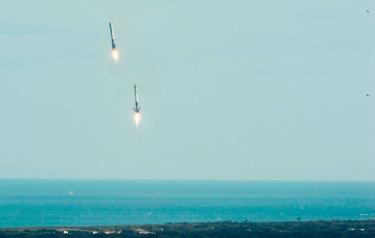
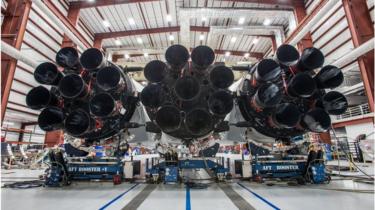
The Falcon Heavy is essentially three of SpaceX’s workhorse Falcon 9 vehicles strapped together. And, as is the usual practice for SpaceX, all three boost stages – the lower segments of the rocket – returned to Earth attempting controlled landings.
LandingImage copyrightGETTY IMAGES
Image captionTwo boosters head back to Florida’s Space Coast
Two came back to touchdown zones on the Florida coast just south of Kennedy. Their landing legs made contact with the ground virtually at the same time.
“That was epic,” said Mr Musk. “That’s probably the most exciting thing I’ve ever seen, literally.”
The third booster was due to settle on a drone ship stationed several hundred kilometres out at sea. Unfortunately, it had insufficient propellant left to slow the descent, missed the target vessel and was destroyed as it hit the water at some 500km/h.
By then, the upper-stage of the Falcon Heavy, with its Tesla cargo, had begun what eventually would be an escape trajectory to Mars’ orbit.
That required the engine on the upper-stage to fire on three separate occasions, with the third and final ignition only occurring after a long cruise phase.
Mr Musk warned before the flight that this was one of the phases he was most concerned would not work properly. The upper-stage was set to to pass through a concentrated region of radiation above the Earth, known as the Van Allen Belts, and this could interfere with electronic systems.

Media captionA car, a golf ball, a pie… the oddities sent into space over the years.
Having such a large and powerful rocket should open up some fascinating new possibilities for Mr Musk and his SpaceX company. These include launching:
  • Much bigger satellites for use by US intelligence and the military. The scale of these satellites is limited by current rocket performance.
  • Large batches of satellites, such as those for Mr Musk’s proposed constellation of thousands of spacecraft to deliver broadband across the globe.
  • Bigger, more capable robots to go to the surface of Mars, or to visit the outer planets such as Jupiter and Saturn, and their moons.
  • Huge telescopes. Hubble’s successor, the James Webb Space Telescope, is having to be folded origami-like to fit in its launcher next year.
But it is the low cost – brought about through the recovery and reuse of the boosters – that Elon Musk believes will be a game-changer when allied to the new performance.
“It’ll be game-over for all other heavy-lift rockets,” he told reporters on Monday.
“It’ll be like trying to sell an aircraft where one aircraft company has a reusable aircraft and all the other companies had aircraft that were single-use where you would parachute out at your destination and the plane would crash-land randomly somewhere. Crazy as that sounds – that’s how the rocket business works.”
Falcon HeavyImage copyrightSPACEX
Image captionThe Falcon Heavy is essentially three Falcon 9s strapped together
Design a site like this with WordPress.com
Get started