Media captionKim Jong-un and Donald Trump: From enemies to frenemies?
President Trump has tweeted that a deal with North Korea is “very much in the making”, a day after revealing he had agreed to meet its leader Kim Jong-un.
North Korea has yet to make a statement.
Earlier, the White House said the meeting would not take place unless Pyongyang takes “concrete actions” first.
US media report that Mr Trump made the decision to meet without consulting key figures in his administration.
The top US diplomat, Secretary of State Rex Tillerson, was on his first official trip to Africa when the announcement was made.
Speaking to reporters on Friday from Djibouti, Mr Tillerson said: “That is a decision the president took himself.”
“I spoke to him very early this morning about that decision and we had a very good conversation.”
Mixed messages
Mr Trump stunned observers when he agreed to the summit following an invitation delivered by South Korea. No sitting US president has ever met a North Korean leader.
Confusion mounted when Mr Trump’s own press secretary, Sarah Sanders, told reporters that North Korea has “promised to denuclearise”. She added: “We’re not going to have this meeting take place until we see concrete actions.”
South Korean envoys – who recently met with Mr Kim in Pyongyang – have said North Korea is “committed to denuclearisation” as an end goal, but they have not said this would start before a meeting with the US.
Instead, North Korea is understood to have agreed to halt its testing programme as negotiations continue.
US Vice-President Mike Pence has pledged to maintain pressure on North Korea, and Mr Trump spoke with Chinese president Xi Jinping on Friday to agree to maintain sanctions for the time being.
There has been no mention of the meeting in North Korean media.
An initial statement from the South Korean delegation said the meeting would take place by May – but no place or date has officially been set.
The Korean border’s demilitarised zone (DMZ) and Beijing are seen as possible venues.
How did we reach this point?
Kim Jong-un unexpectedly used his New Year’s message to reciprocate a offer of talks made by the South last year. This led to North Korea sending a delegation to the Winter Olympics in the South.
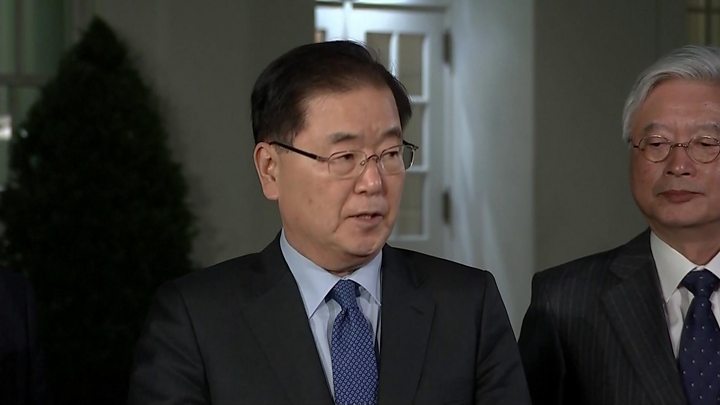
Media captionThe South’s Chung Eui-yong talks to reporters at the White House
Speaking outside the White House after the meeting, South Korean National Security Adviser Chung Eui-yong said Mr Kim was prepared to sit down with the US president and was now “committed to denuclearisation”.
However, the North has halted missile and nuclear tests during previous talks, only to resume them when it lost patience or felt it was not getting what it demanded, analysts say.
Some expressed concern the Trump regime could “fall into the North Korean trap” of granting concessions with nothing tangible in return.
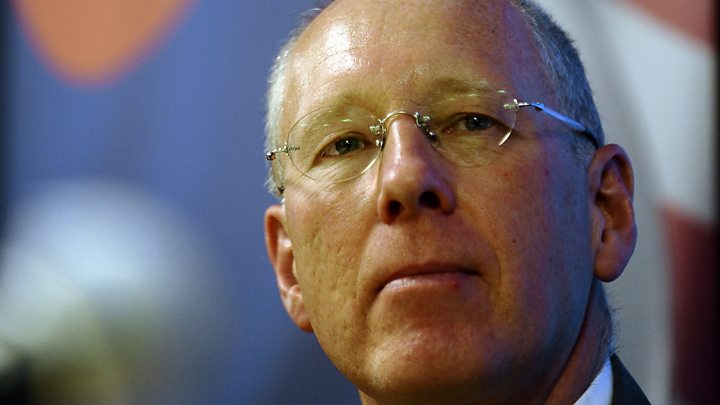
Media captionFormer British ambassador to N Korea warns of dangers of Trump/Kim meeting
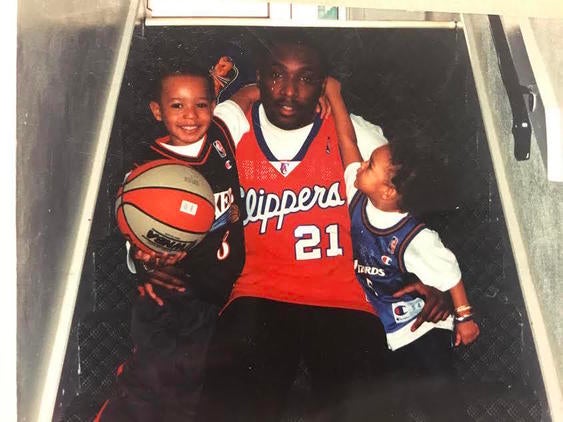
overlooked the backyard of the family’s home in New Castle, Del., a suburb 30 miles outside Philadelphia. The family had moved here for a better, calmer life for their children, a different world from where Trevon’s parents had met in New York City. It was their dream house: A big yard, a pool, a basketball hoop in the driveway and, in the backyard, a concrete basketball court. From her perch in the kitchen, the boy’s mother watched the drama unfold.
Her then-husband, Trevor Duval, had poured the concrete and built the basketball court for their oldest son. And every day, those two were on that court, doing basketball drills. Layups with either hand. Dribbling drills. Free throws. Some days, young Trevon didn’t want to do the work. And on those days, his dad jawed with him. Got in his head. Made him do pushups.
This was one of those days.
Trevon, eight or nine years old at the time, walked in the back door, furious at his father. Chaka was concerned. Was her husband being too hard on the boy? Was he forcing him into a basketball life that he didn’t want?
“I said, ‘Son, listen: If you don’t want to do this no more, just tell me so,’ ” Duval’s mother recalled years later. “He looked at me, took a few breaths. And he said, ‘Mommy, it’s OK. I want to do it.’ And once he said that, whenever they bumped heads, I’d just let them be.”
These days, Duval is starting as the freshman point guard for a Duke team that is the nation’s most talented squad. Duke is 25-6 and ranked fifth in the country going into this weekend’s ACC Tournament. If Duke isn’t on your short list for potential national champions, you haven’t been paying attention.
And Duval, a flashy player whose game is inspired by his father taking him to New York City streetball courts and watching AND1 mixtapes together, may be the key to how deep Duke can make it in March. Duval’s season has been up and down. His 3-point shooting has been subpar, at 28 percent, and there have been games where he tries to do too much and ends up having too many turnovers. Yet Duval, when he plays within himself, can become Duke’s X factor, dishing assists to his talented teammates and driving down the lane like a madman. In Duke’s final regular-season game, a home win over North Carolina, it was Duval who keyed Duke’s comeback with six assists, two steals, a key three-pointer and, crucially, zero turnovers.
“There is the flash, and that’s kind of his reputation coming in, the whole ‘Tricky Tre’ thing,” Duke associate head coach Jeff Capel said. “The things he can do with the ball, the things he can do with his passing, his vision – you don’t want to completely tone it down, but you have to steer it in the right way. He has gifts and tools, but his dad used to say this when we were recruiting him: He’s raw. He’s being taught certain things about the point guard position. But he can make plays that you can’t teach.”
Yet they were taught. CBS SPORTS HQ sat down with Duval, his parents and coaches to discuss the path that brought this young man to one of college basketball’s premier programs with a game built on asphalt ideology as much as hardwood engineering.
Courtesy of the Duval family
His father was his first teacher. When Trevon, the oldest of four, was a baby, his dad would slip a Nerf basketball in the crib. At age 2, he was playing in a YMCA league; Trevon would come to games wearing headbands and Jordans, shooting jumpers over 4-year-old fools. In their old apartment, his dad would drill him on their Little Tikes hoop. Father and son would watch “Come Fly With Me,” the old 1989 Michael Jordan documentary, on VHS. They also watched AND1 mixtapes, studying streetball legends like Rafer “Skip 2 My Lou” Alston and Ed “Booger” Smith, a Brooklyn streetball legend.
As Trevon grew older, his father kept pushing him. Other parents saw it. They wondered if the dad pushing the son so hard was healthy. James Johns, who coached Duval in AAU ball since sixth grade, wondered at first if the dad was crazy. Soon, he learned Trevor Duval wasn’t crazy; he was driven toward a goal, and Trevon was driven toward the same goal.
“His dad’s a mad scientist,” Johns said. “The kid wanted it from an early age. You just saw the desire he had to be great. The family made so many sacrifices get him to be great. His dad’s just a basketball junkie. He just pushes him. And anybody who has any involvement with him is required to push him at that same level.”
Trevor Duval always taught his son to be a fun player – “fundamentally creative” is how he terms it. As Trevon grew older, his father pushed him to study NBA guards. Steve Nash. Derrick Rose. Kyrie Irving. James Harden. The flashy player he became melded well with Duval’s Caribbean roots: His father’s family is from Trinidad, and his mother grew up in Jamaica before moving to New York in elementary school.
“I always tell him, where I’m from, the era I’m from, you want to be entertaining,” his father said. “You want to get fundamentals right, but you want to be exciting. You gotta add some flash to your game.”
Anyway, his mother was convinced even before he was born that he was going to be an entertainer.
“It’s crazy – when I was pregnant with Trevon, I was living in New York, and I was out and this Jamaican guy came over to me and touched my stomach,” Trevon’s mother recalled. “He said, ‘I’m telling you, you’re having a little boy, and he’s go to be some kind of entertainer. I don’t know what kind of entertainer he’s go to be, but he’s go to entertain people.’ “
His dad pushed him to steer that entertaining nature toward basketball. Sometimes he pushed him too hard. When he was 4, the Harlem Globetrotters put on a camp in Delaware. The camp was for age 7 and up, so Trevon’s dad told him to lie about his age. It wasn’t like he couldn’t compete; at that age, Trevon was already playing in a league for ages 8 and under.
“We’d go to the YMCA in New Castle to work out,” Trevon Duval said. “My dad used to go there and play sometimes, and I’d play on the side with younger kids, but when we went there to work out, it’d be an empty gym, just me and him. I wouldn’t like whatever he was saying. He’d just get on me. If I didn’t want to play, if I acted like a baby, he’d say, ‘Run laps.’ Or, ‘Do pushups.’ “
“There were times when I’d be in a game and he’d talk to me too much, and I’d just say, ‘Shut up, leave me alone,’ ” he continued. “But it all helped me come to where I am now.”
Courtesy of the Duval family
There was another moment, too, when the son realized how much his father’s basketball obsession was actually expressing a tough sort of love through basketball.
It was winter of Trevon’s eighth-grade year. Trevon scored an invitation to a prestigious John Lucas basketball camp in Chicago. The situation seemed to call for the family cancelling the trip: A blizzard was coming. His dad’s car wasn’t working. And his dad was supposed to start a new job in Delaware on Monday, the day after the camp ended.
Trevon Duval didn’t care. He knew his son needed this camp, the coaching it would give him and the exposure it would provide. He rented a compact car at the last minute. Starting on Friday night, the father first drove to the King of Prussia Mall in Philadelphia to buy Trevon a new pair of sneakers, red, white and blue Under Armour Spines. Then they drove down the Pennsylvania Turnpike as the blizzard came down. Trevon slept in the back seat. Through the whole night, the father drove, 13 hours straight. When Trevon woke up, they talked basketball, and they planned on how he could best showcase his skills during the weekend.
“Dad,” Trevon said, “they’re going to remember my name at this camp. Everyone’s going to know who I am by the time we leave here.”
When they got to Chicago, they didn’t even check in at the hotel. They drove straight to the camp. Trevon brushed his teeth in the bathroom, washed up and got dressed.
It did become Trevon Duval’s breakout weekend. It was the first time he dunked on someone. It was that weekend that rocketed him up in recruiting rankings, an ascendance that eventually led him to Duke. On the drive back, the father and the son were euphoric. They knew they were heading to something big. They knew the hard work and the butting of heads was going to pay off.
“My dad had really good interests for me in whatever I did,” Duval said. “There were tough times. And it took a while to realize that. But I definitely do now.”
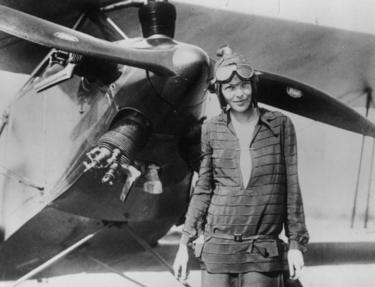
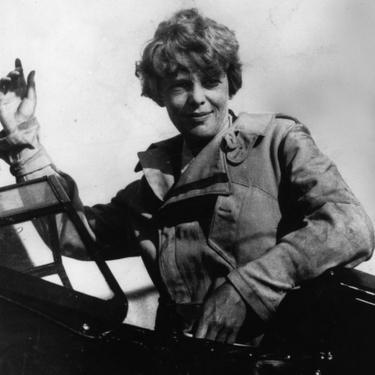
Image copyrightGETTY IMAGESImage captionResearchers used photographs and clothing to determine that the bones match
Bones discovered on a Pacific island in 1940 are “likely” to be those of famed pilot Amelia Earhart, according to a US peer reviewed science journal.
Earhart, her plane, and her navigator vanished without a trace in 1937 over the Pacific Ocean. Many theories have sought to explain her disappearance.
But a new study published in Forensic Anthropology claims these bones prove she died as an island castaway.
The report claims they are a 99% match, despite an earlier conclusion.
The study, titled Amelia Earhart and the Nikumaroro Bones, was first published by the University of Florida and conducted by Professor Richard Jantz from the University of Tennessee.
It disputes that the remains found on the eastern Pacific island of Nikumaroro – about 1,800 miles (2,900km) southwest of Hawaii – belonged to a man, as a researcher had determined in 1941.
Earhart was known to have been near the island when she vanished during her doomed attempt to fly across the globe.
Image copyrightGETTY IMAGESImage captionEarhart was perhaps the most famous woman in the world when she vanished
A British party exploring the island for habitation in 1940 found a human skull, a woman’s shoe, a Navy tool used by her navigator Fred Noonan (who also vanished), and a bottle of the herbal liqueur Benedictine – “something Earhart was known to carry”.
“There was suspicion at the time that the bones could be the remains of Amelia Earhart,” Dr Jantz wrote in the study.
The party found a total of 13 bones, which were then sent to Fiji to be analysed by Dr D W Hoodless, who concluded that they had belonged to a male.
But Dr Jantz argues that because forensic osteology – the study of bones – was still in its early stages, Dr Hoodless probably reached a wrong conclusion.
“Forensic anthropology was not well developed in the early 20th century,” the paper states.
Consulting Dr Hoodless’ measurements of the bones, Dr Jantz used Fordisc, a modern computer programme now widely used by forensic anthropologists, to compare them to Earhart’s height and body stature.
The bones have unfortunately since been lost, and so cannot be analysed.
But the research team used historical photographs, as well as her pilot’s and driver’s licences, to determine that her body proportions matched the skeletal remains.
A “historical seamstress” was also consulted to analyse her clothing, including “the inseam length and waist circumference of Earhart’s trousers”.
“This analysis reveals that Earhart is more similar to the Nikumaroro bones than 99% of individuals in a large reference sample,” the report states.
The research found the remains belonged to a taller-than-average woman of European descent, as Earhart was.
“This strongly supports the conclusion that the Nikumaroro bones belonged to Amelia Earhart.”
“Until definitive evidence is presented that the remains are not those of Amelia Earhart,” Dr Jantz writes in the paper, “the most convincing argument is that they are hers.”
Earhart was the first woman to fly across the Atlantic Ocean, and was considered one of the most famous women in the world when the mystery of her disappearance began.
Media captionTrump laughs off awkward slip-up with steelworkers
President Trump has signed controversial orders imposing heavy tariffs on steel and aluminium – but some countries will be spared.
Mr Trump has said the US is suffering from “unfair trade” and that the move would boost US industry.
But countries have expressed outrage at his plans, and experts have warned of new trade wars.
The tariffs will go into effect in 15 days and include exemptions for Canada and Mexico.
Tariffs of 25% are to be placed on steel and 10% on aluminium imported into the US.
The tariffs are opposed by many in the president’s own party and by the US’s major trading partners.
Republican Senator Jeff Flake – a prominent critic of Mr Trump who opposes the move – said he was drafting legislation to nullify the tariffs, saying trade wars are only ever lost.
House Speaker Paul Ryan said he disagreed with the action and feared its unintended consequences.
What has the international reaction been?
EU Trade Commissioner Cecilia Malmstroem tweeted that, as a close ally of the US, the bloc should be excluded from the tariffs
French Finance Minister Bruno Le Maire said there were “only losers” in a trade war and that France regretted the US announcement
The British government said it would work with EU partners to consider “the scope for exemptions” while “robustly” supporting UK industries
On tonight’s announcement – the EU is a close ally of the US and we continue to be of the view that the EU should be excluded from these measures. I will seek more clarity on this issue in the days to come. Looking forward to meeting USTR Lighthizer in Brussels on Sat to discuss.
Mr Trump praised them as “the backbone of America” – and alluded to their role in his election.
He said such workers had been betrayed – but that was now over and he was delivering on a campaign promise.
The president said the tariffs would defend America’s national security.
What exemptions will there be from the new tariffs?
They will apply to all countries except Canada and Mexico, which will be exempt while discussions over the North America Free Trade Agreement (Nafta) take place.
There are provisions within the documents for other countries to get exemptions.
“We are going to be very fair, we’re going to be very flexible,” Mr Trump said earlier on Thursday.
He also praised his country’s close relationship and trade surplus with Australia, saying “we’ll be doing something with them”.
The president linked defence spending to trade, and said the US “subsidised many countries” in the military.
He said there would be a reduction in tariffs for countries that “treat us fairly”, but said “many of the countries that treat us the worst on trade and on military are our allies”, singling out Germany for criticism in his earlier comments.
Why is Mr Trump doing this?
Mr Trump says he aims to protect the American worker – and he promised in his campaign that he would rebuild the steel and aluminium industries.
The two metals are “the bedrock of our defence-industrial base”, the president said on Thursday.
The industry has been “ravaged” by aggressive foreign trade practices that are “an assault on our country”, the president said.
He is also making a political decision, aiming to appeal to blue-collar voters in states such as Pennsylvania – voters who turned away from the Democrats to support Mr Trump in 2016.
What are possible repercussions?
Mr Trump’s announcement last week about his plan to impose the hefty tariffs sparked alarm and upset markets at home and abroad.
Major trading partners have threatened retaliation and the plans are opposed by many in his own party.
China has threatened an “appropriate and necessary response” in any trade war with the US. Foreign Minister Wang Yi said China and the US should strive to be partners rather than rivals
Mr Trump has said that the US would “win big” in a trade war.
Other countries are likely to take the US to court, arguing that the decision violates World Trade Organization moves.
The White House says that the national security rationale for the move is “unassailable” and national security considerations are allowed under WTO rules.
The director of UK Steel said the tariffs would have a profound and detrimental impact on the UK steel sector.
“Imposing such measures on US allies in the name of national security is difficult to comprehend,” Gareth Stace added.
What happens now?
OP’S NEWS
President Trump made clear on Wednesday he will consider exemptions to the tariffs.
The move invites lobbying from other countries and could quiet critics who say his actions will lead to a trade war.
Will Mr Trump’s approach, which the White House has described as “flexible”, mean this proves to be another announcement stronger on rhetoric than substance?
We don’t know yet. The White House has said exemptions will be granted to nations that offer other ways to resolve his concerns about national and economic security.
The strategy has raised objections from at least one Republican. But should countries want to talk, that provides Mr Trump the opportunity to revisit a host of issues near and dear to his heart, including a wall along the Mexican border, barriers to US goods in countries like Germany and South Korea – even US contributions to security organisations like Nato.
Mr Trump, who casts himself as the ultimate negotiator, is opening the door to more of the deal-making he appears to relish.
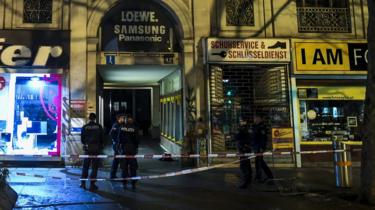
Image copyrightEPAImage captionThe attack happened in Vienna’s Second District on Wednesday evening
Police in Austria say a 23-year-old man has admitted carrying out knife attacks in Vienna which left four people seriously injured on Wednesday evening.
The man, an Afghan national, has denied a political motive for the attacks.
Three members of the same family were hurt in the first attack at Nestroyplatz at 19:45 (18:45 GMT) and an unrelated man, 20, was stabbed nearby around half an hour later.
The suspect reportedly told police he had been in a “bad, aggressive mood”.
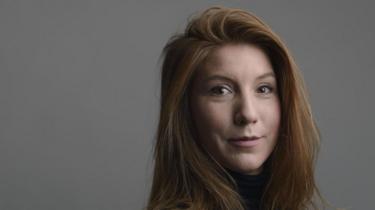
Image copyrightTOM WALLImage captionKim Wall boarded Peter Madsen’s submarine to interview him
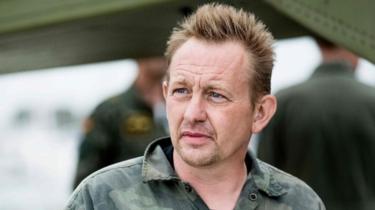
Danish inventor Peter Madsen has denied murdering Swedish journalist Kim Wall on his homemade submarine, saying she died in an accident.
At his trial in Copenhagen, Mr Madsen said the 30-year-old died of carbon monoxide poisoning when the vessel filled with toxic exhaust fumes.
But he has admitted dismembering Ms Wall’s body and disposing of it at sea.
When asked why he did so, he told the court: “I don’t see how that mattered at that time, as she was dead.”
Ms Wall’s remains were found by a passing cyclist, 11 days after she interviewed the inventor last August.
Mr Madsen is charged with murder, dismemberment and aggravated sexual assault.
He faces a life sentence if convicted, which typically means 15 to 17 years in prison without parole.
Around 40 witnesses are set to give evidence, as prosecutors attempt to shed light on the circumstances of Ms Wall’s death.
What do we know about what happened?
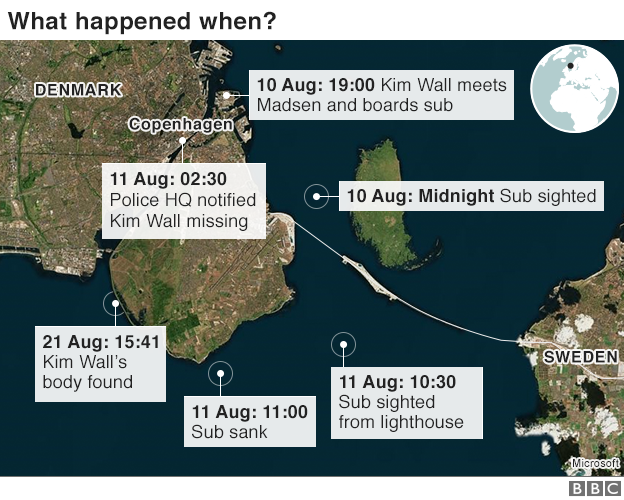
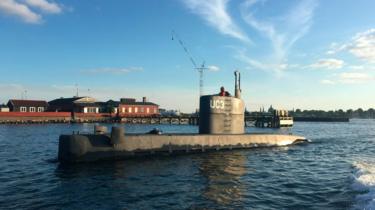
Kim Wall, a freelance journalist, boarded Peter Madsen’s UC3 Nautilus on the evening of 10 August 2017 to interview him for a story.
She had left her boyfriend at a going-away party the couple were having ahead of a planned move to Beijing. When she did not return, her boyfriend alerted the police.
Image copyrightAFPImage captionPeter Madsen is the only suspect in a case that has horrified Denmark
Peter Madsen was rescued the next morning as his vessel was sinking. He initially told police that he had dropped off the reporter before the vessel began to go down.
But he later said she died when a heavy hatch on the submarine fell on her head.
Eleven days later, a cyclist found the remains of the journalist’s headless torso on a nearby beach. Weeks later, police divers discovered other parts of her body in plastic bags weighed down with metal.
The 47-year-old Dane – the skipper and designer of the Nautilus, a 17m- (56ft) long privately-owned submarine – changed his version of events several times.
After saying a hatch fell on her head, he maintained instead that she had been killed by carbon monoxide poisoning inside the submarine while he was up on deck.
He initially denied cutting up her body, but then admitted dismembering it and dumping the body parts in the sea.
What was said in court?
Peter Madsen appeared calm on Thursday, wearing a black T-shirt, jeans and black glasses. Members of the Wall family were also in the session.
His lawyer Betina Hald Engmark told the court he denied murder but admitted “violating the law about indecent handling of a corpse”.
Explaining his version of events, Mr Madsen said the air pressure on board his submarine suddenly dropped while he was standing on the deck and Ms Wall was in the engine room.
He said the vessel began to fill with exhaust fumes but he was unable to open the hatch and enter.
“When I finally manage to open the hatch, a warm cloud hits my face. I find her lifeless on the floor, and I squat next to her and try to wake her up, slapping her cheeks,” he said.
Asked why he had changed his story several times, Mr Madsen said that he had “wanted to spare her family” the “gruesome details.”
Unclear answers
OP’S NEWS
This is a high-profile trial being covered by more than 100 journalists from around the world, with some queuing for hours in the snow to secure a good view from the court or the press room, where reporters are asked to remain silent and banned from making phone calls.
During breaks, Danish journalists here have told me Peter Madsen’s black T-shirt and jeans combination isn’t unusual attire in courtrooms in Denmark, where casual business dress is common.
What fluent Danish speakers here say is significant is that while he is able to speak at length about his own actions and his passion for all things nautical, his answers about what specifically happened to Kim Wall on the night she died have been shorter and less clear.
He has continued to deny killing the Swedish journalist, repeatedly describing her death as “terrible”.
During the session, the prosecution said:
It was not clear how Kim Wall died but there was the suspicion that Mr Madsen had “psychopathic tendencies”
Pipes and straps discovered in the same bag as the journalist’s clothes matched similar items found in his workshop
Blood on his nose was the journalist’s but there was no evidence of his sperm on her body
Films found on his computer showed real women being tortured and mutilated
The trial is expected to last 12 days over seven weeks, with a verdict expected on 25 April.
Who was Kim Wall?
The journalist was born in 1987 and grew up in a close-knit community in the small town of Trelleborg in southern Sweden, just across the strait dividing Denmark from Sweden.
Image copyrightEPAImage captionKim Wall is seen here on board Peter Madsen’s submarine on the evening of 10 August
She studied international relations at London School of Economics and went on to gain a place on the rigorous masters programme of Columbia University’s School of Journalism – described as the “Oxbridge of journalism”.
She had a long career in journalism, having previously reported from North Korea, the South Pacific, Uganda and Haiti, writing for the New York Times, Guardian, Vice and the South China Morning Post.
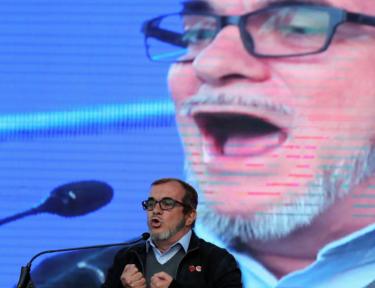
Image copyrightEPAImage captionRodrigo Londoño – aka Timochenko – has also been pelted with eggs and tomatoes while out on the campaign trail
The Farc former rebel group says its candidate for the presidential election in May is withdrawing from the race because of ill-health.
The group’s leader, Rodrigo Londoño, is recovering after undergoing heart surgery in a Bogotá clinic on Wednesday.
Better known by his nom de guerre, “Timochenko”, he had only been polling about 1% support.
But the group says it will continue to stand in legislative polls this Sunday.
Under the terms of the 2016 deal that brought an end to the Farc’s half-century of armed struggle, it is guaranteed 10 seats in the legislature as long as it campaigns for them.
“The surgery which took place yesterday, combined with… features of the electoral campaign, has led us to decline our presidential aspirations,” said Farc number two and Senate candidate Ivan Marquez.
The party has cancelled campaigning eventsover protests it says are from right-wing groups. Last month Timochenko’s motorcade was pelted with tomatoes and eggs by angry protesters.
Timochenko has a history of health problems – he suffered a heart attack while negotiating the peace deal in Cuba in 2015, a stroke in 2017 and another heart attack last week, prompting Wednesday’s surgery.
Media captionWhy are women in Spain going on strike?
Women workers in Spain are marking International Women’s Day with an unprecedented strike targeting gender inequality and sexual discrimination.
Work has been halted as part of a 24-hour strike organised by the 8 March Commission and backed by 10 unions and some of Spain’s top women politicians.
Scores of marches under the slogan “if we stop, the world stops” are taking place across Spain.
Events marking the day are being held in dozens of other nations.
What’s happening in Spain?
Women taking part have stopped working and have been urged by organisers to spend no money and ditch any domestic chores for the day.
Police were called to stop protesters blocking main roads in Barcelona but some women pickets still brought areas to a standstill.
Public transport nationwide is available but at reduced services and flights have also been affected.
Evening marches in Madrid, Barcelona, Bilbao, Valencia and a number of other cities are leading events in 200 Spanish locations.
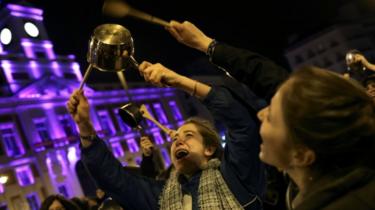
Image copyrightREUTERSImage captionThe Spanish event began with the banging of pots in the early hours
Many prominent women in the media were absent from their programmes.
The 8 March Commission is behind the strike. Its manifesto calls for “a society free of sexist oppression, exploitation and violence” and says: “We do not accept worse working conditions, nor being paid less than men for the same work.”
A poll of 1,500 people for the El Pais daily suggested 82% supported the strike, while 76% thought women in Spain had harder lives than men.
Feminist groups only want women to strike to show how important their absence is but Spanish law does not allow for single-gender strikes and men were welcome to support it.
The two main unions had called for members to stop work for two hours in the morning, and said that 5.3 million people had joined the stoppage.
Some have opposed the strike. The ruling centre-right party, the Partido Popular (PP), said the action was “for feminist elites and not real women with everyday problems”.
However, two of the five female ministers in Spain’s conservative government, Agriculture Minister Isabel García Tejerina and the president of the Madrid region, Cristina Cifuentes, said they would work longer hours to show the capacity of women.
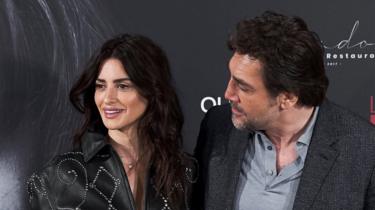
Actress Penelope Cruz cancelled planned public events and said she would go on “domestic” strike.
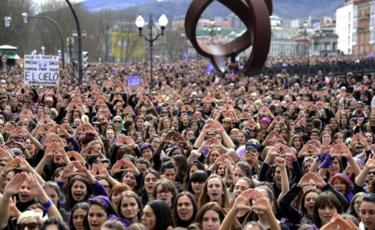
Image copyrightGETTY IMAGESImage captionPenelope Cruz says she will go on “domestic” strikeImage copyrightEPAImage captionProtesters attend a rally in Bilbao in northern Spain
The mayors of Madrid and Barcelona – Manuela Carmena and Ada Colau – are also backing the strike.
But the National Federation of Self-Employed Workers told El Pais that self-employed women remained overwhelmingly at work.
Activists in China have been angered by the approach of retailers who have dubbed the day “Queens’ Day” or “Goddesses’ Day” and offered women customers discounts on goods such as cosmetics
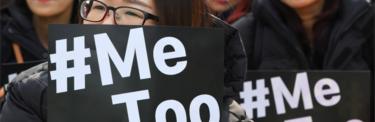
Protesters against sexual abuse wore black, waved roses and held banners of the #MeToo movement at a rally in the South Korean capital, Seoul
Several female journalists in Ukraine started a Facebook drive called “I am not your darling”, in response to President Petro Poroshenko’s use of the term in a reply to a woman reporter
French daily paper Libération raised its price on Thursday – but only for men. Women pay the standard €2, while men have to cough up another 50 cents to highlight the gender pay gap. President Emmanuel Macron also pledged to “name and shame” companies that pay women less than men for doing the same work
Prince Harry and fiancée Meghan Markle went to Millennium Point in Birmingham in the UK to encourage young women students to pursue a career in maths or sciences
Irish Health Minister Simon Harris said it was fitting the country had on this day finalised the wording for a referendum on whether to liberalise abortion
While leaders across Africa praised the role of women, the government in Ivory Coast decided to update a list of jobs that women are banned from doing. The labour laws now preclude “work that exceeds the ability and physical capacity of women, or work that presents dangers which is likely to undermine their morality, for example, working underground or in the mines”.
What are they saying on social media?
UK PM Theresa May announced the launch of a consultation to improve protection of those suffering domestic abuse. She sent out a tweet in support of International Women’s Day.
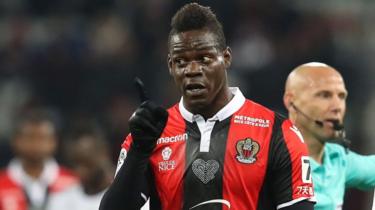
Image copyrightAFP/GETTYImage captionMario Balotelli made the criticisms on Instagram
Italian footballer Mario Balotelli has attacked the country’s first black senator in an online post.
Toni Iwobi was elected on Sunday for the anti-immigration Lega party.
“Maybe I’m blind or perhaps they have not told him yet that he is black. But shame!!!” the footballer posted on Instagram.
Born in northern Nigeria, Mr Iwobi came to Italy in 1976 and became a councillor for Lega (the League) in the Lombardy city of Spirano in 1995.
What did Balotelli’s post say?
The Italy striker, who plays for French Ligue 1 side Nice, put his post on Instagram on Tuesday.
Accompanying the text was a photo of Mr Iwobi and League leader Matteo Salvini, both raising clenched fists and wearing T-shirts saying “Stop Invasion” at an anti-immigration rally.
While there have been black members of Italy’s lower house, the Chamber of Deputies, the 62-year-old Toni Iwobi is the first black senator.
In a Facebook post celebrating his election, Mr Iwobi thanked Mr Salvini, who he called “a great leader”.
Anti-discriminatory body Fare said the striker should get “added protection” from referees for highlighting such abuse.
What happened in Italy’s election?
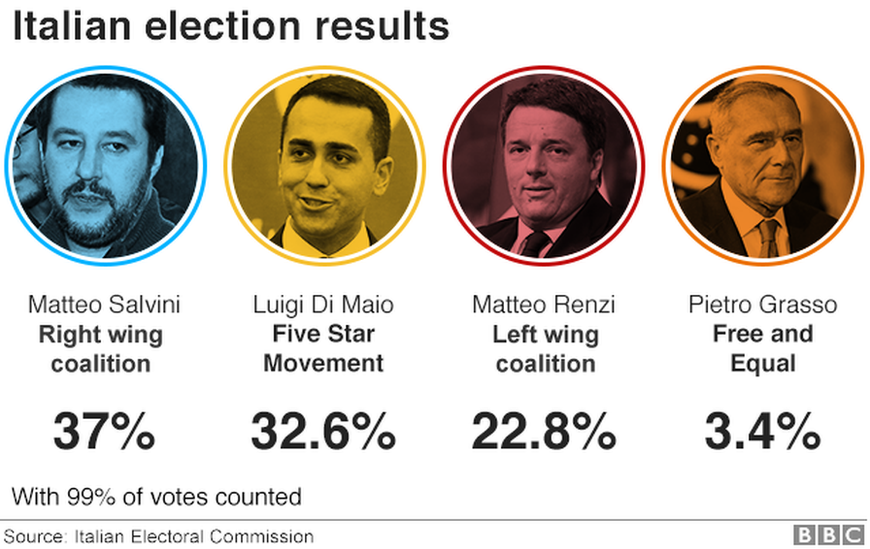
No one party gained a majority, but the results show a major shift away from traditional parties.
The Eurosceptic, populist Five Star Movement was the biggest single party, with about a third of the vote.
Five Star leader Luigi Di Maio announced that his party was open to coalition talks – despite ruling this out in the run-up to the vote.
However, the right-wing coalition, mainly comprised of the League and former PM Silvio Berlusconi’s Forza Italia but also including the Brothers of Italy, is also vying for power.
Mr Salvini said on Monday his party had the “right to govern” and that although he did not want a broad “minestrone” coalition government, he would speak to other parties to form a parliamentary majority.
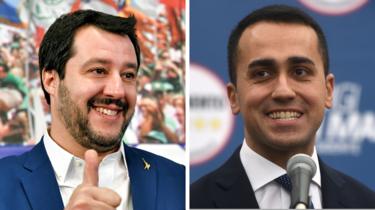
Image copyrightAFPImage captionLeague chief Matteo Salvini and Five Star leader Luigi Di Maio both want to lead Italy
On Wednesday, former PM Silvio Berlusconi said he would “loyally support” Mr Salvini’s efforts to form a government.
His right-wing Forza Italia won 14% of the vote, so was relegated to the second-largest party in its coalition with the League, which won 17.4%.
What does the election result mean?
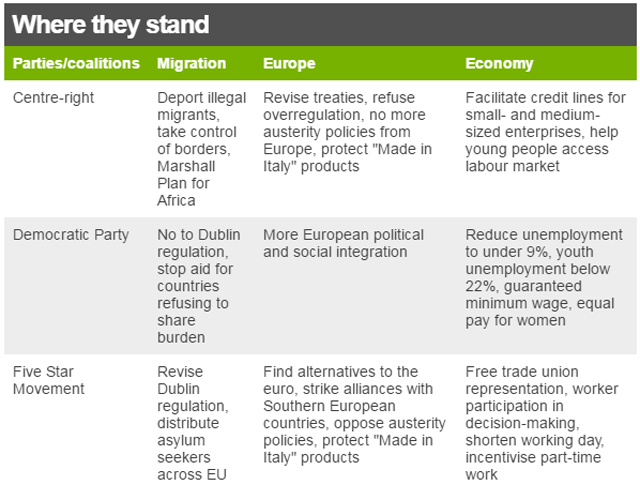
The surge of support for populist parties has been compared with the Brexit vote in the UK and the election of Donald Trump in the US.
Five Star was founded in 2009 by comedian Beppe Grillo, who denounced cronyism in Italian politics. It has captured new voters in the poorer regions of southern Italy, feeding off anger over institutional corruption, economic hardship and immigration.
Italian voters appear to have abandoned the Democratic Party, led by Matteo Renzi until he quit on Monday, because of dissatisfaction over these issues, and the centre-left coalition is set for a distant third.
With more than 600,000 people making the sea journey from Libya to Italy since 2013, immigration was a key issue.
But the state of the economy was also at the centre of the debate. In 2016, some 18 million people were at risk of poverty, and unemployment is currently at 11%.
Results from the vote for Italy’s Senate also favoured populists and parties of the right.
Five Star performed better than anticipated and was set to take the most seats but miss out on a majority.




 OP's News