Mystery as widow questions why husband’s body returned from Mexico with no brain, stomach or heart

A widow of a South Koreanman who died in Mexico has spoken out after his body was returned without his brain, stomach or heart.

The death of a 35-year-old man, who has been identified in the media only by his last name Kim, remains a mysteryas Mexican authorities insist he died of natural causes on Jan. 3 – contrary to the claims made by his grieving widow.
TEN CHILDREN IN TANZANIA KIDNAPPED AND KILLED FOR THEIR BODY PARTS, AUTHORITIES SAY
She claims there was nothing natural about her husband’s death and says he was involved in a fight at a karaoke bar on the day he died, News.com.au reported. He was then brought to the hospital unconscious and later pronounced dead, she said, noting that the incident was caught on CCTV cameras.
She also says that when his body was flown back to South Korea, it was missing his “brain, stomach and heart,” sparking fears of a cover-up by Mexican authorities, according to the outlet.
This prompted her to launch a petition on the website of the South Korea presidential office, asking for her husband’s body parts to be returned so an additional autopsy could be done.
MOB BURNED TO DEATH TWO MEN FALSELY ACCUSED OF CHILD ORGAN TRAFFICKING, REPORT SAYS
She also wrote on the website that the forensic scientists gave her two conflicting conclusions whether her husband suffered external injuries.
The second autopsy by the National Forensic Service in South Korea found a bruising on the body, contrary to Mexican authorities, yet couldn’t determine the exact cause of death due to missing organs, News.com.au reported.
“My husband was a citizen of Korea. His three-year-old son and 11-month-old daughter have lost their father,” she wrote on the petition site, gathering tens of thousands of signatures. “Please help me and help my husband.”
The South Korean government has also separately asked the Mexican authorities to comply with the request and return them to South Korea, according to KBS World Radio.
The case of the Korean man drew comparisons to a similar case of missing organs from December when the body of a British tourist, Amanda Gill, who died in Mexico, was returned to Britain without her eyes, brain or heart, with family accusing Mexican organ traffickers of stealing her organs.

Sri Lanka To Borrow $1 Billion From China For Highway Project

The construction of the first phase of the road linking Colombo with Kandy had been delayed for more than two years due to a lack of funding.

Sri Lanka To Borrow $1 Billion From China For Highway Project

China had provided assistance to Sri Lanka in both long-term project loans and day-to-day needs.
Beijing: 
Sri Lanka, which last year handed over a strategic port to a Chinese firm for a 99-year lease as a debt swap, will soon sign a USD 1 billion concessional loan agreement with Beijing to fund a major highway project linking Colombo to the hill resort of Kandy.
The construction of the first phase of the road linking Colombo with Kandy had been delayed for more than two years due to a lack of funding.
Sri Lankan Ambassador to China Karunasena Kodituwakku, was quoted by the official media on Friday as saying that the USD one billion will be used for the first stage of the central highway.
The second stage will be financed by Sri Lankan consortiums and the third by Japanese loans.
Earlier, the chief of Sri Lanka’s central bank said the country will receive a sovereign loan of USD one billion from the Bank of China in the first quarter of this year, and it will be used to meet repayments in the coming months
Mr Kodituwakku did not confirm if it was the same loan and whether it is linked with the USD one billion loan from the Export-Import Bank of China, the state-run Global Times reported.
The envoy thanked China which he said had provided assistance to Sri Lanka in both long-term project loans and day-to-day needs. Mr Kodituwakku also revealed that the country was negotiating with the China Development Bank for short-term loans.
Playing down the allegations that China’s financial assistance to Sri Lanka has led it into a debt trap, he said, “We don’t agree with that. China never forced us to take a loan. If there is something wrong with the loans we have taken, it’s our responsibility. It’s not fair to blame China or another country, saying Sri Lanka is a victim”.
According to reports, Sri Lanka owed USD eight billion debt to China.
The envoy said though Colombo has borrowed from many countries, including India and Japan, as well as multilateral organisations, it is not heavily indebted.
“This year Sri Lanka has to settle nearly USD 4 billion, and the country has more than USD 8 billion in reserves. But we cannot use all that money just to pay back. We have to keep a minimum balance,” he said.
Sri Lanka is in talks with China on a free trade agreement. “They have reached consensus on many issues, but (the agreement) isn’t finalised,” the Ambassador said, adding “We hope this year will be the critical year to finalise it.” 
He said the Colombo port is a very crucial transit port serving India. India’s strong economy will prop up the port as a successful entity.
Sri Lanka last year granted a 99-year lease on Hambantota port to a Chinese firm over its inability to repay loans to Beijing for the USD 1.4 billion project.
He expressed hope that Chinese firm can turn the Hambantota port into a successful facility.

"Nancy Pelosi Hurting Our Country": Trump Amid Border Wall Deadlock

US-Mexico Border wall talks are to conclude in two weeks and Donald Trump has warned that if they do not end well, he will allow another government shutdown.

Nancy Pelosi and other Democrats have not approved Donald Trump’s border wall offer.
Washington: 
US President Donald Trump said talks with lawmakers on building his proposed Mexico border wall are pointless and suggested he will declare a national emergency to get it done.
“I think Nancy Pelosi is hurting our country. very badly by doing what she’s doing and, ultimately, I think I’ve set the table very nicely,” Trump said Thursday in a wide ranging interview with The New York Times, referring to the speaker of the House of Representatives.
The talks are to conclude in two weeks and Trump has previously warned that if they do not end with money to build a wall on the border with Mexico he will allow another government shutdown.
An earlier 35-day shutdown just ended after a showdown with Democrats led by Pelosi.
In the New York Times interview, Trump made no mention of another closure, however, and suggested he will declare a national emergency on the border as a way to use military funds to erect such a barriera, key campaign pledge that plays to his conversvative nationalist base.
“I’ve actually always gotten along with her, but now I don’t think I will anymore,” Trump said of Pelosi.
“I think she’s doing a tremendous disservice to the country. If she doesn’t approve a wall, the rest of it’s just a waste of money and time and energy because it’s desperately needed
Elsewhere in the interview, Trump dismissed the various investigations being waged against him including the one on Russian interference in the 2016 election and whether the Trump campaign colluded with the Russians.
He said his lawyers have been reassured by the departing deputy attorney general Rod Rosenstein that Trump is himself was not a target.
“He told the attorneys that I’m not a subject, I’m not a target,” Trump told the Times
(Except the headlines it not edited by op’s staff and it is published from syndicated feed)

Indian-American Republican To Run For Ohio state Senate In 2020

Niraj Antani will run for the open State Senate District 6, currently represented by Senator Peggy Lehner whose term is ending and also she is retiring, he was quoted as saying.

Indian-American Republican To Run For Ohio state Senate In 2020

Niraj Antani is currently serving a third term in the Ohio House of Representatives.
Washington: 
Niraj Antani, an 27-year-old Indian-American Republican state representative, has announced that he will be running for the Ohio state Senate in 2020.
Mr Antani represents Miamisburg in the 42nd Legislative District. He is currently serving a third term in the Ohio House of Representatives.
He will run for the open State Senate District 6, currently represented by Senator Peggy Lehner whose term is ending and also she is retiring, Mr Antani was quoted as saying in a statement by a local radio station on January 30.
The Ohio Senate District 6, which encompasses most Dayton area suburbs, has been a Republican stronghold since 1985.
“Having been born and raised in this community, I am running for state senator to ensure every Ohioan who works for it has the opportunity to achieve their American Dream,” Mr Antani said in a statement. “I will lay out a vision throughout this campaign to solve the many great challenges our community and state face.”
The Ohio Senate is the upper chamber of the Ohio General Assembly, the legislative body that makes laws for Ohio”s 11.5 million citizens.
Mr Antani is the third youngest member of the state House of Representatives and the first Indian American Republican elected to the Ohio House
Born and raised in Miamisburg, he is a graduate of the Ohio State University.
If elected as state senator, he would become the highest ranking Indian American elected official, and the first Indian-American state senator in Ohio history, the statement said.
“I just knocked on the first door of my campaign for state Senator! Team Antani is pounding the pavement, talking to voters about their most important issues. We will work hard every day to earn the support of every voter,” he tweeted on Thursday.

US Student Found Unconscious Near University In Minus 21 Degrees, Dies

Temperatures were minus-21 degrees with a wind chill of minus-55 at the time Gerald Belz was found, according to data from the National Weather Service.

US Student Found Unconscious Near University In Minus 21 Degrees, Dies

Gerald Belz, a student of the University of Iowa, was found unresponsive near a campus building. 
An eastern Iowa community is grieving an 18-year-old college student who local officials believe died after exposure to the subzero temperatures pervading the Midwst.
Gerald Belz was a first-year student from Cedar Rapids on the pre-medicine track at the University of Iowa. The circumstances surrounding his death remain murky, but university police said they found the freshman unresponsive near a campus building just before 3 a.m. Wednesday. He later died at a hospital.
Police do not suspect foul play and think Belz’s death was linked to the extreme cold in Iowa that morning, the university said in a statement. Temperatures were minus-21 degreeswith a wind chill of minus-55 at the time Belz was found, according to data from the National Weather Service. Historically cold weather across the Midwest has been linked to at least seven deaths in recent days, a number that will likely continue to climb.
“[He was] quiet but tough, but he was a very compassionate individual,” Gerald’s father, Michael Belz, told NBC affiliate KWWL, adding that his son aspired to be a cardiologist or a neurosurgeon. Michael Belz also described his son as a “mama’s boy with a tough exterior,” according to ABC affiliate KCRG.
A spokesman with the local medical examiner’s office said Thursday more tests were needed to determine exactly how Belz died, a process that will likely take several weeks. Michael Belz has stressed in interviews that no alcohol was found in his son’s system at the time he died – but the grieving father said he still has questions.

US To Withdraw From Landmark Cold War Missile Treaty With Russia

US said Russia had not addressed concerns over missile system that Western states believe goes against the 1987 Intermediate-Range Nuclear Forces Treaty.

US To Withdraw From Landmark Cold War Missile Treaty With Russia

Secretary of State Mike Pompeo said US still wanted to engage in arms control negotiations with Russia
Washington: 
The United States said Friday it was withdrawing from the landmark Cold War INF missile treaty with Russia, saying Moscow was in violation.
Ahead of a deadline set by Washington, the United States said that Russia had not addressed concerns over a new medium-range missile system that Western states believe goes against the 1987 Intermediate-Range Nuclear Forces Treaty.
Effective Saturday, “the United States will suspend its obligations under the INF Treaty and begin the process of withdrawing from the INF Treaty, which will be completed in six months unless Russia comes back into compliance by destroying all of its violating missiles, launchers and associated equipment,” President Donald Trump said in a statement.
“The United States has fully adhered to the INF Treaty for more than 30 years, but we will not remain constrained by its terms while Russia misrepresents its actions,” Trump said.
Secretary of State Mike Pompeo, announcing the decision at a news conference, said that Washington still wanted to engage in arms control negotiations with Russia and hoped Moscow would come into compliance.

Eastern Ghouta: Syrian army splits enclave in three, reports say

(adsbygoogle = window.adsbygoogle || []).push({});

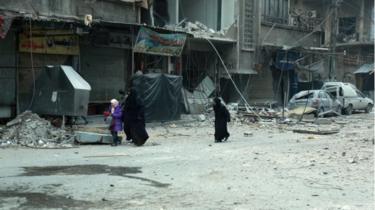
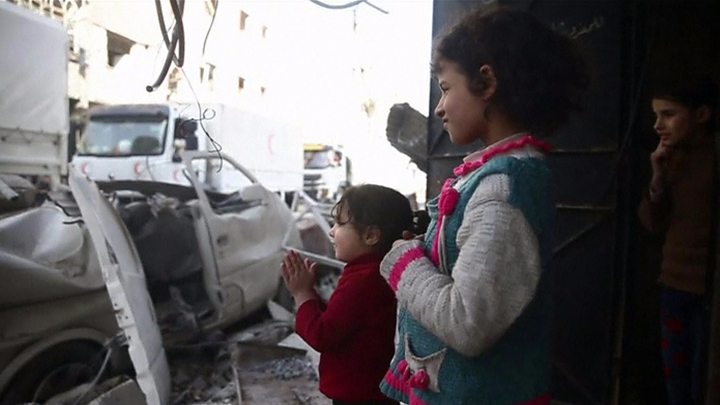
Syrian women run for cover following Syrian government bombardment on the town of Douma in the rebel-held enclave of Eastern Ghouta on the eastern outskirts of the capital Damascus on March 10, 2018.Image copyrightAFP
Image captionDouma continues to be under government bombardment

The Syrian army has made a significant advance in its effort to take rebel-held Eastern Ghouta, reports say.
Troops have cut off the region’s biggest town, Douma, and isolated another, according to UK-based conflict monitors the Syrian Observatory for Human Rights (SOHR).
The advance would effectively split the region into three parts.
The Syrian government began a major offensive last month to re-take Eastern Ghouta, near the capital Damascus.
Since then they have reportedly taken control of half of the region, in an advance that has left around 1,000 civilians dead over the past three weeks, according to SOHR.
The UN has called the bombardment “unacceptable”, saying it amounts to “the collective punishment of civilians”.
The military has been accused of targeting civilians, but it says it is trying to liberate the region – one of the last rebel strongholds – from those it terms terrorists.

What’s happening on the ground?

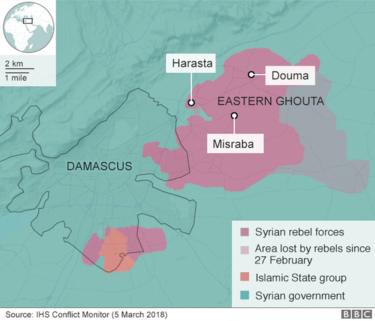
A clear strategy of the Syrian government’s offensive in Eastern Ghouta has been to divide the enclave into isolated sections and so cut off rebel support and supply networks, the BBC’s Arab Affairs editor Sebastian Usher says – and now the government appears to have all but achieved that goal.
The Syrian government has reportedly captured the central town of Misraba, and advanced onwards into surrounding farmland.
Misraba is located along a major road that links Douma, in the north, with another big town, Harasta, in the west.
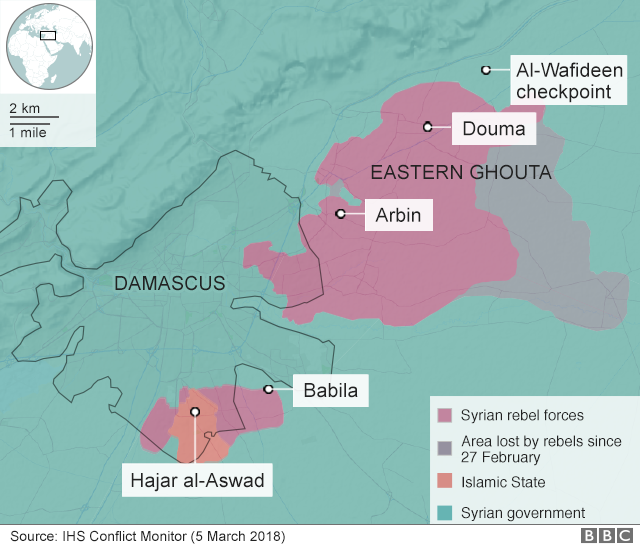
If confirmed, the advance leaves the enclave divided into three – Douma and its surrounding towns in the north, western Harasta, and the rest of the territory in the south.
Syrian state television also said the army had splinted Eastern Ghouta, but a spokesman for one of the main rebel groups told Reuters neither Harasta nor Douma were cut off.

A map showing Eastern Ghouta, Syria

Meanwhile an opposition website said that a group of fighters from the jihadists Hayat Tahrir al-Sham (HTS) arrived in central Hama province from Eastern Ghouta, a day after an evacuation deal was reached.
On Friday a UN convoy was able to successfully deliver aid to Eastern Ghouta, after previous deliveries were halted by shelling.
Some 400,000 people are still thought to live in the area, seven years into Syria’s civil war. It has been besieged by government forces since 2013.

Who are the rebels?

The rebels in Eastern Ghouta are not one cohesive group. They encompass multiple factions, including jihadists, and in-fighting between them has led to past losses of ground to the Syrian government.
The two largest groups are Jaish al-Islam and its rival Faylaq al-Rahman. The latter has in the past fought alongside HTS.

Media captionA short guide to the Syrian civil war

Eastern Ghouta is so close to Damascus that it is possible for rebels to fire mortars into the heart of the capital, which has led to scores of civilian deaths.
The Syrian government is desperate to regain the territory, and has said its attempts to recapture it can be attributed directly due to the HTS presence there. HTS was excluded from a ceasefire agreed at the UN that has yet to come into effect.
The group is an alliance of factions led by the Nusra Front, which sprang from al-Qaeda.

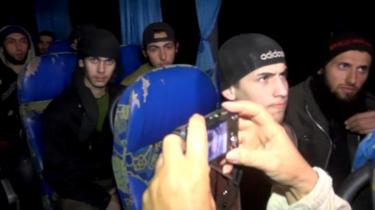
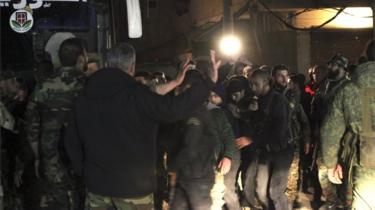
Syrian rebel fighters sit on a busImage copyrightAFP/SANA
Image captionSyrian state media showed what it described as rebel fighters being evacuated from Eastern Ghouta

What else is happening in Syria?

In January, Turkey began an offensive to oust the Kurdish YPG militia from the Afrin region in northern Syria, near the Turkish border.
Turkish troops, and some allied Syrian rebel militias, are now on the outskirts of Afrin town, the SOHR says.
Both the SOHR and an embedded news agency reporter said that Turkish forces had captured a military base from Kurdish groups and were seen taking heavy machine guns out, while exchanging fire with Kurdish fighters.
Turkey regards the YPG as a terrorist group and says it is linked to the banned Kurdistan Workers’ Party, which has fought an insurgency for Kurdish autonomy in Turkey for three decades.
Kurdish media report that Turkish forces have blown up public water facilities, cutting off drinking water supplies to hundreds of thousands of civilians.
Turkey’s President Recep Tayyip Erdogan said his troops could enter the town “at any moment”. He said they would “purge” the town and then carry on further east.

Florida shooting: NRA sues as Florida enacts gun-control law

(adsbygoogle = window.adsbygoogle || []).push({});

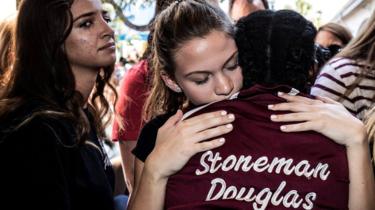
Students from Marjory Stoneman Douglas High School attend a memorial following a school shooting incident in Parkland, FloridaImage copyrightREUTERS
The National Rifle Association has sued Florida after it passed a gun control law in the wake of a school shooting last month that left 17 people dead.
Governor Rick Scott, a Republican and staunch ally of the gun lobby, enacted the bill.
The law raises the legal age for buying rifles in Florida, but also allows the training and arming of school staff.
It does not ban semi-automatic rifles like the one used in the 14 February massacre in Parkland.
But it does introduce a three-day waiting period on all gun sales and a ban on bump stocks, a device that enables semi-automatic rifles to fire hundreds of rounds a minute.
The NRA filed its lawsuit on Friday just an hour after the bill was signed by the governor.
The complaint says the law violates the second amendment of the US constitution, which governs the right to bear arms.
It also argues the bill breaches the 14th amendment’s equal protection clause by banning law-abiding citizens between 18-21 from buying guns.

Media captionAmerica’s gun laws explained
The legal action says the Florida legislation particularly affects young women.
“Females between the ages of 18 and 21 pose a relatively slight risk of perpetrating a school shooting… or, for that matter, a violent crime of any kind,” says the lawsuit.
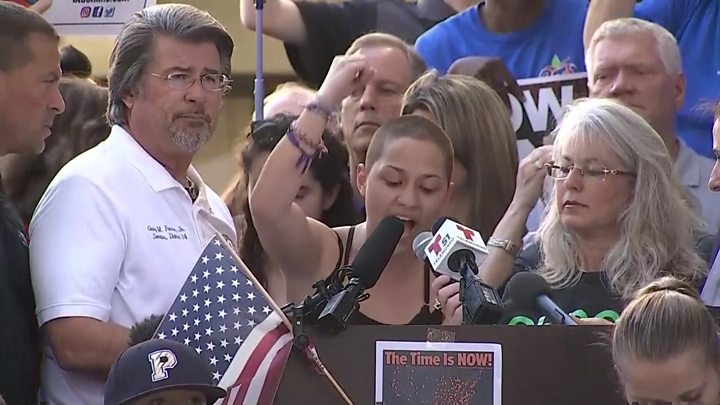
The bill’s passage by a Republican-controlled legislature in a state where the NRA wields considerable influence is seen as a testament to an impassioned pro-gun control campaign launched by young survivors of the shooting and parents of the victims.
Governor Scott signed the bill surrounded by Parkland students and families.
“Today should serve as an example to the entire country that government can and must move fast,” he said.

Media captionStudents have been lobbying for greater gun control
A former student with a history of mental health issues is accused of killing 14 students and three staff members at Marjory Stoneman Douglas High School on 14 February in the second-deadliest US school shooting ever.
The Florida bill is also controversial because it allows school staff to be specially trained to carry guns as campus “guardians”.
However, local sheriffs and individual school districts may opt out and most classroom teachers will be excluded from the scheme.
Six other states – Wyoming, South Dakota, Tennessee, Georgia, Kansas and Texas – allow public school employees to carry firearms to work, according to the National Conference of State Legislatures.
President Donald Trump has voiced support for arming teachers and so has the NRA.
The Florida bill also included a provision to make it easier for police to confiscate weapons from anyone found to pose a threat of violent behaviour.
This so-called “red flag” measure has also been proposed by five other states – Rhode Island, Utah, Kentucky, Alabama and Pennsylvania – since last month’s Parkland attack, according to the Brady Campaign to Prevent Gun Violence.

Syria war: Jaish al-Islam to evacuate number of Eastern Ghouta fighters

(adsbygoogle = window.adsbygoogle || []).push({});

Media captionA short guide to the Syrian civil war

Syrian rebel group Jaish al-Islam has agreed to evacuate jihadist fighters being held in its prisons in besieged Eastern Ghouta, a statement says.
The group says the decision was made in consultation with a delegation that entered with a UN aid convoy.
The Syrian government has stepped up efforts in retake the rebel-held enclave in recent weeks, leading to more than 900 reported civilian deaths.
Pro-government forces have now reportedly taken half the area.
Some 400,000 people are trapped and efforts to reach a deal to halt the bloodshed have gone on for weeks.
Jaish al-Islam said it had come to an agreement with a variety of parties, including the UN, to evacuate the fighters from Hayat Tahrir al-Sham (HTS) – an alliance of factions led by the Nusra Front, which sprung from al-Qaeda.
The extreme jihadist militants are excluded from the yet-to-be-implemented UN ceasefire and their presence provided a justification for the government bombardment of the area.
They are expected to travel to Idlib, which has been the destination for fighters under previous agreements – most notably when the Syrian government retook Eastern Aleppo.
However correspondents say the Russian-backed offensive is likely to continue despite the fighters’ removal.

Some 13 fighters from besieged Eastern Ghouta in the countryside of Damascus, Syria, are transported on a government bus on 9 March 2018Image copyrightEPA
Image captionThe first 13 were said to have been transported out using the Syrian government designated al-Wafidden corridor

Who are the rebel groups?

The rebels in Eastern Ghouta are not one cohesive group. They encompass multiple factions, including jihadists, and in-fighting between them has led to past losses of ground to the Syrian government.
The two largest groups are Jaish al-Islam and its rival Faylaq al-Rahman. The latter has in the past fought alongside HTS.
Eastern Ghouta is so close to Damascus that it is possible for rebels to fire mortars into the heart of the capital, which has led to scores of civilian deaths.

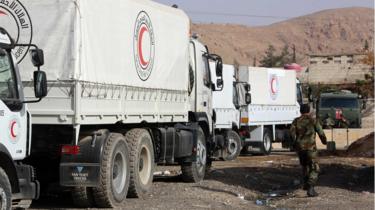
Trucks belonging to the International Committee of the Red Cross (ICRC) are parked on the outskirts of rebel-held Eastern Ghouta, 8 March 2018Image copyrightGETTY IMAGES
Image captionInternational aid has been trying to get into the area in recent days

The Syrian government is desperate to regain the territory, and has said its attempts to recapture the Eastern Ghouta are directly due to the HTS presence there. HTS was excluded from a ceasefire agreed at the UN that has yet to come into effect.

What is the situation in Eastern Ghouta?

The enclave has been beyond government control since 2012, but in recent weeks its efforts to retake the territory have markedly intensified.

Media captionFootage shows an earlier aid convoy reaching “hell on earth”

An estimated 950 civilians have been killed in the Eastern Ghouta region since the Russian-backed government assault was launched on 18 February, according to the UK-based Syrian Observatory for Human Rights (SOHR) monitoring group, which has a network of sources on the ground. Many of the victims are children.
On Friday a UN convoy was able to successfully deliver aid to the area, after previous deliveries were halted by shelling.
Hundreds of thousands of residents are still thought to live in the Eastern Ghouta, seven years into the civil war.

Map of Damascus and Eastern Ghouta

Turkish push against Syrian Kurds ‘imminent’

Further north in Syria, Turkish President Recep Tayyip Erdogan has said the Turkish army and its Free Syrian Army allies could enter the town of Afrin “at any moment” and are surrounding its centre.
Their forces have been pressing an assault against the Kurdish-held enclave since January 20. They have already taken control of the nearby town of Jinderes, a few kilometres from Afrin, Turkish reports say. Kurdish fighters insist the Turkish military has not yet besieged Afrin.

Media captionAfrin: What is going on in Syria’s other battle?

The Turkish government has entered the area because it says the Kurdish militia holding the territory – the People’s Protection Units (YPG) – are an extension of the banned Kurdistan Workers’ Party (PKK), which has fought for Kurdish autonomy in south-eastern Turkey for three decades.
The YPG denies any direct organisational links to the PKK – an assertion backed by the US, which has provided the militia and allied Arab fighters with weapons and air support to help them battle the jihadist group Islamic State (IS).

‘Pharma Bro’ Martin Shkreli sentenced to seven years

(adsbygoogle = window.adsbygoogle || []).push({});

Martin Shkreli arrives for his trial at US Federal Court in BrooklynImage copyrightREUTERS
Martin Shkreli, the former drug firm executive found guilty of defrauding investors, has been sentenced to seven years in prison.
The 34-year-old wept at a hearing as a federal court judge in Brooklyn, New York, handed down the prison term.
Shkreli was convicted last year of sending fake account statements to investors while concealing huge losses from two hedge funds he ran.
He first became notorious in 2015 for hiking the price of a lifesaving drug.
His lawyers had asked the judge to impose a sentence of 12 to 18 months, while prosecutors were seeking at least 15 years.
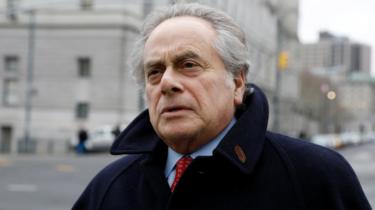
Attorney Benjamin Brafman arrives for a hearing for his client, former drug company executive Martin Shkreli,Image copyrightREUTERS
Image captionAttorney Benjamin Brafman arrives for a hearing for his client, former drug company executive Martin Shkreli,
“I’ve got my begging voice on,” Shkreli’s lawyer Benjamin Brafman told the judge on Friday, while acknowledging his client could be annoying.
“There are times when I want to hug him and hold him and comfort him and there are times when I want to punch him in the face,” said Mr Brafman.
An uncharacteristically apologetic Shkreli said in court: “There is no conspiracy to take down Martin Shkreli.
“I took down Martin Shkreli with my disgraceful and shameful actions.”
In 2015 the youthful executive made headlines after he founded Turing Pharmaceuticals, bought the anti-parasitic drug Daraprim and raised its price by 5,000% to $750 (£540) per pill.
The medication is used to treat Aids patients, the pregnant and elderly. Price gouging is not illegal or even unusual in the US pharmaceutical industry.
But Shkreli became a poster boy for corporate excess, and was dubbed “Pharma Bro” and the “most hated man in America”.
In December 2015, he was charged with securities fraud charges and looting millions of dollars from two hedge funds he operated, MSMB Capital and MSMB Healthcare.
He was convicted of those charges, as well as scheming to prop up the stock price of Retrophin, the drug company he founded in 2011.
Before his sentencing, Mr Brafman told the judge that Shkreli is a “somewhat broken” person who suffered from depression and an anxiety disorder.
Mr Brafman said the US government would like to just “throw away” his client.
During the trial last year, Shkreli called the prosecution “junior varsity” in off-the-cuff remarks to reporters covering his trial.
Prosecutors sought a gag order on him after that outburst, but the judge denied their application.
After a jury found him guilty in August last year, Shkreli was allowed to remain free pending sentencing.
But a month later he offered social media followers $5,000 if they could bring him hair from former US presidential candidate Hillary Clinton, who repeatedly criticised him during her campaign.
A judge revoked bail and Shkreli was jailed.

Prosecutors moved to seize $7.4m of his assets, including a single copy of an album by American hip hop group the Wu-Tang Clan that the disgraced executive is said to have paid $2m for at auction in 2015.

Design a site like this with WordPress.com
Get started