Media captionFirst Minister Carwyn Jones says the European market is hugely important
New trade deals with countries such as the United States cannot replace the UK’s current trading relationship with the EU, the Welsh Government has said.
Ministers in Cardiff accept there are “significant trading opportunities” outside the EU and support the “merits of international trade”.
But they still prioritise “full and unfettered access” to the EU’s single market and customs union membership.
The UK government said it is “committed to securing a good deal with the EU”.
But it added the UK will leave the single market and customs union.
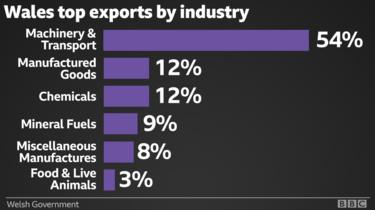
Wales exported £14.6bn worth of goods in 2016, with 61% of those being sold to countries within the EU. In the same year, only 41% of all UK goods were exported to the EU.
In 2015, 35% of the total £1.7bn worth of services sold in Wales went to the EU.
“What’s hugely important to us is that we have full and unfettered access to our most important market,” said First Minister Carwyn Jones, at the launch of a new paper on future trade policy.
“It’s hugely important we get the trading relationship with Europe right and of course we can look at what other opportunities there might be in other parts of the world, but nothing’s going to replace Europe as an important market.
“At the moment we have access to that market which means we don’t have to pay any tariffs, we don’t face any barriers.
“Why would we want to put barriers where none exist?”
A second report looking at the possible impact of Brexit on Wales’ largest companies was published by Cardiff Business School on Friday.
One of the authors, Prof Max Munday, said their research has found there is no “one size fits all” solution to address the different risk factors faced by companies as a result of Brexit.
“For some firms, yes, possible value-added tariffs are important but for other firms issues such as the labour market implications, non-tariff barriers are most important,” he added.
Non-tariff barriers include different regulations, standards and subsidies between one country and another.
The report said: “Care should be taken in over-focusing on firms that appear to be large exporters” because in some of the largest exporting sectors “little value is actually added within Wales”.
A spokesman for the Department for Exiting the EU said: “We respect the four freedoms of the EU and that is why, as we leave the EU, we are leaving the single market and customs union.
“We are committed to securing a good deal with the EU that works for the whole of the UK including Wales, through a bold and ambitious future economic partnership.”
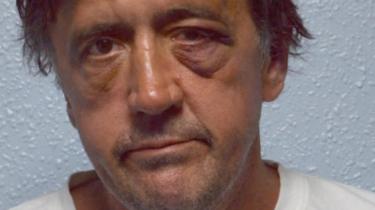
Image copyrightMET POLICEImage captionDarren Osborne was found guilty of murder and attempted murder, at Woolwich Crown Court
A man who drove a van into a crowd of Muslims near a north London mosque has been sentenced to life in prison, with a minimum term of 43 years behind bars.
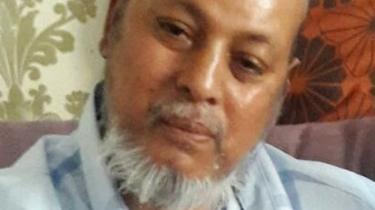
Darren Osborne, 48, was found guilty of murdering Makram Ali, 51, after deliberately ploughing into a crowd of people in Finsbury Park in June.
Mrs Justice Cheema-Grubb said Osborne, from Cardiff, had planned “a suicide mission” and expected to be shot dead.
“This was a terrorist attack – you intended to kill,” the judge told him.
Osborne, who had been found guilty of murder and attempted murder, said “God bless you all, thank you”, as he was led away from court.
‘Malevolent hatred’
The father-of-four mowed down worshippers in Finsbury Park shortly after 12.15am on 19 June last year, killing Mr Ali and injuring nine others.
The jury took an hour to return the verdict at Woolwich Crown Court on Thursday after a nine-day trial.
She said he was “rapidly radicalised over the internet by those determined to spread hatred of Muslims”.
“Your use of Twitter exposed you to racists and anti-Islamic ideology,” she added.
“In short, you allowed your mind to be poisoned by those who claimed to be leaders.”
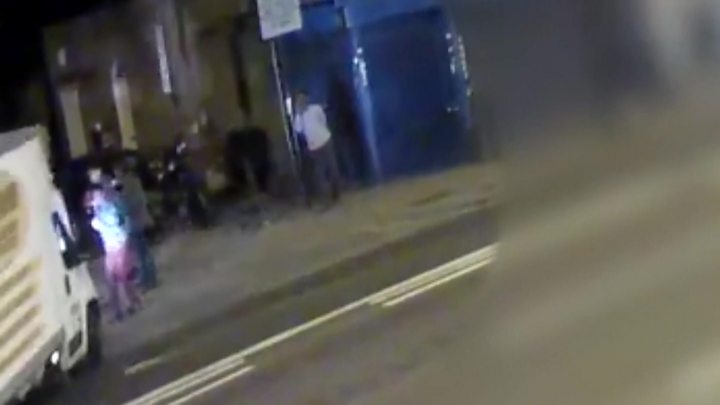
Media captionCCTV showed Darren Osborne’s movements before and during the attack
Before sentencing, the court heard a statement from Razina Akhtar, the daughter of Mr Ali, who said she had suffered “recurring nightmares” since the death of her father.
“The incident was near to our house and I walk past it most days. It keeps me awake at night thinking about the attack.”
She said her mother, Mr Ali’s widow, was now scared to go outside by herself for fear of being attacked.
“My father was the most sincere and warmest person I know. He was full of jokes and laughter, and full of love for his family and grandchildren.
“His life was taken in a cruel way by a narrow-minded, heartless being,” the statement added.
Other witness suffered feelings of anxiety, flashbacks, fear of going out and loss of confidence, prosecutors said.
Image copyrightPAImage captionMakram Ali, 51, was killed in the attack
Mrs Justice Cheema-Grubb also heard a list of Osborne’s previous convictions – including a string of violent offences – spanning more than 30 years.
Osborne had appeared before the courts on 33 occasions for 102 offences, she was told.
The judge said Osborne’s previous convictions showed he was a “belligerent and violent character”.
She said Mr Ali died immediately after being struck by the van. He was found with tyre marks on his torso, she added.
‘Obsessed’ with Muslims
The trial heard the victims had been outside the Muslim Welfare House, in Finsbury Park, when the area had been busy with worshippers attending Ramadan prayers.
Mr Ali had collapsed at the roadside in the minutes before the attack.
Police later found a letter in the van written by Osborne, referring to Muslim people as “rapists” and “feral”.
He also wrote that Muslim men were “preying on our children”.
Osborne, the trial heard, had became “obsessed” with Muslims in the weeks leading up to the attack, having watched the BBC drama Three Girls, about the Rochdale grooming scandal.
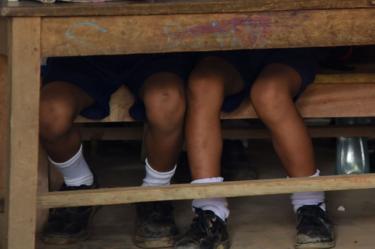
Image copyrightGETTY IMAGESImage captionCorporal punishment is banned in Indian schools
Police in India have lodged a complaint against a school principal after she allegedly forced 13 pupils to hold their hands over a candle flame.
The head teacher, Sushanti Hembrom, was trying to find out if one of the nine-year-olds had stolen money from another classmate.
The incident occurred on Wednesday in a private school in the eastern Indian state of Jharkhand.
Ms Hembrom was suspended the next day after parents complained.
Police told BBC Hindi’s Ravi Prakash that the teacher said she had expected the guilty student to step forward out of fear.
But all the students did as they were told and put their hands over the flame. While some of them quickly snatched their hands away, seven sustained burns.
At least one of them, whose hand Ms Hembrom is alleged to have forcibly held over the flame, was injured badly and had to be admitted to hospital. He was discharged on Thursday.
Police said Ms Hembrom, who has since admitted to what happened, said she had made a “big mistake” and has apologised to the students as well as their parents.
Corporal punishment is banned in Indian schools but continues to be widespread. It is also not unusual for stripping to be used as a form of punishment in schools.
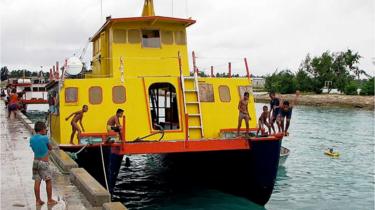
Image copyrightAFPImage captionA file picture of the MV Butiraoi in the harbour
The Pacific nation of Kiribati is mourning the biggest loss of life ever to hit the archipelago.
The sinking of the MS Butiraoi just over two weeks ago is thought to have claimed at least 81 lives, among them many children and teenagers.
An international search operation that last week found seven survivors was called off on Friday. Local boats will continue the search but by now they are probably looking for bodies, not survivors.
The mood among the roughly 115,000 islanders has turned from hope to anger and frustration.
People are asking how a tragedy like this could have happened.
‘Incompetence at every level’
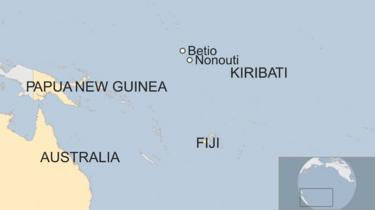
The ferry embarked on 18 January for a routine two-day trip, covering 260km (160 miles) of Pacific waters.
The Butiraoi was carrying at least 88 passengers from the island of Nonouti to the township of Betio on the archipelago’s main island of Tarawa – but it failed to arrive.
“It seems that at every level, everything was met with incompetence,” Reese Masita, president of the Melbourne Kiribati Association told the BBC.
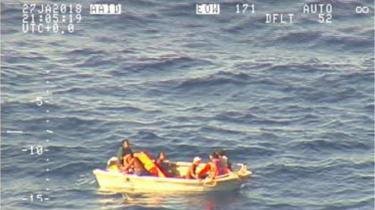
Image copyrightAFPImage captionA small dinghy was spotted from the air and rescued
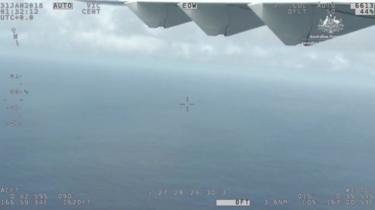
After days of not hearing anything from the 17.5m (57ft) vessel, an international search effort got under way with aircraft from New Zealand, Australia and the US scanning the ocean for wreckage, debris and survivors.
On 27 January, a New Zealand military plane found a five-metre dinghy adrift carrying seven survivors, among them a 14-year old girl.
The remaining passengers are now all thought to have died. A preliminary passenger document lists 14 children, 16 students and 58 adults.
It is the time of year when students return to school and the ship was even more overcrowded than usual. It was designed for only about 25 passengers.
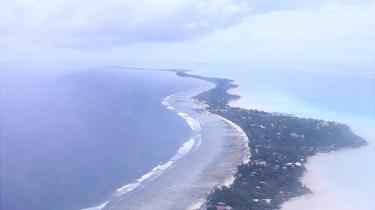
Image captionThe ferry was headed for the main island of Tarawa
Though its 33 atolls and reef islands are spread across millions of square kilometres of ocean, Kiribati is a small community – almost everyone knows via a few connections about one or more of the victims. Ms Masita spent the past few years in Australia, but one of her friends’ daughters was on the ferry.
Lessons ignored
It is not the first time that Kiribati has suffered a ferry disaster. In 2013, a similar incident claimed the lives of 35 people.
Yet little appears to have been done about the problems identified then.
“It’s now sunk in for everyone that nothing has changed,” Ms Masita says.
A vessel that was not seaworthy and in violation of safety standards was allowed to embark on a long journey. There were not enough life jackets and dinghies and no beacons or flares.
While initial anger was directed against the ferry’s owner, who is now facing charges, people are now asking deeper questions.
All the ferries operating as lifelines between Kiribati’s small islands are in a similar condition, explains Ms Masita.
“There’s also a cultural issue at play, the people running the boats are taking risks because they feel they would be letting people down,” she said.
Small local planes fly between the islands, but for the majority of citizens, ferries like the Butiraoi are the only way to get to where they have to be.
So blame has quickly shifted to the authorities for not enforcing minimum safety standards.
Hope for the future
The Butiraoi might not look like a ferry you would choose for a two-day trip on the Pacific, but it is representative of all the boats connecting Kiribati’s 33 atolls.
Image copyrightREUTERSImage captionThe international search operation is now being called off
“Safety is a problem on all of them, you can say that. The maintenance and I guess safety procedures and all of that are basically nonexistent,” Ms Masita said.
She has three main questions for the authorities:
The ship had undergone repairs and was thought to be unseaworthy. Why was it allowed to still make that journey?
After two days it didn’t arrive at its destination. Why did it take days before an international rescue operation was under way?
Why was there no proper crisis management strategy in place? Immediately sending out boats and local planes could have saved precious time in the search for survivors.
But Ms Masita says there is now hope that the scale of this latest disaster could finally prompt change.
There is a sense that if the government can’t be relied on to act, people have to start by pushing for change themselves.
A Gofundme page has been launched to equip all ferries with an emergency locator beacon.
As the islanders mourn their loved ones, there is also determination that such loss of life will not happen again.
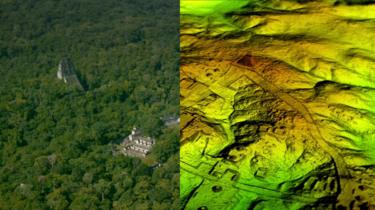
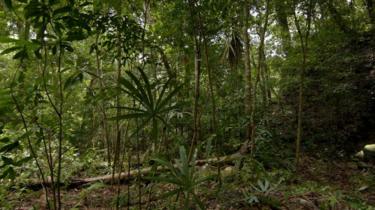
Image copyrightWILD BLUE MEDIA/CHANNEL 4Image captionThe Mayan city of Tikal was surrounded by a complex network of previously undiscovered structures and causeways
Researchers have found more than 60,000 hidden Mayan ruins in Guatemala in a major archaeological breakthrough.
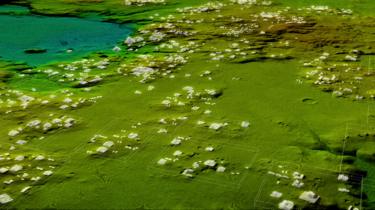
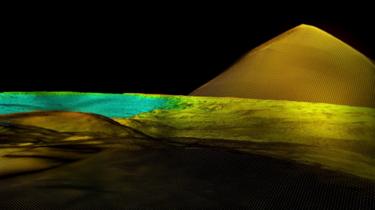
Laser technology was used to survey digitally beneath the forest canopy, revealing houses, palaces, elevated highways, and defensive fortifications.
The landscape, near already-known Mayan cities, is thought to have been home to millions more Mayans than other research had previously suggested.
The researchers mapped over 810 square miles (2,100 sq km) in northern Peten.
Image copyrightWILD BLUE MEDIA/CHANNEL 4Image captionMost structures are believed to be stone platforms for pole-and-thatch homes
Results from the research using “revolutionary” Lidar technology, which is short for “light detection and ranging”, suggest that Central America supported an advanced civilisation more akin to sophisticated cultures like ancient Greece or China, National Geographic reports.
“The Lidar images make it clear that this entire region was a settlement system whose scale and population density had been grossly underestimated,” Thomas Garrison, an Ithaca College archaeologist, told the magazine.
Revolutionary technology
Described as “magic” by some archaeologists, Lidar is unveiling archaeological finds almost invisible to the naked eye.
The group of scholars who worked on this project beamed laser pulses at the ground from a plane and measured the wavelengths as they bounced back, which is not unlike how bats use sonar to hunt.
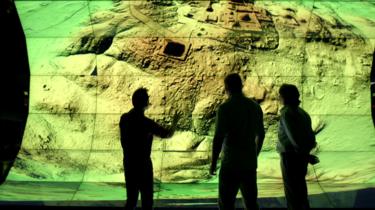
Lidar enabled them to digitally remove the tree canopy and create a detailed three-dimensional image of what is really under the surface of the now-uninhabited landscape.
Image copyrightWILD BLUE MEDIA/CHANNEL 4Image captionLidar images have surprised surveyors who previously underestimated the population size and complexity of Mayan civilisation
Archaeologists excavating a Maya site called El Zotz in northern Guatemala, painstakingly mapped the landscape for years. But the Lidar survey revealed a 30-foot-long (9m) fortification wall that the team had never noticed before.
“Maybe, eventually, we would have gotten to this hilltop where this fortress is, but I was within about 150 feet of it in 2010 and didn’t see anything,” Maya expert Tom Garrison told Live Science.
In recent years Lidar technology has also been used to reveal previously hidden cities near the iconic ancient temple of Angkor Wat in Cambodia.
Mayan civilisation, at its peak some 1,500 years ago, covered an area about twice the size of medieval England, with an estimated population of around five million.
“With this new data it’s no longer unreasonable to think that there were 10 to 15 million people there,” said Mr Estrada-Belli, “including many living in low-lying, swampy areas that many of us had thought uninhabitable.”
Most of the 60,000 newly identified structures are thought to be stone platforms that would have supported the average pole-and-thatch Mayan home.
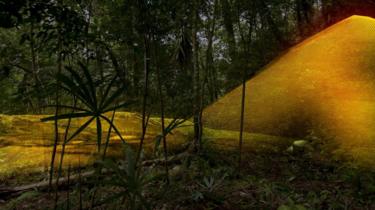
One of the hidden finds is a seven-storey pyramid so covered in vegetation that it practically melts into the jungle.
Image copyrightWILD BLUE MEDIA/CHANNEL 4Image captionArchaeologists excavated Maya sites that could not be seen under the jungle foliageImage copyrightWILD BLUE MEDIA/CHANNEL 4Image captionDigitally stripping away the forest canopy, Lidar technology revealed an undiscovered seven-storey pyramidImage copyrightWILD BLUE MEDIA/CHANNEL 4Image captionResearchers believe the Lidar data, which reveals more than 60,000 new structures, will take years to fully understand
A discovery that surprised archaeologists was the complex network of causeways linking all the Mayan cities in the area. The raised highways, allowing easy passage even during rainy seasons, were wide enough to suggest they were heavily trafficked and used for trade.
The Lidar survey was the first part of a three-year project led by a Guatemalan organisation that promotes cultural heritage preservation. It will eventually map more than 5,000 sq miles (14,000 sq km) of Guatemala’s lowlands.
The project’s discoveries will feature in a Channel 4 programme called Lost Cities of the Maya: Revealed, airing in the UK on Sunday 11 February at 20:00 GMT.
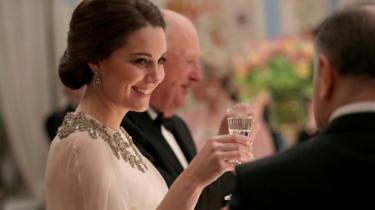
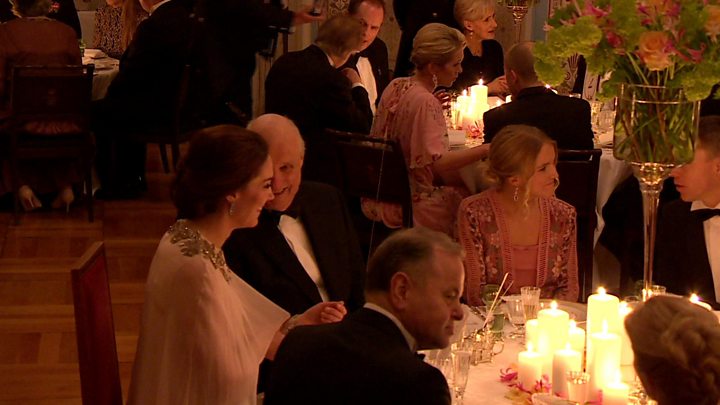
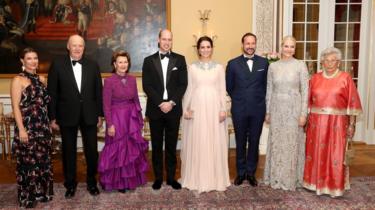
The King of Norway has paid tribute to the Duke and Duchess of Cambridge at a gala dinner in their honour in Oslo.
Speaking at the Royal Palace, King Harald described the couple as “family” while Prince William celebrated the UK’s relationship with Norway.
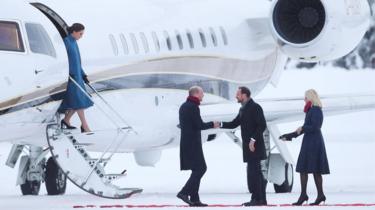
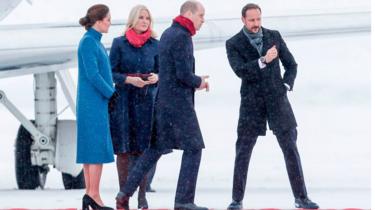
Crown Prince Haakon and Princess Mette-Marit had greeted the duke and duchess at a snow-covered airbase at the start of the second leg of their Nordic tour.
Staff cleared the runway as the private chartered plane arrived from Sweden.
Prince William and Catherine are visiting the two countries at the request of the Foreign Office – part of a series of trips seen as attempt to strengthen ties with European nations ahead of Brexit.
Norway is not in the EU but is associated through its membership of the European Economic Area.
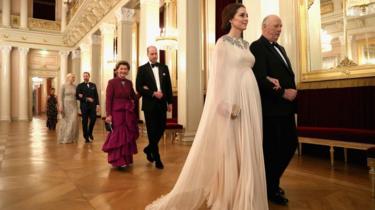
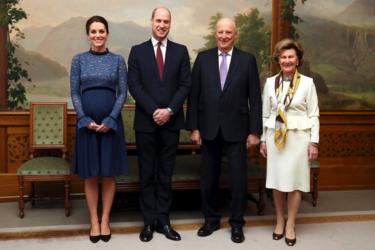
Image copyrightGETTY IMAGESImage captionThe duke and duchess were escorted to the dinner by King Harald V and Queen Sonja
In his speech, King Harald said: “I hope we will be able to maintain our close and extensive co-operation when the United Kingdom withdraws from the European Union.”
Prince William said: “Norway has been, and will continue to be, enormously important to Britain both as a friend and a partner.”
Media captionKing of Norway’s speech quotes Love Actually
He added: “Defending freedom is a core value for both Norwegians and Britons.
“The cherished symbols of our freedom and friendship are the Christmas trees sent from Norwegian communities to Britain each December.”
Image copyrightREUTERSImage captionThe Duke and Duchess of Cambridge were met by Crown Prince Haakon and Crown Princess Mette-MaritImage copyrightAFP
The royal couple are due to visit Norwegian start-ups and entrepreneurs, including reMarkable, Play Magnus, No Isolation and Motitech, which all work towards tackling issues such as the environment, mental health and well-being.
The duke will also meet Norway’s chess grandmaster Magnus Carlsen.
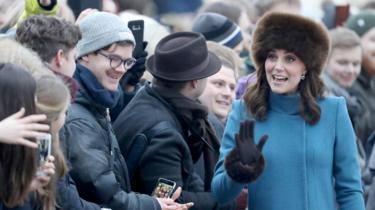
Image copyrightREUTERSImage captionThe Duke and Duchess of Cambridge met King Harald V and Queen Sonja in OsloImage copyrightGETTY IMAGESImage captionThe royal couple took a tour of Oslo’s Royal Palace gardens and met members of the publicImage copyrightGETTY IMAGESImage captionThey later posed with King Harald V and Queen Sonja of Norway alongside extended Norwegian royalty ahead of the dinner at the Royal PalaceImage copyrightGETTY IMAGES
Kate, who is six months pregnant with the couple’s third child, kept warm in a Catherine Walker coat and Seraphine dress as they were greeted by their hosts on Thursday morning.
They were then driven to central Oslo to the Royal Palace for an audience with King Harald and Queen Sonja, before taking a tour of the Princess Ingrid Alexandra Sculpture Park and spoke to members of the public.
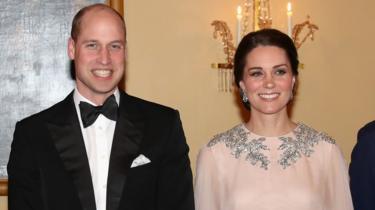
The Duchess smiled in a pink flowing gown by Alexander McQueen as she was led to dinner by King Harald V, while Prince William followed closely behind, accompanied by Queen Sonja.
The duke and duchess’s Norwegian visit comes exactly 34 years after Princess Diana’s solo trip to the country in 1984, when she also met Harald and Sonja.
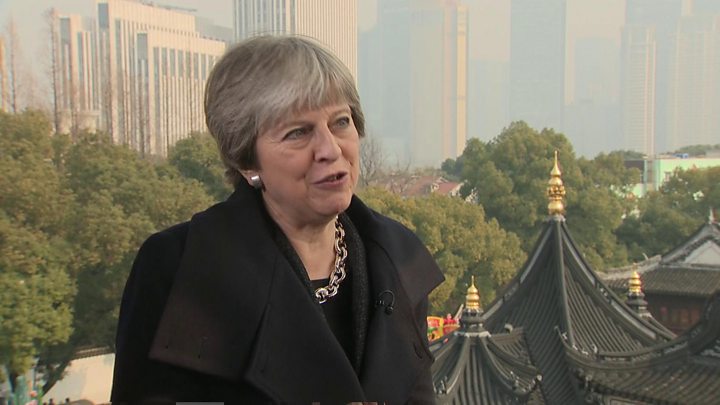
Media captionPM: The UK will not have to choose between EU deal and one with the rest of the world.
Theresa May is coming under increasing pressure to set out where she stands on Britain’s future trade agreements.
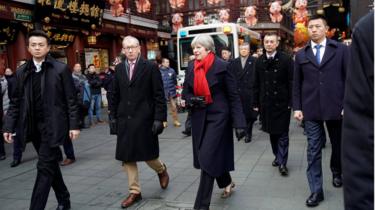
Speaking at the end of a trade visit to China, the PM said Britain would not face a choice between a free trade deal with the EU after Brexit and striking deals with the rest of the world.
It comes as she has faced criticism from Eurosceptic Tory MPs that she is heading for a “Brexit in name only”.
Asked about her future as PM, Mrs May said she was “not a quitter”.
During the prime minister’s three-day visit to China, Downing Street said more than £9bn of business deals would be signed.
However, Mrs May has faced growing criticism from MPs, including many in her own party, who have called for her to be more specific about her priorities on UK’s future trade arrangements with the EU.
Speaking to the BBC’s political editor Laura Kuenssberg, the prime minister said she had already spelled out what she wants from the deal and did not believe the UK would have to choose between Europe and the rest of the world.
“I don’t believe that those are the alternatives,” she said.
“What the British people voted for is for us to take back control of our money, our borders and our laws and that’s exactly what we are going to do.
“We also want to ensure that we can trade across borders.”
She added: “What I favour is a deal, an arrangement for trading with the European Union which is going to be good for trade between the UK and the European Union and good for jobs in Britain.”
Analysis
Image copyrightREUTERSImage captionTheresa May and her husband Philip in Shanghai
By Iain Watson, BBC political correspondent
While Theresa May has been away – successfully signing trade deals – I have been assessing the battles she faces on the home front, within her own party.
What is most striking is that some who supported her have, at the very least, become wobblier. One ex-minister said he felt “badly let down”. She has been accused of blocking, not delivering, radical change.
A former supporter questioned her lack of decisiveness: “She has more reviews than a film critic would produce in a lifetime.”
A Remainer who despises Boris Johnson wondered if – to coin a phrase – the foreign secretary’s “bad leadership would be better than no leadership”.
Council candidates fear poor results in London’s May elections and think this could be a trigger for the PM to go.
And a Conservative-supporting business leader felt – though he didn’t advocate it – that her opponents “will pull the pin from the grenade”.
Downing Street believes the feeding frenzy of speculation will abate when more progress is made on EU withdrawal. But they are aware of the challenges at home as well as abroad.
The prime minister has come under pressure from Eurosceptics worried about potential concessions by the UK in the Brexit talks.
Last week, Chancellor Philip Hammond suggested Britain’s relationship with the EU would change only “very modestly” after Brexit.
However, cabinet members – including Foreign Secretary Boris Johnson – have warned the UK will lose the main advantages of Brexit if it remains bound by trade rules of the single market and customs union.
They have called for the prime minister to be clearer about her own position.
‘Job to be done’
Mrs May has repeatedly said Brexit will mean leaving the single market and customs union.
She told the BBC her goal in upcoming talks with Europe was to strike a deal that “is going to be good for trade between the UK and EU and good for jobs in Britain”.
Media captionTheresa May: I am not a quitter
She added: “It means a free trade agreement with the EU. We are now starting to negotiate that free trade agreement with the EU.
“We want that to enable trade to take place on as frictionless and tariff-free a basis as possible across our borders, but we also want to be signing trade deals in the rest of the world, like here in China.”
Asked again about her own future as prime minister, Mrs May said “throughout my political career I’ve served my country and I’ve served my party”.
“I’m not a quitter. I’m in this because there is a job to be done here and that’s delivering for the British people and doing that in a way that ensures the future prosperity of our country.”

 GETTY IMAGES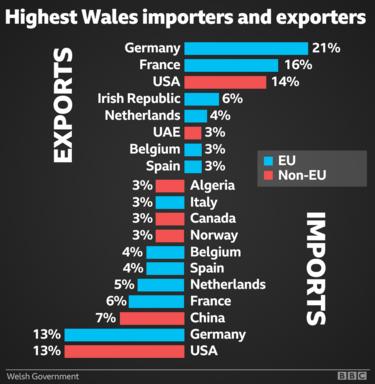

 OP's News