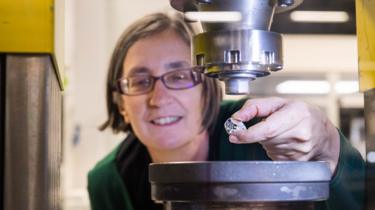
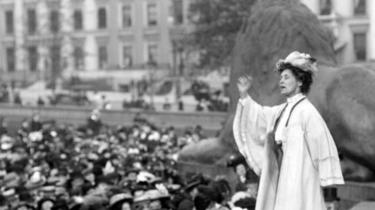
Speaking at the coin’s striking, Dr Pankhurst said: “My great-grandmother Emmeline Pankhurst was a key suffragette, campaigning for women’s suffrage.
“I think she would have been happy that the coin is here to mark the struggle.
“Suffragettes actually used to deface coins and mark them with ‘Votes for Women’ so there is an element of justice in having an official coin.
“It’s creation is also very timely given that gender equality is so in the news.”
Image copyrightROYAL MINTImage captionThe new 50p coin, photographed here against the paper copy of the Act, will be in general circulation later this year
The 50p coin, which will be in general circulation later this year, depicts a woman in a celebratory pose holding her ballet paper aloft, alongside a soldier, suffragette and two other men.
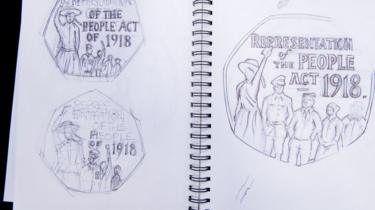
Stephen Taylor, a Royal Mint graphic artist who designed the coin, said: “My design uses the familiar idea of a British queue, to suggest a line of people waiting to cast their votes at the ballot box.
“I paid careful attention to their poses and clothing, showing the different classes of society finally being given a political voice after years of struggling to be heard.”
Image copyrightROYAL MINTImage captionThese are some of designer Stephen Taylor’s original sketches
A women’s football league has been suspended by the Football Association of Wales (FAW) after a dispute over the admission of a team from Denbighshire.
Rhyl Ladies FC wanted to put a team into the North Wales Women’s Football League (NWWFL), which opposed the move.
The club already has a team in the Welsh Women’s Premier League, and the sides could have met in the NWWFL if the first team got relegated.
The FAW will oversee the management of the league for the rest of the season.
It said in a statement the decision had been made because the NWWFL was “not willing” to follow a non-compliance order made on 30 November 2017.
Rhyl Ladies won its dispute to have a development team included in the 2017/18 season, but the NWWFL failed to admit it to the fixture list.
The league argued that there could be problems if Rhyl’s first team was ever relegated from the Premier League into the NWWFL.
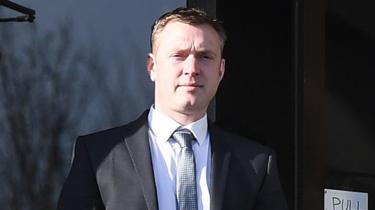
Image copyrightWALES NEWS SERVICEImage captionIan Spiller was accused of deliberately running over his wife’s new partner
A road safety campaigner has been cleared of knocking down his estranged wife’s new partner after seeing them together in the street.
Ian Spiller, 36, was accused of using his Audi A5 to deliberately run down Karl Davies, 40, in February 2017.
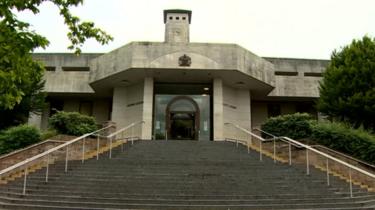
But a jury at Newport Crown Court took less than an hour to find him not guilty of dangerous driving and causing serious injury by dangerous driving.
The father-of-two, who was married for 10 years, had denied all charges.
The jury heard Mr Davies, 40, started a relationship with Mr Spiller’s wife Vicky, after meeting up for runs.
Mr Spiller, a community councillor is Laleston near Bridgend, was accused of revving his engine and driving towards Mr Davies after becoming “jealous” seeing the couple out together.
Mr Davies was knocked unconscious and left with a fractured skull after the incident in February 2017.
But Mr Spiller denied being responsible for Mr Davies’ injuries and said he hurt himself when he attacked the defendant’s car.
During the trial, Mr Spiller said: “There were just punches going everywhere. I turned the car back into reverse – he followed, he was in a blind, blind rage.”
Speaking after the verdicts, Mr Spiller – who led a a campaign for road safety in their home village – said: “I am numb at the moment.”
Image copyrightUKIPImage captionMichelle Brown would not take lessons on political correctness from Gareth Bennett, a spokesman said
UKIP AM Michelle Brown is facing a week’s exclusion from the assembly without pay over a racial slur she used to describe a Labour MP.
Members of the standards committee, including party colleague Gareth Bennett, ruled she committed a “severe breach” of the code of conduct.
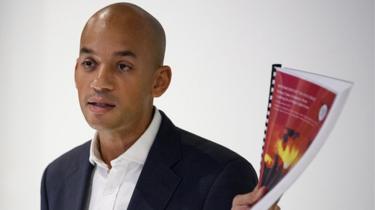
Ms Brown made the comment about Chuka Umunna in a private phone call in 2016.
A spokesman for Michelle Brown said she would appeal. She has apologised for any offence caused.
The spokesman, alluding to occasions where Mr Bennett has drawn negative publicity, added: “Michelle Brown is not likely to take any lessons at all on political correctness or conduct, from Gareth Bennett.”
The recommendation of the standards committee, and the results of an investigation by the standards commissioner Sir Roderick Evans that prompted it, have come to light after its report was leaked to BBC Wales.
It will be up to Assembly Members to decided whether to endorse the exclusion in a vote in Senedd. It is thought to be the first case of its kind.
Ms Brown called the MP for Streatham, Chuka Umunna, a “coconut” in a phone call in May 2016 to her then senior adviser Nigel Williams, which he released a recording of to the Daily Post newspaper last summer.
In his investigation the standards commissioner found that the term “coconut” fell below the standard of conduct required of AMs.
He said the point that Ms Brown was making – that, despite Mr Umunna’s heritage, his privilege upbringing meant he had no greater understanding of the lives of ordinary members of the black and minority ethnic community – was “within the range of points that a politician is entitled to make”.
But he said that fact remained that “Ms Brown, in making her point, resorted to using a term of racial abuse”.
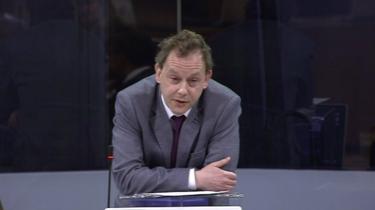
Image captionGareth Bennett was one of the three members of the standards committee that made the recommendation
Ms Brown had told the standards commissioner that the comments complained of “were made during a private and personal conversation between two friends and party colleagues.”
But the commissioner said that was “not realistic” as she had been discussing the terms of employment of a person whom she was considering employing.
The committee agreed saying “the term used in this instance was a term of racial abuse, and as such utterly unacceptable”, accusing her of bringing the assembly into disrepute.
It said that the language is “below the expectations of an assembly member and that racism has no place in society”, calling the use of the term a “severe breach” of the code of conduct for AMs which they said applies “at all times”.
According to the report, Ms Brown had argued that the term was “not racist”.
Image copyrightGETTY IMAGESImage captionChuka Umunna was briefly a contender for the Labour leadership in 2015
The UKIP North Wales AM told the commissioner that she did not apologise “for using the verbal short-cut coconut”, and that there was no evidence the assembly had been brought into disrepute.
Her words, she said, “were recorded and released to the press without my consent and the motivation for the release was personal spite, not a desire to further the public good”.
However the committee’s report said that she later apologised for any offense her words may have caused, and an advisor to her also accepted that it was a term of racial abuse “at the lowest level of severity”.
Because the Labour group had made the initial complaint only three members of the four member committee – Plaid Cymru’s Llyr Gruffydd, the Conservatives’ Paul Davies and UKIP’s Gareth Bennett – oversaw the deliberations, with Labour AM Jayne Bryant absenting herself.
The committee said it would not expect to see complaints being made by party groups this way again as it has a “detrimental impact on the process”.
It was also concerned that information relating to the complaint by the chair of the Labour group was released at the point of submission to the standards commissioner.
Ms Brown’s spokesman said: “Of course Michelle will be appealing as the committee have reached the wrong conclusion.”
A UKIP Wales spokesman said: “It would be improper to make a comment on an alleged leaked report.”
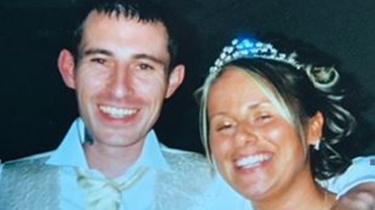
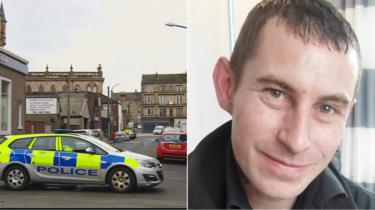
Image copyrightPOLICE SCOTLANDImage captionPaul Mathieson pictured with his sister, Amanda Digby
The sister of a man killed in a “frenzied and brutal” street attack has made a fresh appeal in a bid to catch his attacker.
Paul Mathieson, 37, was found with serious facial injuries in Wilson Street, Renfrew, on 14 January. He died in hospital almost a week later.
Mr Mathieson had been in Renfrew’s Western Bar and the Kind Man’s before stopping for a pizza on the way home.
His sister Amanda Digby said: “The family are devastated.”
She added: “Imagine if you were in our position, you would do everything you could to find out why your loved one has been cruelly snatched away in such awful circumstances.
“Please help us find who is responsible.”
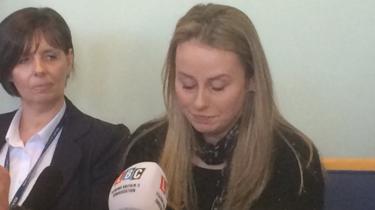
Image captionAmanda Digby said her brother may have known his attacker
Ms Digby said Mr Mathieson was not only a brother, but also a father to a 12-year-old son.
Appealing for anyone with information to come forward, Ms Digby said: “He may have known his attacker.”
Police confirmed Mr Mathieson met another man after leaving the pizza shop.
He was then subjected to a sustained attack and lay on the ground for some time before a passer-by raised the alarm.
Image copyrightBBC/POLICE SCOTLANDImage captionPolice was attacked as he walked home with a pizza after a night out in Renfrew
Mr Mathieson was discovered about 01:10 on 14 January and died in hospital on 20 January.
Det Ch Insp Martin Fergus said officers were keen to find out if Mr Mathieson had fallen out with people in the past.
He said his inquiry team have been looking at “hours and hours” of CCTV footage and urged anyone who was in Mr Mathieson’s company, or who saw him on the night he died, to get in touch.
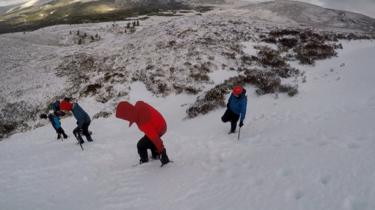
The avalanche risk in the six areas – Lochaber, Glen Coe, Northern and Southern Cairngorms, Creag Meagaidh and Torridon – monitored by the Scottish Avalanche Information Service (SAIS) has also been rated “considerable” over the past few days.
Almost 70 avalanches have been recorded in the service’s latest season, which started in December and ends in April. There were 90 for the whole of its 2016-17 season.
SAIS’ Southern Cairngorms team has also reported winds gusting to 100mph this week.
Cairngorms-based Glenmore Lodge instructor Mr Jones said: “In the days leading up to what you want to do get as much information as you can about the conditions to help you make a sound judgement.
“Don’t decide on one route several days before and then stick to that plan.
“You need to have several options and then choose which of those options is best with the weather on the ground at the time.”
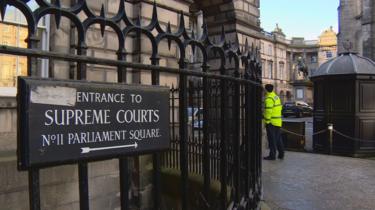
Image captionThe case was heard at the Court of Session on Friday, with a decision due next week
A Scottish judge will decide next week whether the European Court of Justice (ECJ) should be asked if the UK can unilaterally stop the Brexit process.
Campaigners argue that MPs have the legal power to revoke Article 50 completely, without the consent of the other 27 EU members.
They took their case to the Court of Session in Edinburgh, where they asked for the case to be referred to the ECJ.
But they admitted Lord Doherty had been “sceptical” about their argument.
Lord Doherty is expected to announce his decision on Tuesday morning.
The legal action was launched by a group of politicians from the SNP, Labour, Scottish Greens and Liberal Democrats after a crowdfunding campaign reached its £50,000 target.
‘Providing clarity’
It has been backed by the Good Law Projectcampaign group, which said it was about “providing clarity to inform the democratic process”.
Speaking outside Friday’s Court of Session hearing, Jolyon Maugham of the Good Law Project said the judge had clearly been “sceptical” about the argument put forward on behalf of the campaigners by Aidan O’Neill QC.
He told BBC Scotland: “If you make the assumption that he rejects the petitioners’ claim, we will have to decide whether or not we ask the inner house of the Court of Session to reconsider.”
The petitioners include SNP MP Joanna Cherry and MEP Alyn Smith, Labour MEP Catherine Stihler, Scottish Green MSPs Andy Wightman and Ross Greer, and Lib Dem MP Christine Jardine.
What is the legal action all about?
Michel Barnier, the EU’s chief negotiator, has previously said that any decision by the UK to halt the Brexit process would need the unanimous agreement of all of the EU states.
But the campaigners, who oppose Brexit, argue that Mr Barnier’s position has never been tested by the courts.
They believe that the UK Parliament should be able to withdraw Article 50 if MPs vote to do so, and without needing the permission of other EU members.
If it is ultimately successful, the move could strengthen the hand of any attempts to block Brexit after the terms of the final deal between the UK and EU are known.
This is because it would give parliament the power to halt Brexit if it feels the final deal is unacceptable – even if the government wants to leave regardless.
What does the UK government say?
The government’s position is effectively that there is no option before parliament to halt Brexit – because MPs will only be asked to vote on whether to accept the final exit deal, or for the country to leave the EU without a deal.
Its lawyers argue that Article 50 will therefore not be revoked, so we do not need to know the answer to the question of whether or not it can be.
But the campaigners argue it is for parliament – not the government – to decide what its options are.
They say that MPs should actually have three choices open to them at the end of the Brexit process – to accept the deal that is reached between the UK and EU, to reject the deal and leave EU regardless, or to reject the deal and remain in the EU.

 ROYAL MINT
 PA
PA ROYAL MINT
 ROYAL MINT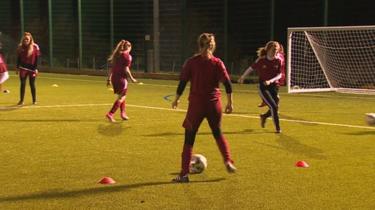


 OP's News