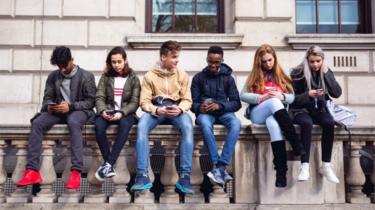
Ban phones in schools, says minister Nick Gibb

Pupils should be banned from taking smartphones into school, the minister for school standards in England has told the BBC.
Nick Gibb spoke out ahead of the government publishing new guidance for schools, expected to address internet safety, social media and online gaming.
It is expected to say children should be taught to limit the amount of time they spend online.
Schools have the power to ban phones from being taken on to the premises.
But government policy is that it is the responsibility of head teachers to determine whether this is appropriate.
Patsy Kane, executive head teacher at the Education and Leadership Trust in Manchester, said Mr Gibb’s plan was “missing the point on just how fantastically useful mobile phones can be for learning”.
“Whether that’s practising the modern languages, so you can quickly get your phone out in a lesson and search new words that you might not know.
“There’s a fantastic range of apps now for revision and the students are really motivated to use them.”
She told BBC Breakfast her multi-academy trust encourages the responsible use of smartphones during lessons and that teachers do remove the devices if they are used inappropriately during school time.
The trade union that represents head teachers has expressed its scepticism about outright bans.
But Mr Gibb said: “Many schools have already taken the decision to ban mobile phones from the classroom.
“While this is clearly a matter for the head teacher, my own view is that schools should ban their pupils from bringing smartphones into school or the classroom.”
What is known as “relationships education” is to become compulsory from September 2020, with schools being encouraged to teach it from September of this year.

‘Balancing time’

Last summer, the government published draft guidance about how this could be implemented.
“Children and young people are growing up in an increasingly complex world and living their lives seamlessly on and offline,” it said.
But it acknowledged that while this presented “many positive and exciting opportunities” there were also “challenges and risks”.
Since the publication of the document, which said “pupils should be taught about the benefits of balancing time spent on and offline”, there have been more than 11,000 responses to it and new guidance is expected soon.
“Children should not be spending hours and hours on their smartphones or iPads. There are obviously huge benefits to the internet and there’s nothing intrinsically damaging about spending time online,” Mr Gibb said.
“But if the time children spend using social media or playing computer games becomes excessive, it drives out time for them to talk to their parents, exercise, do their homework or play with friends.
“It eats into the amount of sleep and rest children have, resulting in their coming into school the next day tired and unable to concentrate.”

Boy using phone in a classroomImage copyrightGETTY IMAGES
The minister, who has spent more than six years at the Department for Education, added: “Ensuring children can regulate their own use of smartphones and social media is becoming an increasingly important life skill for them to learn.”
But the NAHT union, which represents school leaders, has said banning pupils from taking a mobile phone to school can be counterproductive.
Giving evidence to the Commons Science and Technology Committee in October last year, the union’s senior policy adviser Sarah Hannafin said: “Mobile phone bans certainly work for some schools but there isn’t one policy that will work for all schools.
“Outright banning mobile phones can cause more problems than it solves, driving phone use ‘underground’ and making problems less visible and obvious for schools to tackle.”
She added: “Ultimately, schools work to prepare young people for the outside world, giving them the awareness and strategies to responsibly monitor their own screen use and the ability to identify and deal with any negative impacts or problematic content they encounter.”
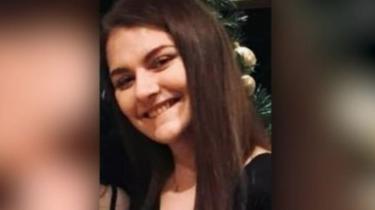
Libby Squire: ‘Significant concerns’ for missing Hull student

Police searching for a 21-year-old student who went missing after leaving a club have said they have “significant concerns” about her safety.
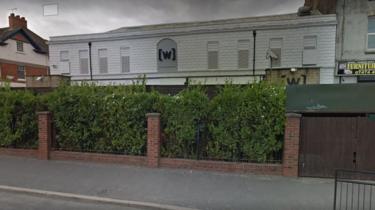
Libby Squire was last seen by her friends getting into a taxi outside The Welly on Beverley Road, Hull, at about 23:00 GMT on Thursday.
The University of Hull student was then seen by a man who tried to help her at 23:45 GMT near Beresford Avenue.
Det Supt Simon Gawthorpe said her disappearance was out of character.
Speaking at a press conference, he said: “Her family have described Libby as a very thoughtful young woman who always put other people before herself.
“They have said this is very out of character for Libby, and clearly that raises our concerns about her significantly.”
The Welly in HullImage copyrightGOOGLE
Image captionLibby Squire got a taxi outside The Welly club
More than 70 officers are involved in the search, and fire crews have been searching a frozen pond at Oak Road playing fields.
They have spoken to friends, and visited pubs and clubs in the area, as well as speaking to residents.
Det Supt Gawthorpe appealed for drivers with dashcam footage who were in the Beverley Road area between 23:00 GMT and 03:00 GMT to get in touch.
Police have also asked residents to check their gardens, sheds and outbuildings to see if she has taken shelter there.
Friends of the student have also organised their own search party through social media.
Ms Squire, who is 5ft 7in and has long dark brown hair, was wearing a black leather jacket, black long sleeved top, a leather jacket and a black denim skirt with lace.

UK weather: Snow and ice still causing disruption

Freezing temperatures are continuing to disrupt travel and sports events.
A number of League One and League Two football matches have been postponed, some roads remain closed and hundreds of homes are without power.
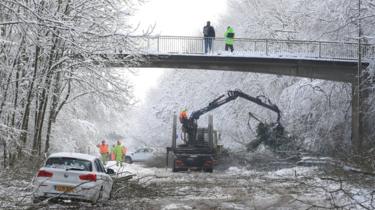
Parts of southern England saw 19cm (7.5in) of snow on Friday, with motorists stuck in vehicles overnight and falling trees blocking train lines.
Temperatures could fall as low as -16C (3F) on Saturday night, with the Met Office warning of icy conditions.
Highways England said police had worked until 02:00 GMT on Saturday to free vehicles from the M3 near Basingstoke
Robert Bell, Highways England South East operations manager, said: “We have every sympathy for drivers who found themselves stranded in the severe weather.
“Safety is our top priority and our teams of gritters and snow ploughs, supported by our traffic officers, worked through the night to keep the roads treated.”

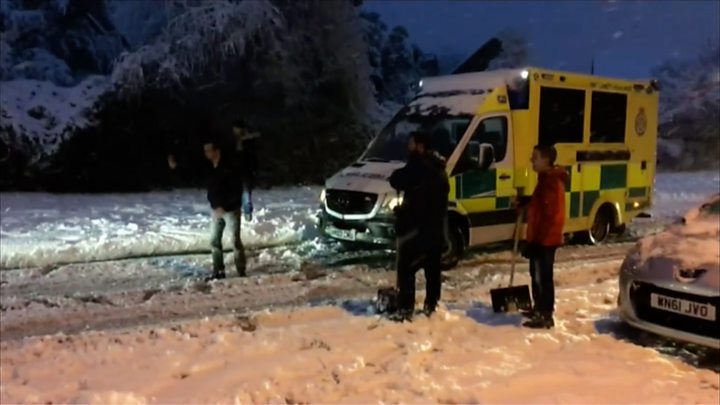
Media captionAmbulance rescued on snowy road in Basingstoke
Up to 1,500 people are without power in the Basingstoke area following the heavy snowfall.
Scottish and Southern Electricity Networks said engineers were struggling to reach “fault locations… with snowdrifts of up to 5ft in places” but hoped to have power restored to all affected homes by Saturday afternoon.
The area bore the brunt of Friday’s snowfall, with drivers abandoning vehicles and the local hospital urging people not to use the A&E department if possible.
Kent County Council said they had 18 tree surgeons working to clear the A2045 where a number of trees were brought down by the weight of the snow.
Overnight sleet and snow in the county on Friday hampered efforts to free drivers trapped on the roads, with police reporting an “incredibly busy night”.
The A2045 in Walderslade was not expected to be open again until Sunday afternoon.
In the West Country, Bristol Airport – which closed its runway on Friday – said there may be some further delays due to the de-icing of runways.
Cardiff Airport was also anticipating some disruption “due to adverse weather”.
The Met Office has issued a yellow weather warning for ice across southern parts of the UK from 16:00 GMT on Saturday to late Sunday morning.
It said, while most areas would be dry, temperatures are expected to fall rapidly after dark with wet surfaces refreezing, meaning an increased likelihood of accidents due to icy surfaces.

Sports fixtures postponed

Six English Football League matches have been postponed because of snow and freezing conditions in the UK.
Five Scottish League One and Two matches have also been postponed, including one League One match, Accrington v Blackpool and five league two matches.
Media captionIs more snow and ice on the way? Check out the latest forecast

What’s the weekend forecast?

BBC weather presenter Helen Willetts said there was lying snow in many parts of the UK, and the ice risk remained high through Saturday night and into Sunday morning.
Snow showers would ease in the later part of the day, but the weather is expected to turn very cold overnight, with experts predicting “the coldest night of the winter so far”.
Temperatures even in cities such as London and Birmingham could fall to a “very unusual” -4 or -5, with -12 expected over the snowfields in Scotland.
However Sunday will mark “a day of change” with milder air pushing in bringing heavy rain and some windy conditions in the coming week.
Temperatures fell to their lowest level this winter in the early hours of Friday, with Braemar, Aberdeenshire, dropping to -15.4C (6F).
This is the lowest in the UK since 2012 – when temperatures fell to -15.6C in Holbeach, Lincolnshire.
Presentational white space

Virginia Governor Ralph Northam sorry for racist yearbook photo

Media captionVirginia governor says sorry for racist photo
Virginia Governor Ralph Northam has apologised after his 1984 student yearbook page emerged, showing a photo featuring men in racist costumes.
“I am deeply sorry for the decision I made to appear as I did in this photo and for the hurt that decision caused then and now,” he said in a statement.
Black politicians in Virginia called the image “disgusting” and Republicans urged the Democrat to resign.
The picture showed a man in blackface and another man in Ku Klux Klan robes.
It appeared on a page with other photos of Mr Northam, who was aged about 25 at the time, as well as personal details about him.
He did not elaborate on which costume he was wearing, but said he appeared in a photograph that was “clearly racist and offensive”.
Mr Northam was elected governor of Virginia in November 2017.

How has this come about?

Mr Northam’s yearbook page, which came from the paediatric neurologist’s time at Eastern Virginia Medical School, was first published by conservative website Big League Politics.
The Virginian-Pilot newspaper tweeted a picture of the page which it said it obtained from the medical school library.
Presentational white space
An official from the medical school verified the photo and told the Huffington Post it came from a “student-produced publication”.
The page, which features Mr Northam’s full name and photos of the future doctor and politician, also included a quote from a Willie Nelson song that read: “There are more old drunks than old doctors in this world so I think I’ll have another beer.”

What has Northam said?

“This behaviour is not in keeping with who I am today and the values I have fought for throughout my career in the military, in medicine, and in public service,” the governor said in a statement after the image was made public.
“But I want to be clear, I understand how this decision shakes Virginians’ faith in that commitment.”
He continued: “I recognise that it will take time and serious effort to heal the damage this conduct has caused. I am ready to do that important work.
“The first step is to offer my sincerest apology and to state my absolute commitment to living up to the expectations Virginians set for me when they elected me to be their governor.”
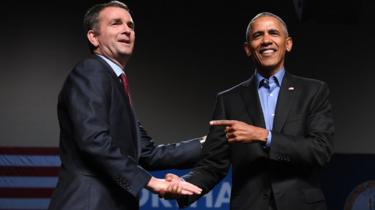
Former US President Barack Obama (R) gestures to Democratic Gubernatorial Candidate Ralph NorthamImage copyrightAFP/GETTY IMAGES
Image captionFormer President Barack Obama campaigned for Mr Northam in 2017
Mr Northam later released a video statement via Twitter in which he said he was “deeply sorry” for the offence the image had caused.
“I accept responsibility for my past actions and I am ready to do the hard work of regaining your trust,” he said.
Before he was elected governor, Mr Northam served for a decade as a Virginia state legislator.
His responsibilities as governor include implementing state laws, restoring voting rights for individuals who have had them withdrawn and issuing pardons.
In 2017, Mr Northam told the New York Times he had voted for Republican George W Bush in his presidential campaigns years earlier, saying that his decision was “wrong”.

What is the reaction?

The Virginia Legislative Black Caucus, which comprises African Americans elected to the Virginia General Assembly, said it was “still processing what we have seen about the governor” but described the images as “disgusting, reprehensible and offensive”.
“These pictures rip off the scabs of an excruciatingly painful history and are a piercing reminder of this nation’s sins. Those who would excuse the pictures are just as culpable,” it said in a statement.
The photo also prompted a swift backlash from conservatives, including Jack Wilson, the chairman of the Republican Party of Virginia, who called on Mr Northam to step down.
“Racism has no place in Virginia,” he said in a statement. “These pictures are wholly inappropriate. If Governor Northam appeared in blackface or dressed in a KKK robe, he should resign immediately.”
Calls for his resignation also came from four Democratic candidates for president – Senators Kirsten Gillibrand, Kamala Harris and Cory Booker, and Texan mayor Julian Castro.
Presentational white space
Democratic Senator Elizabeth Warren, who is considering a presidential run in 2020, also called for Mr Northam to resign.
Presentational white space
The Ku Klux Klan is one of the oldest and most infamous hate groups in the US, and has targeted African Americans, Jews, Catholics and immigrants, according to the Southern Poverty Law Center, which tracks hate groups.
The group has a long history, with KKK membership peaking in the 1920s.

Australia weather: Monsoon rains cause floods in Queensland

Media captionFamilies are being evacuated
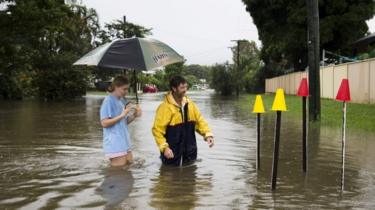
Exceptional monsoon rains have caused severe flooding in parts of Australia’s north-eastern state of Queensland.
Cars and livestock have been swept away over a large area around the coastal city of Townsville. Emergency crews are evacuating people on rafts.
Up to 20,000 homes could be flooded if the downpours continue, officials warn.
A dam has reached twice its capacity and water is being released to avoid putting further strain on it. More rain is expected in the coming days.
Northern Queensland has a tropical climate and experiences monsoon rain from December to April. But the current conditions in the Townsville area are rare.
We have not been in this situation before,” Queensland Premier Annastacia Palaszczuk is quoted as saying by the Australian Broadcasting Corporation (ABC).
“There has been a lot of rain falling over the Townsville catchment and some of these levels are unprecedented.”
Flooding in Townsville, QueenslandImage copyrightREUTERS
Image captionUp to 20,000 homes in the Townsville area are at risk
The army is helping to protect homes with sandbags.
Resident Chris Brookehouse, whose home is flooded, told ABC: “The volume of water is just incredible. Downstairs is gone, the fridge and freezer are floating. Another five or six steps and upstairs is gone too.”
Meanwhile, parts of southern Australian are in the grip of a severe drought.
Bushfires are burning in the southern island state of Tasmania, and January was the hottest month on record for Australia as a whole.

Turkey warned over Venezuela gold trade

The Turkish government is coming under renewed pressure to stop buying gold from Venezuela, the BBC has learned.
A senior Western diplomatic source told the BBC that Turkey was now considered the main concern among the countries engaging in the trade.
They added that there are growing suspicions that gold exported to Turkey was ending up in Iran, which would violate US sanctions.
Turkish President Recep Tayyip Erdogan backs Venezuelan President Nicolás Maduro, who is facing a growing political challenge.
Venezuela’s gold trade with Turkey is soaring. Last year, the country exported almost $900m (£688m) worth of gold to Turkey, ostensibly to be refined there and returned to Venezuela, although there is no record of re-exportation
American government officials have previously warned that some of the gold may be heading via Turkey to Iran, which would violate US sanctions.
The BBC has been told that Ankara has received fresh warnings about potential sanctions-busting.
Moreover, Turkey is now seen by Western governments as posing by far the biggest concern regarding the trade, over and above Russia and the United Arab Emirates, both of which are also reportedly receiving the gold.
On Friday, US Senator Marco Rubio, a member of the Foreign Relations Committee, warned the UAE and Turkey not be “accomplices” in the “outrageous crime” of shipping gold out of Venezuela.
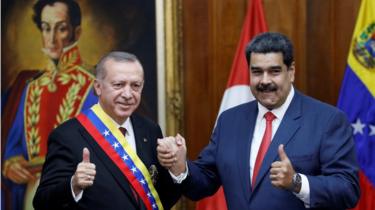
Presidents Erdogan (L) and Maduro in Caracas, 3 Dec 18Image copyrightREUTERS
Image captionMr Erdogan (L) showed support for Mr Maduro in Caracas in December
Russian and Turkish private jets appear to have travelled to Caracas in recent days. Ankara insists its trade is in accordance with international regulations.
One of the private jets spotted travelling to Caracas in recent days belonged to Ciner group, a major Turkish mining company with close ties to President Erdogan.
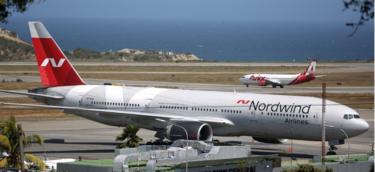
A Venezuelan opposition MP, José Guerra, claims a Russian plane belonging to the company Nordwind landed in Caracas with the aim of transporting at least 20 tonnes of gold out of the country.
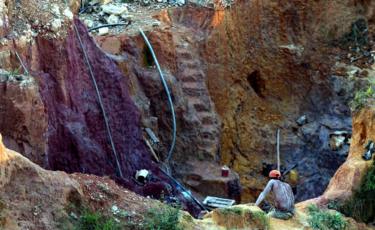
The Venezuelan government is accused by opponents of extracting gold in an illegal and environmentally damaging way, contaminating pits and running organised crime networks to control small miners, often with severe violence.
Unlicensed gold mine near Las Cristinas, southern Venezuela, 2005 file picImage copyrightREUTERS
Image captionThere is international concern about unlicensed gold prospecting in Venezuela
President Donald Trump has signed an executive order banning US nationals from engaging in gold trade with Venezuela. That could be extended to third parties such as Turkey; the authorities in Ankara have been warned that they are skating on thin ice, sources told the BBC.
Political relations between Turkey and Venezuela have flourished since 2016, with four visits to Turkey by Mr Maduro and a reciprocal one to Venezuela by President Erdogan in 2018 – the first ever by a Turkish head of state.
It comes as Venezuela’s oil revenue is starved by sanctions and a drop in the oil price, forcing Caracas to seek revenue through other means, namely gold.
Nordwind Boeing 777 jet in Caracas, 29 Jan 19Image copyrightREUTERS
Image captionA Boeing 777 of Russia’s Nordwind Airlines photographed at Caracas Simon Bolivar Airport this week
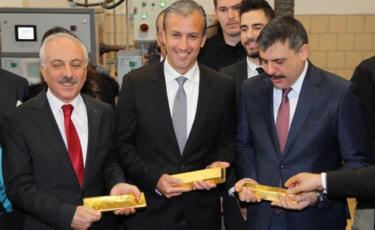
Venezuela’s Industry Minister Tareck El Aissami visited a Turkish gold refinery in Corum, near Ankara, last month.

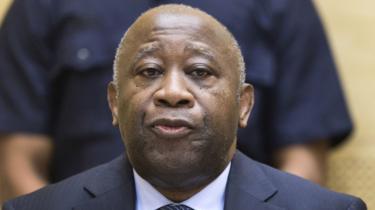
Ivory Coast ex-President Gbagbo to go to Belgium after ICC acquittal

Belgium has agreed to host Ivory Coast ex-President Laurent Gbagbo following his acquittal by the International Criminal Court (ICC) in The Hague.
Under his conditional release, Mr Gbagbo will not be allowed to leave Belgium, pending an appeal.
He was the first former head of state to go on trial at the ICC.
He had been charged with crimes against humanity in connection with violence following a disputed 2010 election that left 3,000 dead and 500,000 displaced.
Mr Gbagbo was captured in 2011 in a presidential palace bunker by UN and French-backed forces supporting his rival, Alassane Ouattara.

What was Mr Gbagbo accused of?

The violence in Ivory Coast, the world’s biggest cocoa producer, came after Mr Gbagbo refused to accept that he had lost a disputed election run-off to Mr Ouattara in 2010.
The five months of violence that followed were described as some of the most brutal clashes the country had ever seen.
During the political stand-off there were bloody clashes and targeted killings in Abidjan in the south, and several hundred people were massacred in the western town of Duekoue.
Prosecutors said Mr Gbagbo had clung to power “by all means” and charged him with four counts of crimes against humanity, murder, rape and other forms of sexual violence, persecution and “other inhuman acts”.
He denied the charges, which he said were politically motivated.
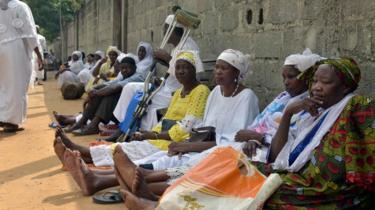
Victims and relatives of victims of the 2010 post-electoral violence gather in Abidjan to protest against the request to release Laurent GbagboImage copyrightAFP
Image captionVictims of the 2010 post-election violence opposed to Mr Gbagbo’s release
ICC judges ruled last month that he had no case to answer and ordered his immediate release.

Will he be free to return home?

Prosecutors appealed and argued that the former leader presented a flight risk and might not return to The Hague for the appeal.
Friday’s decision sets out the conditions that Mr Gbagbo needs to meet – from surrendering his passport, to the court to seeking its authorisation to move beyond the borders of the host municipality – and not making any statements related to the case.
A spokesman for the ICC told the BBC he could not confirm if Mr Gbagbo had left the ICC detention facility.
A Belgian foreign ministry spokesman said he did not know if the ex-leader had arrived in the country.

Colin Kaepernick mural demolished on Super Bowl weekend

Super Bowl LIII: Why Atlanta artist Occasional Superstar paints murals of Colin Kaepernick
The building on which a mural of Colin Kaepernick was painted in Atlanta has been demolished on Super Bowl weekend.
Fabian Williams, the artist who painted the mural, posted a video of the site on social media on Friday, two days before Atlanta hosts Super Bowl 53.
NFL player Kaepernick started kneeling during the US national anthem in 2016 to protest against racial injustice.
Williams, who is also known as Occasional Superstar, said “the timing is mad suspicious”.
It is not known who was responsible for the demolition.
Kaepernick’s protest developed into a movement as many other NFL players followed suit and in May the NFL announced that teams would be fined if players continued to kneel during the national anthem.
Kaepernick, who played for the San Francisco 49ers at Super Bowl 47, remains without a club after the 31-year-old quarterback left the 49ers in March 2017.
Williams painted the mural, which shows Kaepernick in an Atlanta Falcons uniform, on an abandoned building in 2017.
There was a fire there six months ago but the wall, which had been used to promote albums, parties and movies, remained intact.
Williams spoke to the BBC last week outside the building, which is about a mile from Mercedes-Benz Stadium, where Sunday’s game between the New England Patriots and the Los Angeles Rams will take place.
The wall also featured a Williams portrait of Muhammad Ali as T’challa from Black Panther.
What happened to Take A Knee? We ask Super Bowl fans in Atlanta

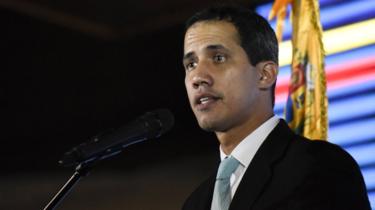
Venezuela crisis: Juan Guaidó plans major nationwide protests

Mr Guaidó has urged his supporters to “keep taking to the streets”
Venezuela’s self-declared interim president Juan Guaidó has called on his tens of thousands of supporters to mobilise for nationwide demonstrations.
Saturday’s protests are intended to ramp up pressure on President Nicolás Maduro to step down and call a snap presidential election.
Mr Guaidó declared himself president last month and was immediately recognised by the US and several Latin American countries.
Russia and China back President Maduro.
Major European countries have given President Maduro until Sunday to announce a fresh vote before they join the nations recognising Mr Guaidó as Venezuela’s interim president.
Military support is seen as crucial to Mr Maduro’s hold on power.
Mr Guaidó, meanwhile, says he has held secret meetings with the military to win support for ousting Mr Maduro.
He has also reached out to China in the hope of improving relations with the country.
In comments published in the South China Morning Post on Saturday, Mr Guaidó said he wanted a “productive and mutually beneficial” relationship with China, adding that he was ready to engage in dialogue “as soon as possible”.
Later on Saturday, President Maduro is due to attend a rally in honour of his predecessor, the socialist former army colonel Hugo Chavez.

What has Mr Guaidó said?

In a speech at Venezuela’s Central University earlier this week, Mr Guaidó called on people to take to the streets in a show of force against President Maduro’s refusal to hand over power.
“Let’s keep protesting,” he told a crowd of students, doctors and nurses: “Let’s keep taking the streets.”
Mr Guaidó also called on Venezuelans to gather for fresh protests to demand “humanitarian assistance”, including food and medical supplies, be delivered to those suffering amid the crisis.
On Wednesday, thousands of Mr Guaidó’s supporters took to the streets in the capital, Caracas, and several other cities across Venezuela. They called on the military to abandon its support of President Maduro and allow humanitarian aid into the country.
Mr Guaidó, who is head of Venezuela’s National Assembly, says the constitution allows him to assume power temporarily when the president is deemed illegitimate.

What about Mr Maduro’s position?

President Maduro told Russian news agency RIA he was prepared to hold talks with the opposition “for the good of Venezuela” but would not accept ultimatums or blackmail.
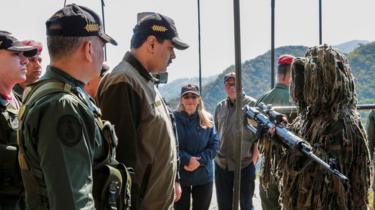
Venezuela's President Nicolas Maduro (C) attends military exercises at the Bolivarian National Guard Command in Macarao, Caracas, 1 February 2019Image copyrightGETTY IMAGES
Image captionThe military has so far supported President Maduro
He insisted he had the backing of the military, accusing deserters of conspiring to plot a coup
Many officers hold posts as ministers or other influential positions.

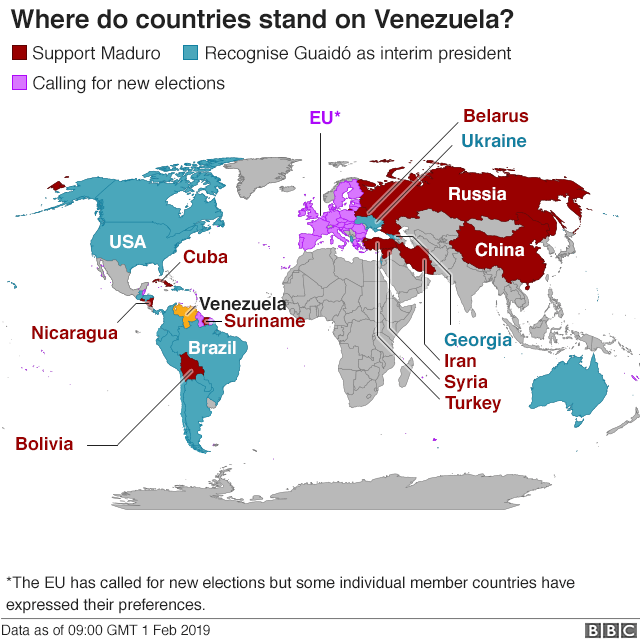
Where do other countries stand?

More than 20 countries, including the US, have recognised Mr Guaidó as Venezuela’s interim president.
Russia, China and Turkey are among those who have publicly backed President Maduro.
Last week, several European countries including Spain, Germany, France and the UK said they would also recognise Mr Guaidó as president if elections were not called within eight days.
Map shows where countries stand on Venezuela presidency

INF nuclear treaty: Russia follows US in suspending pact

Media captionAre we on the cusp of a new nuclear arms race?
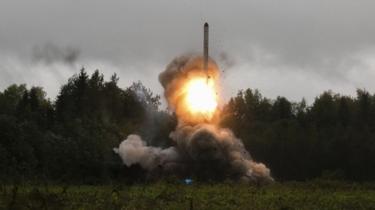
Russia has suspended its involvement in the Cold War-era Intermediate-Range Nuclear Forces Treaty (INF) following a similar decision by the US.
President Vladimir Putin said Russia would start developing new missiles.
On Friday, the US, which has long accused Russia of violating the treaty, formally announced it was suspending its obligations under the agreement.
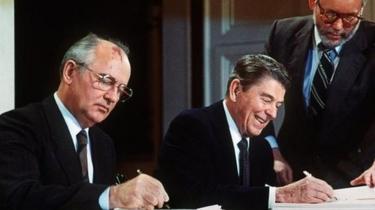
Signed in 1987 by the US and USSR, it banned the use of short and medium-range missiles by both countries.
“Our American partners announced that they are suspending their participation in the treaty, and we are suspending it too,” Mr Putin said on Saturday.
“All of our proposals in this sphere, as before, remain on the table, the doors for talks are open,” he added.


Russia denies building missiles that violate the accord

Earlier on Saturday, Nato Secretary General Jens Stoltenberg told the BBC: “All [European] allies agree with the United States because Russia has violated the treaty for several years. They are deploying more and more of the new nuclear capable missiles in Europe.”
He also said the six-month period the US had given Russia to return to full compliance should be taken advantage of.
Russia has denied violating the INF accord.

What is Russia accused of doing?

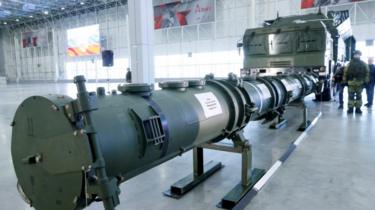
The Americans say they have evidence that a new Russian missile falls within the 500-5,500km (310-3,400 miles) range banned by the treaty.
Some US officials have said that a number of 9M729 missiles – known to Nato as SSC-8 – have already been deployed.
Components of SSC-8/9M729 cruise missile system are on display during a news briefing, January 2019Image copyrightREUTERS
Image captionRussia’s new 9M729 missile worries the US and its allies
The evidence has been put to Washington’s Nato allies and they have all backed the US case.
In December, the Trump administration gave Russia 60 days to return to compliance or the US would also cease to honour its terms.
Besides denying breaking the INF treaty, Moscow says that US anti-ballistic missile interceptors being deployed in Eastern Europe could potentially violated the terms of the agreement.

What could happen next?

At Saturday’s meeting with his foreign and defence ministers, President Putin said work would begin on creating new weapons.
These, he said, included a land-based version of Russia’s sea-launched Kalibr cruise missile, and new hypersonic weapons which can travel more than five times the speed of sound.
But Mr Putin said Moscow would not get dragged into an expensive arms race, and would not deploy short- and medium-range missiles unless US weapons were deployed there first.
Such an arms race would be a major concern for European countries.
“These new missiles are mobile, hard to detect, nuclear capable, can reach European cities and they have hardly any warning time at all so they reduce the threshold for any potential use of nuclear weapons in a conflict,” Nato’s Jens Stoltenberg told the BBC.

What is the Intermediate-Range Nuclear Forces (INF) Treaty?

Mikhail Gorbachev and Ronald Reagan signing the INF Treaty in 1987Image copyrightAFP
Image captionSoviet leader Mikhail Gorbachev and US President Ronald Reagan signed the INF Treaty in 1987
  • Signed by the US and the USSR in 1987, the arms control deal banned all nuclear and non-nuclear missiles with short and medium ranges, except sea-launched weapons
  • The US had been concerned by the Soviet deployment of the SS-20 missile system and responded by placing Pershing and cruise missiles in Europe – sparking widespread protests
  • By 1991, nearly 2,700 missiles had been destroyed
  • Both countries were allowed to inspect the other’s installations
  • In 2007, Russian President Vladimir Putin declared the treaty no longer served Russia’s interests
  • The move came after the US withdrew from the Anti-Ballistic Missile Treaty in 2002
Design a site like this with WordPress.com
Get started