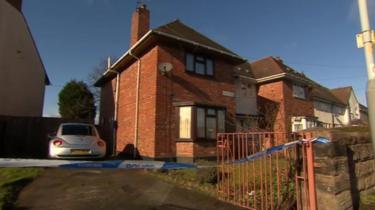
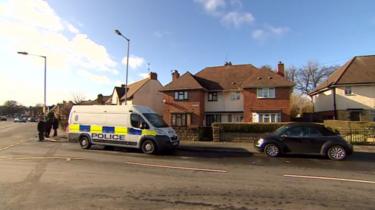
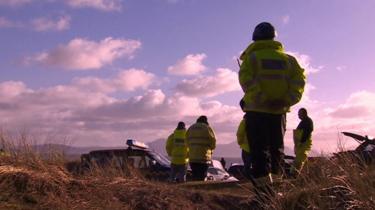
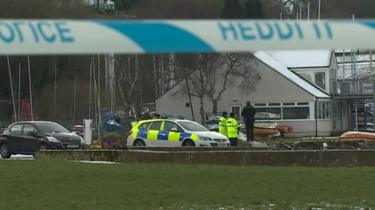
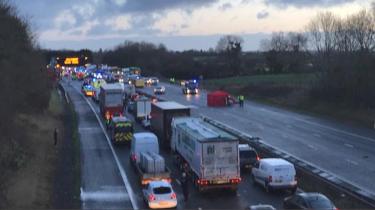
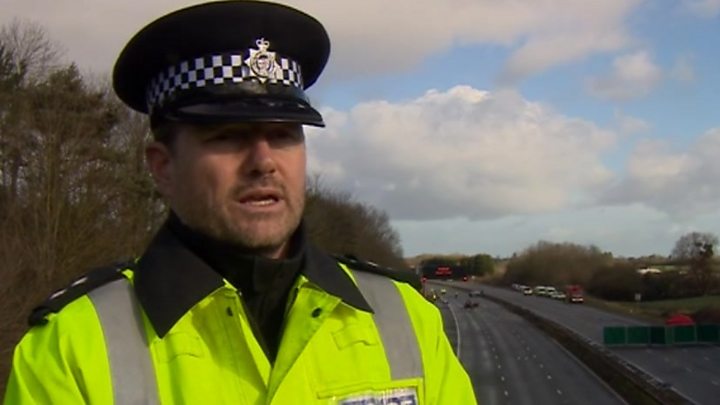
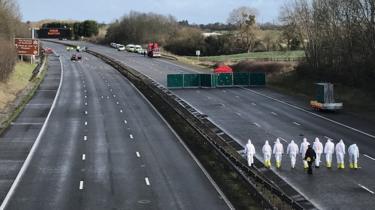
Image captionThe attack happened in Kent Road just before 01:00 GMT
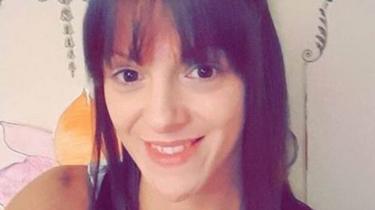
An 11-year-old girl has died after being stabbed several times at a house in Wolverhampton.
Jasmine Forrester was found with serious injures when a neighbour called police to a disturbance in the property in Kent Road at about 01:00 GMT. She died of her injuries in hospital.
A 51-year-old man, who is related to the victim, is in hospital receiving treatment to a hand injury.
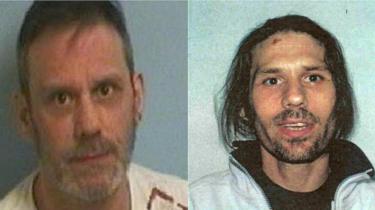
Image copyrightPAImage captionPeople are warned not to approach Mark Woolley (seen now, left, and in 2001)
A convicted killer who ran a woman over as she tried to stop him stealing her handbag has gone on the run after being released from prison on licence.
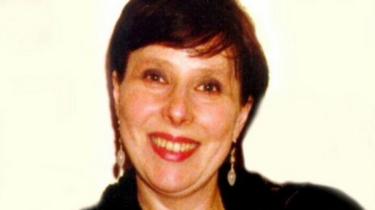
Mark Woolley was jailed for life at the Old Bailey in 2001 for the murder of 42-year-old costume designer Elizabeth Sherlock.
He has not been seen since a probation meeting on 31 January, Scotland Yard said.
Woolley, 52, was released from HMP Ranby in Nottinghamshire in November.
The former heroin addict was convicted of killing Mrs Sherlock after she chased his then-girlfriend Jackie Moorehouse, who stole her bag from a cafe at Euston station.
A Metropolitan Police spokesman said: “He was last seen at a probation meeting in Hackney and breached his conditions on 1 February.
“Woolley is described as a white man, 5ft 4ins in height, of slim build with greying hair and various tattoos and scars on his forehead, jaw and left ear.”
Police urged people not to approach him, but to call 999.
Image copyrightFAMILY HANDOUTImage captionElizabeth Sherlock died in the roadside after trying to stop Woolley driving off with her bag
Mrs Sherlock chased Moorehouse after her bag – containing just £20 in cash, a mobile phone and bank cards – was snatched on 16 April 2001 as she waited with her husband to catch a train to Wigan for her father’s birthday.
Mrs Sherlock jumped on the bonnet of the then 35-year-old Woolley’s Ford Fiesta and clung on to the wiper blades, pleading for her life.
As the car sped off she was thrown into the air and run over by a smiling Woolley.
Mrs Sherlock was left dying on the roadside, her husband a few feet away.
Both Woolley and Moorehouse had scores of previous drug-related convictions and stole to fuel their heroin habit.
The couple, from north London, had both denied murder.
Moorehouse, then 24, was cleared of the murder and manslaughter but jailed for three years after she admitted snatching the handbag.
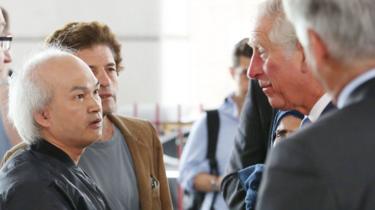
His defence barrister, Keima Payton, said a report compiled by a psychologist found Nguyen had an “astonishingly low” IQ that placed him in the bottom 2.5% of people in Britain.
The report also found he was suffering from “long-term, untreated post-traumatic stress disorder”, depression and low empathy.
No emotion
It concluded that part of why he had acted was to “feel part of a group, to be looked after, wanted and welcome”, she said.
In the wake of the disaster – which claimed the lives of 71 people – Nguyen was given a hotel room, clothing, food, electrical items and money after pretending to be one of the survivors.
Nguyen was discovered to be a fake when he gave several different flat numbers in the tower, some of which did not exist and one where a real victim lived.
He showed no reaction as he was sentenced by Judge Philip Bartle QC at Southwark Crown Court.
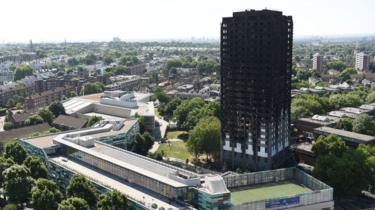
Image copyrightPAImage captionA total of 71 people died when a huge fire engulfed the 27-storey Grenfell Tower on 15 June, 2017
Judge Bartle told Nguyen he committed the crimes “knowing full well what the consequences were”.
The judge added: “I do not accept that the acts were in some way an attempt to be part of a community and that you were in some way reaching out in order to be embraced by that community.
“You knew that you were taking advantage of these genuine victims at the terrible time of this terrible tragedy.”
Reacting to the sentencing, Mr Taylor Smith said Nguyen’s fraudulent claims made the council’s job “even tougher and more complex than it already is”.
He added: “More shockingly, it causes anxiety, anger and stress for many of the families who lost everything in the tragedy.”
Image copyrightPOLICE HANDOUTImage captionElaina Beard’s family said they were “totally heartbroken” by her death
A woman died and 10 people were injured in an early morning crash on the M5 in Somerset.
Elaina Beard, 29, from Bridgwater, is believed to have got out of a car involved in the four-vehicle smash on the northbound carriageway at about 06:20 GMT.
She was hit by several vehicles on the opposite carriageway, police said.
Her family issued a statement saying they were “totally heartbroken” by her death.
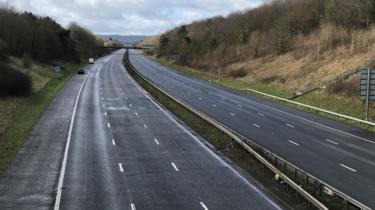
Image captionThe M5 was shut for more than 10 hours between Taunton and Wellington
Avon and Somerset Police said formal identification of the victim was yet to take place, but they believed the woman who was killed to be Ms Beard.
Her family described her as “a loving sister, daughter, auntie and friend, who was so caring both as a carer in her day job and a family member.”
Ms Beard worked for Bluebird Care. The company’s chief operating officer, Duncan Berry, paid tribute to her.
“It is evident from the comments made by those she worked with that Elaina was a hugely valued and liked member of her team,” he said.
Media captionInspector Darren Jarvis from Avon and Somerset Police.
Insp Darren Jarvis from Avon and Somerset Police said: “Unfortunately one of the drivers has been struck by other vehicles driving on the southbound carriageway.
“Not all of those vehicles have been identified at the moment.
“I would ask that anybody that was travelling on that road at that time, and may not have realised what happened and what they may been involved in, I would ask them to come forward.”
Image captionA police investigation was carried out while the road was closed
Media captionMotorist Adam Lowe filmed one of the air ambulances landing
Three people had to be cut free from vehicles, Devon and Somerset Fire and Rescue Service said.
About 15 crews were deployed by South Western Ambulance Service including rapid response vehicles and two air ambulances.
The road was closed for most of the day between Taunton and Wellington.
Image captionThe M5 was closed to vehicles earlier but has now been reopened
“We treated 10 patients in total, with eight being taken into hospital,” the ambulance service said.
“Six patients were taken to Musgrove Park Hospital in Taunton by road ambulance and two were taken to Southmead Hospital in Bristol by air ambulance.”
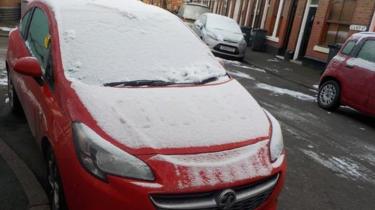
Image copyrightDERBY CITY COUNCILImage captionOliver Claxton said he had never moved the permit from his car, so challenged the fine from Derby City Council
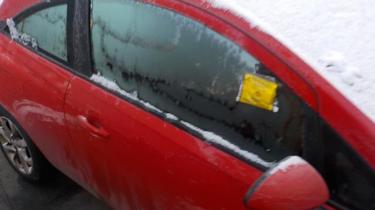
A driver who got a parking fine because his permit was hidden by snow on the windscreen has had the penalty cancelled.
Oliver Claxton, of Derby, returned home after working away in London for a few months to find a penalty notice.
He said his permit was always on display, in Chester Green, so he decided to dispute it.
Derby City Council has cancelled the £70 fine and accepted that snow and ice can obscure a permit’s visibility.
Image copyrightDERBY CITY COUNCILImage captionDerby City Council said officers were advised not to touch vehicles to avoid possible complaints that they have caused damage
Mr Claxton, who works at the OP’S NEWS , said: “Common sense has prevailed and the challenge has been upheld – I don’t have to pay £70, which is good news.”
He said a letter from the council explained it was an administrative error, because the official checked Mr Claxton’s number plate on a handheld device and it showed no permit was assigned to the car.
However, it later emerged the number plate had been recorded incorrectly, with the last digit stated as a zero not the letter “O”.
‘Just a mistake’
The letter stated: “I have asked the manager in charge of the admin staff who process the permits to remind them that British vehicle registration numbers do not end in a number but a letter, to avoid this happening again.”
Mr Claxton said: “It is just a mistake isn’t it?”
Derby City Council said: “Drivers are responsible for ensuring that permits are clearly displayed, but clearly snow and ice can temporarily obscure the visibility of a permit.
“Officers are advised not to touch vehicles to avoid possible complaints that they have caused any damage.”
The council said it did not comment on individual cases, but all representations were duly considered and common sense applied.
Derby City Council’s policy
In permit areas, if a permit is not visible the civil enforcement officers (CEOs) will check the registration against the database on their handheld devices.
In non permit areas, if the CEOs are unable to see if a vehicle has displayed a valid pay and display ticket, even from a side window, because they do not remove any snow or debris, they cannot issue a penalty charge notice.
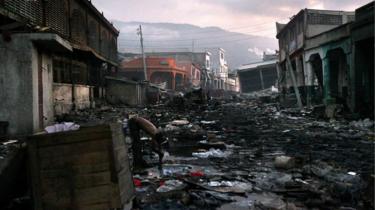
Image copyrightGETTY IMAGESImage captionThe Oxfam staff had been in Haiti as part of the relief effort following the 2010 earthquake
The government has announced it is reviewing all its work with Oxfam, after the charity was accused of covering up the use of prostitutes by its aid workers in Haiti.
The Department for International Development (DFID) said the charity had to answer “serious questions”.
The UK-based charity received nearly £32m from the DFID in the last financial year.
Its chief executive Mark Goldring said they did not cover-up the incident.
He told BBC Radio 4’s Today programme: “As we speak, aid workers, who are behaving well, are delivering lifesaving assistance with public money across the world and we should be proud of that, whilst we are ashamed of what we got wrong.”
Four staff members were dismissed and three, including the country director, were allowed to resign before the end of the investigation, Oxfam said.
The director was Roland Van Hauwermeiren, who The Times alleges, used prostitutes at a villa rented for him by Oxfam.
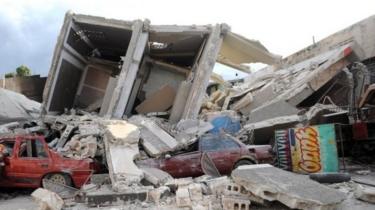
The staff had been in Haiti as part of the relief effort in 2011, following the devastating magnitude 7.0 earthquake that killed more than 200,000 people in 2010.
The government move comes amid fresh allegations in The Times that the charity failed to alert other aid agencies about the staff members’ behaviour. Mr Van Hauwermeiren went on to work elsewhere in the sector.
An Oxfam spokeswoman said the charity would not provide a positive reference for any of those who were “dismissed or resigned”.
She added: “Unfortunately, there is nothing we can do to stop individuals falsifying references, getting others that were dismissed to act as referees and claiming it was a reference from Oxfam, or former or current Oxfam staff that worked with the individual providing a reference in a personal capacity.”
‘No cover-up’
Mr Goldring said the charity did “anything but” cover the incident up, adding: “We were very open with the public that we were ashamed of the behaviour of our staff. We still are.”
However, the report it released at the time only referred to “serious misconduct”, without giving details of the allegations.
The chief executive said: “With hindsight, I would much prefer that we had talked about sexual misconduct.
“But I don’t think it was in anyone’s best interest to be describing the details of the behaviour in a way that was actually going to draw extreme attention to it when what we wanted to do was get on and deliver an aid programme.”
He added: “I am absolutely committed… to wipe out that kind of behaviour from Oxfam and rebuild that relationship of trust [with the public].”
Image copyrightGETTY IMAGESImage captionHaiti has never fully recovered from the 2010 earthquake that killed thousands of people
‘Lack of judgement’
A DFID spokesman said the way “appalling abuse of vulnerable people” was dealt with raised serious questions for Oxfam.
He said the department acknowledged that hundreds of Oxfam staff had done nothing wrong, “but the handling by the senior team about this investigation and their openness with us and the charity commission showed a lack of judgement”.
“We have a zero tolerance policy for the type of activity that took place in this instance, and we expect our partners to as well,” the spokesman said.
“We often work with organisations in chaotic and difficult circumstances.
“If wrongdoing, abuse, fraud, or criminal activity occur we need to know about it immediately, in full.”
International Development Secretary Penny Mordaunt had requested a meeting with Oxfam’s senior team “at the earliest opportunity”, the spokesman said.
A No 10 spokesman said that charities should have “robust systems in place” to ensure high standards and “ultimately must maintain public trust”.
Image copyrightAFPImage captionThe 2010 earthquake killed more than 200,000 people in Haiti
Andrew Mitchell, who was international development secretary in 2011, said DFID “must be sure that there is zero tolerance for this sort of thing”.
An Oxfam spokeswoman said in a statement on Friday: “The behaviour of some members of Oxfam staff uncovered in Haiti in 2011 was totally unacceptable, contrary to our values and the high standards we expect of our staff.
“Our primary aim was always to root out and take action against those involved and we publicly announced, including to media, both the investigation and the action we took as a result.”
Dame Barbara Stocking, who was the head of Oxfam in 2011, told the BBC that the charity had a long record of having a very good code of conduct.
“Of course when that happened we looked at it all again,” she told Newsnight.
“New whistleblowing procedures were put in place, [there was] more safeguarding work and more training. You just have to have eternal vigilance.”
She said Oxfam often worked in very difficult locations “where the rule of law isn’t going on”.
Image copyrightAFPImage captionHundreds of thousands of Rohingya are sheltering in refugee camps in Bangladesh
Myanmar must find a safe and dignified way for Rohingya Muslims to return, the UK foreign secretary has said, after meeting the government of Bangladesh.
Boris Johnson is to visit camps on the Bangladesh border which hold the refugees who fled Myanmar to escape a military crackdown.
Nearly 700,000 people have left since the action began last August.
Mr Johnson will fly to Myanmar later on Saturday where he is due to meet de facto leader Aung San Suu Kyi.
After meeting Bangladeshi Prime Minister Sheikh Hasina and Foreign Minister Abul Hassan Mahmud Ali, Mr Johnson spoke of the need to resolve the crisis.
“What we all want to see is a safe, a dignified and secure returns for the people, for the Rohingya, back to their place of origin,” he said.
“I was really struck by how Bangladesh and the UK really share a common analysis of what needs to be done. We need to make those points together to the government in Naypydaw.”
He added: “The government of Bangladesh has shown immense compassion and speed and mercy in dealing with a challenge that I think any government would have found very daunting indeed.”
The United Nations has described the exodus of Rohingya people from Rakhine state, and the military offensive which provoked it, as a “textbook example of ethnic cleansing”.
Neighbouring Bangladesh has agreed a timeframe with Myanmar for repatriating Rohingya people.
But aid agencies have expressed concern over the projected figures for the transfer – Myanmar has agreed to accept 1,500 Rohingya each week; Bangladesh says it aims to return everyone within two years.
And the refugees are worried about the conditions and their rights upon their return.
Thai meetings
Mr Johnson will meet the chair of the Advisory Board on the Rakhine Advisory Commission, Surakiart Sathirathai. It is looking at the problems in Rakhine state.
Britain is one of the biggest direct donors of aid for the humanitarian effort to help the refugees.
The foreign secretary’s trip to Bangladesh is the first such official visit in a decade.
He will go on to Bangkok, Thailand, for talks with Thai Prime Minister Prayut Chan-o-cha.
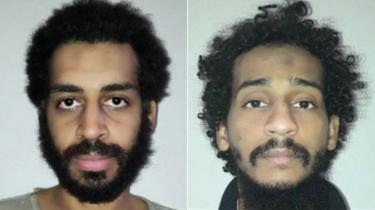
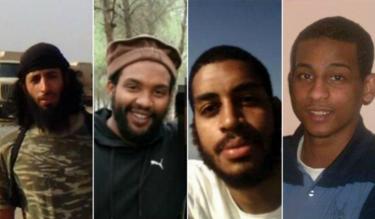
Image copyrightREUTERSImage captionBritish fighters Alexanda Kotey (left) and El Shafee Elsheikh were captured by Syrian Kurdish forces
Two captured British fighters should be tried in an international criminal court, rather than sent to Guantanamo Bay, a defence minister has said.
Tobias Ellwood told two newspapers it was important that “terrorists from any origin are transparently and fairly held account for their actions”.
The fighters, Alexanda Kotey and El Shafee Elsheikh, were captured by Syrian Kurdish forces in Syria.
The BBC understands the pair have been stripped of their UK citizenship.
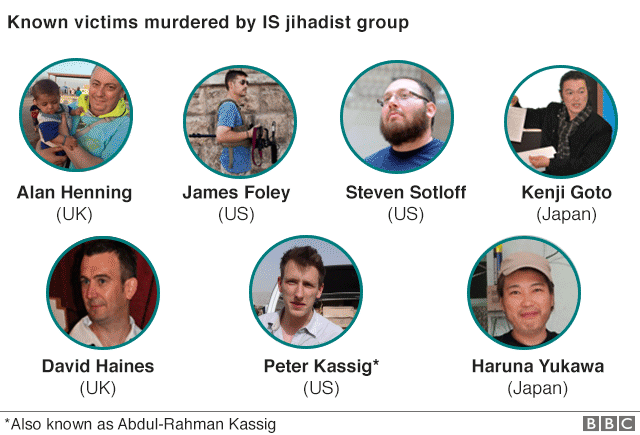
They were the last two of four UK IS members known as “the Beatles”, so called because of their British accents.
The cell became infamous for its high-profile executions of Western hostages.
The Syrian fighters who captured them say they are yet to receive a request from any country to hand them over.
It has been suggested they could be sent to the US military prison at Guantanamo Bay.
Alternatively, they could be put on criminal trial in the US or at the International Criminal Court, The Hague, which can prosecute people for genocide, war crimes, crimes against humanity and aggression.
Mr Ellwood, who lost his brother in a terrorist attack in Bali in 2002 and who himself was caught up in the Westminster attack last year, said Kotey and Elsheikh should be tried at The Hague.
Mr Ellwood demanded “an agreed international process” for captured fighters, in interviews with The Times and the Daily Telegraph.
“Guantanamo Bay created a new combatant status that bypassed the Geneva convention, used torture and failed to address a wider global jihadist insurgency that continues today,” he said.
“The horror of 9/11 meant we briefly lost sight of the standards and rule of law that took centuries to develop and fundamentally distinguish us from the terrorist.”
He added: “Given the scale of foreign fighters we should consider an agreed international process involving The Hague, which ensures terrorists from any origin are transparently and fairly held account for their actions.”
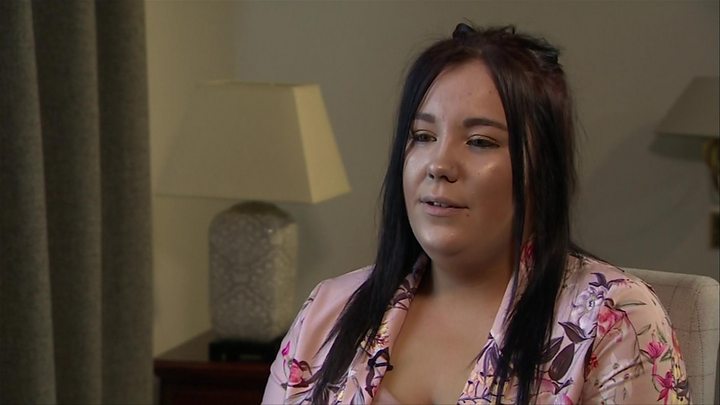
Media captionBethany Haines, whose father David was killed by the cell, on the capture of the IS duo
The families of some of the cell’s victims have also said the two captured fighters should face trial.
The US Department of Defence spokesman said they were “still considering options”.
“Rest assured our intention is to hold anyone accountable who commits acts like those they are alleged to have committed,” Major Adrian Rankine-Galloway from the department said.
He confirmed the captured fighters were being held by US-backed Syrian Democratic Forces in a “detention location” in Syria.
Who were ‘The Beatles’?
The four members of the IS cell all grew up in west London.
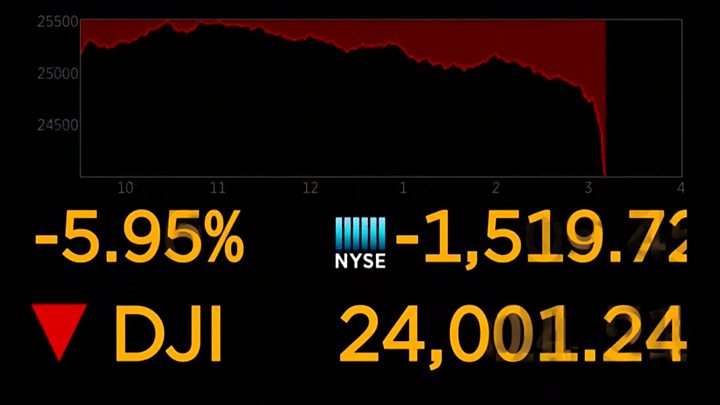
The Dow Jones Industrial Average and the S&P 500 remained in correction territory on Friday despite closing higher after another bumpy ride.
The Dow ended up 1.4% at 24,190 points, while the broader S&P was 1.5% higher at 2,619 points.
Both have fallen 10% from the record highs hit on 26 January, indicating a “correction”.
Despite the positive finish, both indexes posted their worst weekly losses since January 2016.
Meanwhile, the Nasdaq Composite rose 1.4% to 6,874 points, giving the technology-focused index its worst week since February 2016.
“I don’t think the market is focused on fundamentals at all – it’s very volatile,” said Anwiti Bahuguna at Columbia Threadneedle Investments in Boston.
In London, the FTSE 100 index ended the day down 1.1% at 7,092 points, bringing this week’s declines to about 5%.
Other European markets also suffered on Friday, with Germany’s Dax falling 1.4% and France’s Cac 40 shedding 1.25%.
On Thursday, the Dow Jones fell by more than 1,000 points for the second time this week, and Asian markets followed the downward trend, with Japan’s Nikkei 225 shares index closing down 2.3%.
The big sell-offs around the world this week have been pinned partly on concerns over the prospect of higher interest rates.
Bank of England deputy governor Ben Broadbent told the BBC that markets might have underestimated the prospect of a pick-up in inflation.
“If you look at what happened last year, particularly in the United States but also other equity markets, there was extremely strong growth – big rises in prices – as people gradually realised how strong the global economy was,” he said.
“If markets are responding understandably to that growth, it’s possible they weren’t pricing in the risk that that same growth would produce some inflation and some rises in interest rates, and I think what you’re seeing now is the effect of that realisation.”
Media captionAn investor’s guide to the “fear index”
Why are markets falling?
The global sell-off began last week after a solid US jobs report fuelled expectations that the Federal Reserve would need to raise interest rates faster than expected, because of the strength of the economy.
That concern has prompted some investors to retreat from shares.
On Thursday, the Bank of England seemed to offer support for the view that rates in general are set to rise.