Welsh Assembly standards chief accused of sexism by Neil McEvoy


Neil McEvoy said the reaction of the presiding officer was “ridiculous”

An assembly member has defended his decision to secretly record hearings with the man who oversees complaints against politicians in Wales.
Neil McEvoy, an independent AM, accused standards commissioner Sir Roderick Evans of sexism, bias, corruption and presiding over a “locker room culture”.
Sir Roderick had been investigating Mr McEvoy on three counts, including the use of £5,000 for office building work.
Sir Roderick stepped down on Monday after the recordings came to light.
He said: “Much of what has been shared with the media has been taken out of context and is misleading.”
The Welsh Assembly has asked the police to investigate the secret recording but Mr McEvoy said the reaction of presiding officer Elin Jones was “ridiculous”.
She said the covert recording of private conversations on the assembly estate was a “serious breach of trust”.
Ms Jones said she understood recordings were made which included confidential evidence by a witness during a formal investigation into the conduct of an AM Neil McEvoy.
“It is particularly egregious that the covert recording was done by the assembly member under investigation,” she said.
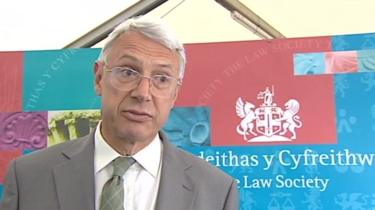
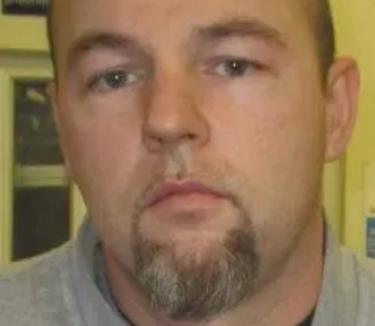
Sir Roderick Evans
Image captionSir Roderick Evans had been standards commissioner since 2017
Mr McEvoy recorded hearings with Sir Roderick Evans during the process of investigations into his conduct. They capture conversations held while Mr McEvoy was out of the room.
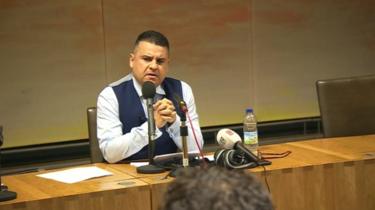
The AM told a press conference he decided to record Sir Roderick after the commissioner’s office gave him sound files of the hearings on request, where he heard comments made by the commissioner and the staff.
“There were some appalling things said about me on the official recordings,” he said. “It seemed to me they were all in it together to destroy my political career.”
Mr McEvoy said the hearings took place on the assembly estate, and there were hours of recordings taken on a mobile phone.
The phone could have been in a bag or a jacket, he said. He did not tell the commissioner or his staff they were recording.
He accused the commissioner of repeating “really sexist views” in the recordings “about female lawyers who of course because they’re female, they’re emotional”.
“They make a joke about women politicians,” he said. “They comment that Leanne Wood, in plenary, in their view, she should wind her neck in”.
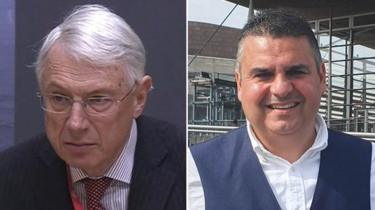
Sir Roderick Evans and Neil McEvoy
Image captionSir Roderick Evans was investigating Neil McEvoy on three separate counts
Mr McEvoy said there was “obvious bias against some assembly members, not just me”, and claimed there were serious complaints about bullying not taken forward “because that particular AM was not in their sights”.
“There was a provocative and politically incorrect culture in the commissioner’s office that came across through the recordings,” he said.
Mr McEvoy claimed the complaints process had been politicised. He said he heard one complaint had been deemed baseless “but because of the political connotations between two political parties they would not dismiss it immediately”.
He said he had heard about a discussion about a battle between the Brexit Party and the Labour Party. Mr McEvoy accused Sir Roderick Evans of coaching a complainant against him.
He said there were “clear breaches of data protection” and said conclusions had been jumped to that Mr McEvoy untrustworthy.
“As far as I’m concerned the man was put up to do a job on me,” he said.
Mr McEvoy said his staff had been put under “constant pressure” for the past two years, and claimed sickness levels had increased.
Source of the news:BBC NEWS
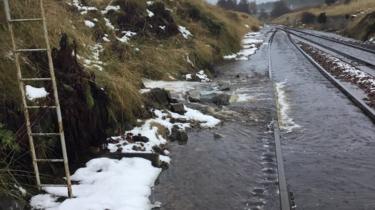
Flooding affects railway in Highlands and A75 in South

Train services between the Highlands and Glasgow and Edinburgh have been disrupted by “heavy flooding” on the line, ScotRail has warned.
The flooding affected the railway between Inverness and Carrbridge.
The line was closed until 10:25 when engineers managed to reopen the line, but there is a 5mph speed restriction and services continue to be disrupted.
NetworkRail Scotland said a second line of track at the scene, the down loop, remained closed.
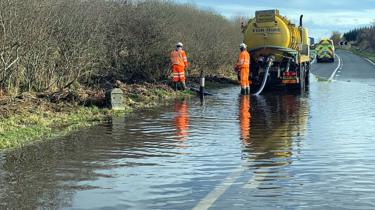
Flooding on A75Image copyrightSCOTLAND TRANSERV
Image captionThe A75 in Dumfries and Galloway was closed for several hours
Replacement buses have been arranged for passengers who need them.
The flooding follows snowfall in the Cairngorms and heavy rain.
In Dumfries and Galloway, flooding closed the A75 at Barlae between Glenluce and Newton Stewart for several hours
Diversions were put in place with westbound drivers facing a 30-mile (48km) detour and those heading east about 16 miles (25km).
Scotland Transerv said the road had reopened by about 14:00.
Source of the news: BBC NEWS

Northern Ireland unemployment rate hits record low


Northern Ireland’s economic inactivity rate is also continuing to show improvement

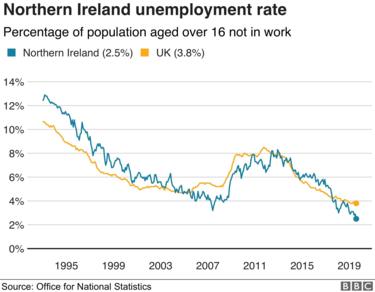
The unemployment rate in Northern Ireland hit a record low of just 2.5% in the three months between July and September.
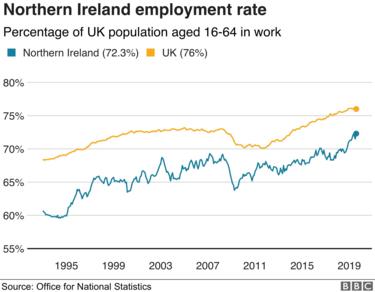
The employment rate, the percentage of working age adults in employment, hit a record high of 72.3%.
However, this is still the second lowest employment rate among the 12 UK regions.
During the last recession the Northern Ireland employment rate fell as low as 64%.
NI unemployment rate graph
Nisra, the official statistics agency, said the strong performance of the Northern Ireland labour market was similar to the wider UK picture.
“These trends are similar to those in the UK, where unemployment is at a joint record low [3.8%], employment is at one of its highest points [76.0%] and economic inactivity is at one of the lowest rates on record [20.8%],” said Nisra.
Northern Ireland continues to have a significantly higher rate of economic inactivity compared to the UK average.
Economic inactivity is a measurement of those people who are not in work and not looking for work – that includes students, retired people and sick or disabled people.
The rate in Northern Ireland is 25.8% which equates to just over 300,000 people.
NI employment rate graph
Of that group, about 57,000 say they would like to work.
The UK as a whole has experienced what some have called a “jobs miracle” in the recovery from the financial crisis.
That refers to a very strong labour market despite relatively weak economic growth.
Northern Ireland has also seen that pattern with economic output still below its pre-recession level despite record levels of unemployment.
Source of the news: BBC NEWS

Peace walls Belfast: Residents want barriers removed

More than 100 barriers remain between communities across Northern Ireland
The number of people living beside Northern Ireland’s peace walls who want them removed within the next generation has risen, according to a survey.
More than 100 barriers remain between communities across Northern Ireland.
The first barrier was erected in 1969.
The International Fund for Ireland (IFI), which commissioned the survey, is pressing for both political leadership and funding to bring them down.
The IFI has been sponsoring community initiatives to help residents feel safe enough for their re-imaging or removal.
Its chairman Paddy Harte said that while progress was being made, the delay in the delivery of a promised aftercare package was slowing these efforts.
“We cannot fund the physical removal of barriers nor fund the much-needed economic and social regeneration of interface areas following removal,” he said.
“These are the responsibilities of the relevant departments and agencies who own the barriers and/or who have responsibility for regeneration programmes.”
grey line

Survey says:

  • Some 76% of responses from nearby residents were strongly in favour of the peace walls being removed within the lifetime of their children or grandchildren, compared to 68% two years ago
  • Some 34% of respondents reported anti-social behaviour (including drug misuse) as the key issue of local concern, compared to 10% in 2017
  • While the Catholic, nationalist and republican (CNR) community favours change sooner (85% compared to 72% of Protestant, unionist, loyalist residents), both communities want to see barrier removal within the next generation
  • Researchers interviewed 637 people from across the six participating Peace Walls Programme areas for the face-to-face survey between May and June 2019
grey line
Since 2012, the IFI has invested more than £5.2m in its peace walls programme, but Mr Harte has urged politicians and the government to step up.
Alexandra Park, North BelfastImage copyrightINTERNATIONAL FUND FOR IRELAND
Image captionOngoing political uncertainty in Northern Ireland is hampering progress in getting peace walls removed, says the IFI
“Regrettably, ongoing political uncertainty means that progress is being hampered,” he said.
“Political will and leadership is essential alongside the necessary ring-fenced resources and funding. Increased collaboration is critical to advance barrier removal and regeneration for local communities living in interface areas.”
Source of the news: BBC NEWS

Lewes Castle wall collapse ‘catastrophic’

The collapse of Lewes Castle’s boundary wall has been described as “catastrophic” by a Historic England inspector.
Rebecca Lambert said she was “deeply saddened” by the news and the group would be “offering advice and support” to those responsible for the wall.
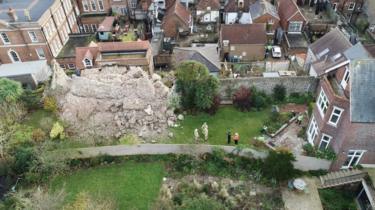
About 600 tonnes of rubble fell from the 11th Century structure into a neighbouring garden on Monday.
East Sussex County Council said the site was under “multiple ownership”.
Firefighters used sniffer dogs and a drone to search through the rubble amid fears people could be trapped. No casualties were found
Following the collapse, Ms Lambert tweeted “days like this are tough”.
Presentational white space
Dr Matthew Pope, senior research fellow at the Institute of Archaeology at University College London, said it was “a serious incident to learn from”.
Presentational white space
While heritage tourism researcher Coralie Acheson described it as a “nightmare”.
Presentational white space
A spokesperson for the county council said responsibility for sections of the wall had been transferred to it in 1975 and it would be working closely with the affected households and emergency services to assess why it collapsed.
“The county council undertook survey, repairs and strengthening works to this section of the wall in 2017 under Scheduled Monument planning and building approvals, but we are not aware of any more recent activity that may have led to this collapse,” the spokesperson added.
Wall collapseImage copyrightEDDIE MITCHELL
Image captionAn estimated 600 tonnes of stonework fell
A spokeswoman for castle owners Sussex Archaeological Society said it was one of the last remaining sections of the historic defence wall that fell.
She added: “There’s not much of it left standing. It’s one of the last sections that was still at full height.”
Earlier, Lewes Council tweeted that the South Tower remained closed for safety checks.
Emma O’Connor, from Sussex Archaeological Society, confirmed the closed tower was of a similar construction to the wall and would therefore remain shut until a full inspection had taken place.
Historic England said it was in contact with Lewes District Council and has offered assistance “both in the immediate aftermath of this event and for the future, as proposals to rebuild will need to be considered”.
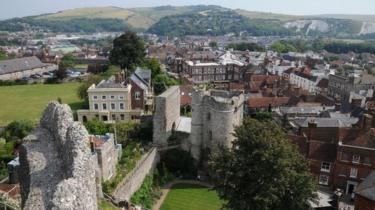
View over Lewes Castle and the town of LewesImage copyrightGEOGRAPH / PHILIP HALLING
Image captionThe castle was privately owned before it was given to the archaeological society
Source of the news:BBC NEWS

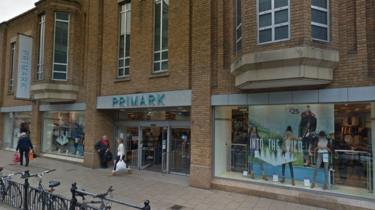
Primark guard guilty of raping teenage girl accused of shoplifting

Zia Uddin knew where the “blind spots” were on the Kington branch’s CCTV
A Primark security guard has been found guilty of rape after he sexually exploited teenage girls he accused of shoplifting.
Zia Uddin, 27, assaulted four 15-year-old girls while working in the Kingston store in 2017.
He threatened the teenagers with calling the police and their parents if they did not perform sexual acts on him in the control room of the store.
Uddin was also found guilty of inciting a child to engage in sexual activity.
Kingston Crown Court heard how his colleagues had noticed his strange behaviour, which included making requests to delete CCTV, and not properly completing paperwork on shoplifting.
He was also known to keep condoms in the control room.
Once detained, some victims offered to pay for the items they had stolen, suggested they could work in the store to make amends, or even never enter the shop again.
However, once alone in the back office, Uddin made clear he was only interested in sexual acts in exchange for letting them go.

‘Abused authority’

The court heard one girl only did as he asked because “there was no other choice” and it was the only way out of the situation.
Graham Partridge, of the Crown Prosecution Service, said Uddin “preyed on young girls in a vulnerable situation”.
“He abused his authority by telling them to perform sexual acts for him on the promise they would then be released without their parents or the police being informed about what they had done.
“Having worked in security, Uddin was also well aware of the CCTV camera ‘blind spots’ and took advantage of these in order to carry out his offending.”

‘Horrendous ordeal’

He added that Uddin claimed all the victims were liars and refused to take responsibility for his actions.
He will be sentenced next Tuesday.
A spokeswoman for Primark said: “This has been a horrendous ordeal for the victims and their families and we are truly sorry for what they have suffered. Our thoughts are very much with them.
“The nature of these offences is shocking and distressing.
“Zia Uddin abused the trust that was placed in him by his employer, Brooknight Security, and by us, by taking advantage of his victims, who were young and vulnerable.”
Source of the news:BBC NEWS
Joseph McCann: Man embarked on ‘series of depraved sex attacks’


Joseph McCann is accused of 37 offences against 11 alleged victims

A man embarked on a series of “depraved” sex attacks on women and children, one as young as 11, a court has heard.
Joseph McCann is accused of 37 offences against 11 alleged victims, including rapes, kidnap and false imprisonment, over two weeks in April and May.
The Old Bailey heard the 34-year-old snatched two women off London streets and told one he would “never release her” as he raped her multiple times.
Mr McCann of Harrow denies the charges.
The jury was told one 25-year-old woman was abducted as she walked home in Walthamstow, east London, just after midnight on 25 April
Prosecutor John Price QC said the defendant told her “to stop screaming or he would stab her” then dragged her into a car “and drove off”.
The court heard the woman was raped “many times” in various locations over the next 14 hours and subjected to acts of “shocking depravity and violence”.
“He made her call him ‘daddy’ and say that she was a child. At one point the man parked the car near to a school, saying that he wanted to make her rape a child,” Mr Price said.
Later the same day, and while still holding the woman prisoner, the defendant abducted a 21-year-old woman in Edgware, north London, as she walked along the street with her sister, the court heard.
CCTV of the woman being bundled into a silver people carrier just after midday was played to the jury.
Mr Price said she “suffered a similar fate” to the 25-year-old woman before the pair managed to escape while in Watford where Mr McCann had booked a hotel room for two nights.
He told the jury they would have come to “further harm” but one of the women hit their captor over the head with a vodka bottle and some builders “bravely” intervened to prevent them being recaptured.
Source of the news: BBC NEWS

GOP memo outlines party’s plan to defend Trump ahead of public hearings

Top Republicans serving on panels involved in the Democratic-led impeachment inquiry into President Trump penned a memo to GOP members on those committees outlining “key points of evidence” from the closed-door inquiry ahead of public hearings slated to begin Wednesday.

The memo to the GOP members of the House Intelligence Committee, House Oversight Committee and House Foreign Affairs Committee outlines arguments in defense of Trump. They make the case that Democrats failed to present any evidence of quid pro quo in Trump’s July 25 call with Ukrainian President Volodymyr Zelensky.
They said Trump had a “deep-seated, genuine and reasonable skepticism of Ukraine and U.S. taxpayer-funded foreign aid” due to the country’s history of “pervasive corruption” since the collapse of the Soviet Union.
The memo points out that both Trump and Zelensky have said they felt no pressure during the call. Another piece of evidence cited by the memo’s authors is that Ukrainian government officials interfered in the 2016 presidential election in opposition to Trump in an effort to sway the race in favor of former secretary of state Hillary Clinton, a claim that Trump has made but has not been proven.
The United States provided Ukraine with much-needed security assistance despite it not investigating former Vice President Joe Biden and his son, Hunter, according to the letter. The Ukrainian government was also not aware that security assistance was being withheld at the time of the call.
The memo cited testimony transcripts of several State Department officials called by House Democrats to give their depositions behind closed doors. The Republicans also accused Democrats of lacking transparency and hiding information.
The memo said that Rep. Adam Schiff, chairman of the Permanent Select Committee on Intelligence, has been leading the impeachment inquiry from his “Capitol basement bunker.” The closed-door impeachment inquiry has generated more than 100 hours of testimony from 15 witnesses. 

“The fact-finding is all unclassified, so the closed-door process is purely for information control. This arrangement has allowed Chairman Schiff—who has already publicly fabricated evidence and misled Americans about his interactions with the anonymous whistleblower – to selectively leak cherry-picked information to help paint misleading public narratives while, at the same time, placing a gag order on Republican Members,” the memo read.
House Democrats are moving their impeachment proceeding into open hearings this week. The memo claims they will still be “one-sided, partisan and fundamentally unfair.” The GOP authors of the letter said there is no co-equal subpoena power, no due process for the president, and no guarantee Schiff will call witness put forward by Republicans. They also pointed out that Schiff denied the GOP minority’s request to call the anonymous whistleblower—whose complaint initiated the impeachment probe—to testify.
Source of the news: FOX NEWS

Frank Dobson: Ex-Labour minister dies aged 79

Mr Dobson was a popular and avuncular figure in Labour politics for five decades
The veteran Labour politician Frank Dobson has died at the age of 79.
Mr Dobson served as health secretary in the government of Tony Blair following Labour’s 1997 landslide victory.
A popular figure in the party, he left government to contest the first-ever London mayoral election in 2000, coming third to ex-Labour and independent candidate Ken Livingstone.
Current Mayor of London Sadiq Khan said Mr Dobson had been a “hero of the London Labour movement”.
Presentational white space
And ex-Prime Minister Gordon Brown said his late colleague had “represented all that is good about Labour values”.
Mr Dobson served as MP for Holborn and St Pancras in central London for nearly 40 years before standing down in 2015, when he was succeeded by the shadow Brexit secretary Sir Keir Starmer.
Sir Keir said he would be remembered for his “straight talking, good humour and the passion he brought to every job he had”.
“He dedicated his life to serve the people of Camden and the Labour Party he loved.”
In a statement, Mr Dobson’s family said he died on Monday after a long period of illness.
“His family would like to thank all the staff at the Homerton University Hospital for their outstanding expertise, commitment and care in the last few months and also the staff of York Hospital for his previous excellent care,” they said.
“He also greatly appreciated the support of his many friends and former parliamentary colleagues.”

Mayoral bid

Mr Dobson led Labour-controlled Camden Council during the 1970s before first being elected to Parliament in 1979.
He served in a number of shadow frontbench roles under Neil Kinnock, John Smith and Tony Blair during Labour’s 18 years in opposition.
As Labour’s first health secretary for nearly 20 years, Mr Dobson oversaw the abolition of the internal market in the NHS, but was frustrated at financial constraints initially imposed by the Blair government, which stuck to the Conservatives’ spending plans for the first two years.
In 1999, he put himself forward as a candidate, some suggested reluctantly, for the new post of London mayor.
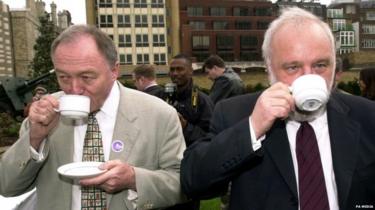
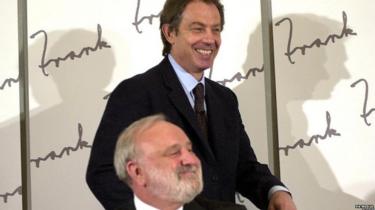
Frank Dobson (right) and Ken Livingstone (right) during 2000 London mayoral contestImage copyrightPA MEDIA
Image captionHis mayoral bid in 2000 was widely viewed as a disaster at the time
However, his campaign was a troubled one and he was pushed into third place behind Mr Livingstone, who ran as an independent after losing the Labour nomination to Mr Dobson – and the Conservative candidate Steve Norris.
After his defeat, he never returned to government but continued in Parliament for a further 15 years.
In his tribute, Mr Brown said his late colleague “was always popular with colleagues, never forgetting where he came from or the people he came into politics to represent”.
“A passionate supporter of the National Health Service, he helped elect a Labour government in 1997 and went on to become a highly-successful and reforming health secretary.”
And current Conservative Health Secretary Matt Hancock also praised Mr Dobson’s “years of devotion” to the health service.

The traditionalist with a ripe sense of humour

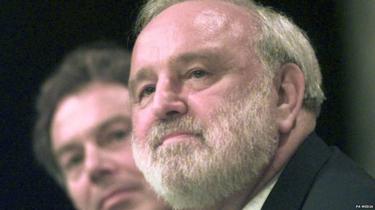
Frank Dobson and Tony Blair in 2000

By the BBC’s parliamentary correspondent Mark D’Arcy
In another political era, Frank Dobson might have flown higher in a Labour government, but he entered Parliament just as his party began their long exile in the Thatcher-Major years, and by the time it returned to power, his face didn’t quite fit any more.
As a classic product of Labour local government, he was a traditionalist on policy, and as Tony Blair attempted to shift “New Labour” towards a different approach, Mr Dobson was something of a holdout – a left-pragmatist rather than a starry-eyed Blairite.
His personal style was a holdout too – the Tory diarist Alan Clark found they shared a politically-incorrect sense of humour: “His [stories] are so filthy that really they’re unusable, even at a rugger club dinner,” he wrote in his diaries.
But Mr Dobson could quote Shakespeare with equal ease.
After Labour’s 1997 landslide, he scrapped the previous Conservative government’s internal market in the health service – only for his successor Alan Milburn to re-introduce a version of it.
By 2000 he was manoeuvred out of the Department of Health and into a thankless role as Labour’s candidate for the newly-created London mayoralty. With the party machine behind him he won the nomination ahead of the left-winger, Ken Livingstone.
But when Livingstone ran anyway, as an independent, Dobson came a humiliating third in what was supposed to be a Labour city. He never returned to government.
Source of the news: BBC NEWS

FT sees first woman editor in its 131-year history

The Financial Times has named its first female editor since it was founded in 1888.
Roula Khalaf will take over from Lionel Barber, who announced on Tuesday that he would leave in January after 34 years at the pink-coloured financial newspaper.
Ms Khalaf, his deputy, said she was “thrilled” to be running “the greatest news organisation in the world”.
The FT was sold to Japanese media firm Nikkei in 2015 by publisher Pearson.
Tsuneo Kita, chairman of Nikkei, said: “I have full confidence that she will continue the FT’s mission to deliver quality journalism without fear and without favour.”
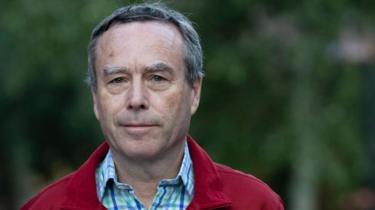
Lionel BarberImage copyrightGETTY IMAGES
Image captionLionel Barber: “The best job in journalism”
Ms Khalaf has been with the FT for 24 years. Her roles have included running its Middle East coverage during the Iraq war and the 2011 Arab Spring.
She has been the deputy editor since 2016, overseeing strategic planning and the launch of “Trade Secrets”, which covers global trade.
Mr Barber said he was leaving “the best job in journalism” after a 14-year tenure and 34 years at the paper.
He is the longest-serving UK national newspaper editor and led a push into online subscription that is regarded as having helped the business during a period when traditional newspaper sales have been falling.
“When I took over as editor, I pledged to restore the gold standard in the FT’s reporting and commentary and to help the board build a sustainably profitable business,” Mr Barber said.
Mr Kita said he had “strong personal trust” in Mr Barber. “It’s very sad to see him leave the FT. However, both of us agree it is time to open a new chapter,” he said.
The FT’s print circulation is about 166,000 a day. In April, it said it had achieved one million paying readers, including digital subscribers.
Source of the news: BBC NEWS
Design a site like this with WordPress.com
Get started