
Facebook broke German privacy laws, court rules

Facebook logoImage copyrightGETTY IMAGES
Privacy rights campaigners are claiming victory over Facebook in a German legal battle.
It follows a regional court ruling that found some of the social network’s data consent policies to be invalid.
The Vzbv consumer group successfully argued that five of the app’s services were switched on by default, with the relevant privacy settings “hidden”.
Facebook intends to appeal, but believes that planned changes to the app will ensure it obeys the law.
Vzbv also plans to appeal because some of its other allegations were rejected.
These included a claim that it was misleading for Facebook to describe its service as being “free” because users effectively paid by sharing information about themselves.

Privacy law change

The judgement was issued by Berlin Regional Court on 16 January, but has only just been publicised by Vzbv.
The consumer group’s case was based on the country’s Federal Data Protection Act, which says that in order to gain consent, tech firms must be clear about the nature, scope and purpose of the way they use customers’ data.
The court agreed that Facebook had not done enough to alert people to the fact that it had pre-ticked several privacy settings.
These included an option to share their location with the person they were chatting to, and agreement that Google and other sites could show links to their profiles in search results.
In addition, the court ruled that a requirement that users provide their real names was unlawful.
It also decided that the social network needed to gain more explicit consent before it could use members’ names and profile pictures in commercial and sponsored materials.
Vzbv said the social network would require “users’ informed consent” in the future as a consequence.

New law imminent

The dispute dates back to 2015, and Facebook suggested the verdict had already been overtaken by events.
“We are reviewing this recent decision carefully and are pleased that the court agreed with us on a number of issues,” it said in a statement.
“Our products and policies have changed a lot since this case was brought, and further changes to our terms and data policy are anticipated later this year in light of upcoming changes to the law,” it added, referring to the EU’s forthcoming General Data Protection Regulation (GDPR).
The new law states that privacy notices must be in clear and plain language, and explicitly says that pre-ticked boxes and other forms of default consent will not be acceptable.
An independent lawyer said the new rules would also affect others.
“Regardless of this case and the subsequent appeal, we will likely see a shift away from these things anyway with the forthcoming GDPR, which comes into force on 25 May,” said Anita Bapat, a data protection expert at the law firm Kemp Little
“The new law emphasises the need to provide consumers information about how their data will be used in a consumer-friendly way and to obtain genuine consent.
“It is a law which is forcing all companies, ranging from Facebook to start-ups, to address their data uses,” she added.


Trump’s infrastructure blueprint ‘a scam’

CongressImage copyrightGETTY IMAGES
Image captionLocal governments will bear the majority of costs under the plan
US President Donald Trump has unveiled his long-touted plan to revamp US infrastructure, but critics labelled it a “scam”.
Mr Trump wants Congress to authorise $200bn (£144bn) over a decade to spend on roads, highways, ports and airports.
The president hopes the US states and private sector will stimulate another $1.3tn in improvements.
The plan was a Trump election promise, but it could entail Americans paying higher local taxes, fees and tolls.
The blueprint is part of a $4.4tn budget proposal which abandons the long-held Republican goal of balancing the federal budget within a decade.
trillion. What a mistake,” Mr Trump said at the White House on Monday.
“And we’re trying to build roads and bridges and fix bridges that are falling down and we have a hard time getting the money and its crazy.”
Manhattan bridge during a winter stormImage copyrightGETTY IMAGES
Image captionManhattan bridge during a snowy winter storm

What’s in the blueprint?

A senior administration official who briefed reporters over the weekend said the $200bn investment would be paid for “out of savings from other areas of the federal budget”.
The plan calls for $50bn of public funding dedicated to modernising infrastructure in rural areas, many of which voted for Mr Trump in the 2016 elections.
The proposal includes $100bn for an incentives programme “to spur additional dedicated funds from States, localities, and the private sector”.
The administration also seeks $20bn in loans and bonds to finance projects including transportation and water.
The blueprint allows states to add or increase tolls on inter-state highways, and to charge fees to use highway rest areas.
However, it bans states from charging for “essential services such as water or access to restrooms”.
The plan also seeks to reduce the time required to obtain environmental permits.
The Trump administration is planning to sell off Reagan National and Dulles International airports near Washington DC as part of the proposal.
“The Federal Government owns and operates certain infrastructure that would be more appropriately owned by State, local, or private entities,” the plan says.
Presentational grey line

A legislative bridge to nowhere?

Analysis by OP’S NEWS 
If there’s one thing politicians love, it’s infrastructure spending. It creates jobs, pleases businesses and gives officeholders something tangible to point to when constituents ask what they’ve done for them lately. So it’s quite a remarkable achievement for the Trump administration to have come up with an infrastructure plan that will likely be of limited popularity and difficult to pass in Congress.
The main problem for the White House is that the proposal allocates no new funds for bridges, railways, roads and tunnels. Instead, it recommends taking money out of other government programmes – although it leaves to Congress the unenviable task of determining what gets the axe.
In addition, the plan leans heavily on states and localities to pick up the tab for the projects. Their budgets are always tight, and recent cuts to federal deductions for state and local taxes will make it harder to raise revenue.
Then there’s the private funding component of the proposal. While it seems attractive in theory, tolls and fees that line corporate pockets have long been unpopular with Americans.
This doesn’t mean an infrastructure bill won’t happen. Chances are, however, what Congress passes will look very different from what was presented on Monday.

What’s the response?

The plan already faces stiff opposition.
It does not offer as much new federal funding as Democrats seek. They have advocated public infrastructure investment of five times the amount just proposed by Mr Trump.
“After a full year of empty boasts, the president has finally unveiled a puny infrastructure scam that fully fails to meet the need in America’s communities,” said House Democratic leader Nancy Pelosi.
On the right, deficit hawks are likely to baulk at any new spending unless savings can found elsewhere in the budget.
Some critics say the administration’s plan is a bid to privatise the nation’s infrastructure, shifting the cost burden on to states, which would pass it on to citizens.
Environmentalists say the proposal to streamline the review process for permits would increase risks to vulnerable wildlife.
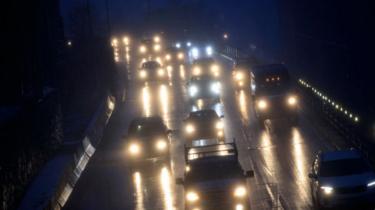
trafficImage copyrightGETTY IMAGES
“It’s a scam to line the pockets of corporate polluters by gutting protections for our environment,” said the Center for American Progress.
But one prominent business group was full of praise for the president’s proposal.
“It could help us reclaim our rightful place as a global leader on true 21st-century infrastructure,” said Jay Timmons, head of the National Association of Manufacturers.

What next?

The administration has called this proposal a starting point for negotiations.
But Mr Trump has made it a legislative priority this year, as November’s mid-term congressional elections loom.
The president met state and local officials on Monday, including the governors of Wisconsin, Louisiana, Virginia and Maine.
He will try to sell the proposal to congressional leaders on Wednesday.

Baltimore police guilty of robbing citizens

Daniel Hersl (middle) and Marcus Taylor (rightImage copyrightTOM CHALKLEY
Image captionDaniel Hersl (middle) and Marcus Taylor (right) were the only two members of the unit who did not take a plea deal
A federal jury has found two Baltimore police officers guilty for their role in a sprawling police corruption case that involved robbing city residents.
Daniel Hersl and Marcus Taylor were convicted of racketeering and robbery charges and cleared of others.
They were part of an elite unit tasked with seizing illegal firearms. But instead the squad went rogue, stealing cash and guns and reselling drugs.
Six officers have pleaded guilty, some of whom testified in court.
Baltimore police have struggled to regain public trust after Freddie Gray, a young black man, died in police custody in 2015.
The city’s police department is currently subject to federal monitoring as part of court-ordered reforms due to discriminatory and unconstitutional policing.
The verdict follows three weeks of explosive testimony in a federal courtroom.
Additional officers named in the testimony have either been suspended or announced their retirement.
A jury deliberated on Thursday and Monday over a series of charges stemming from an FBI investigation of the Baltimore Police Department unit, the Gun Trace Task Force (GTTF).
In additional to the guilty findings, they cleared Hersl and Taylor on charges of possession of firearm in furtherance of crime of violence. They face a maximum sentence of 60 years.
After the verdict on Monday. State’s Attorney Marilyn Mosby called the facts revealed at the trial “deeply disturbing” and said her office was “continuing to comb through the cases” potentially implicated by the officers’ illegal acts.
According to the Baltimore city’s Office of the Public Defender, as many as 3,000 cases could have been affected by the GTTF.
All but one member of the task force was indicted and arrested in March 2017.
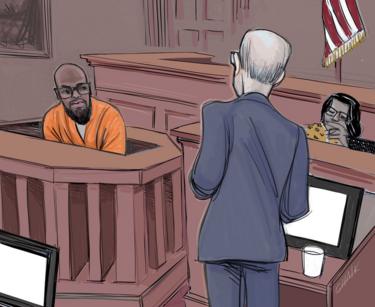
Six former officers pleaded guilty, and four of those – Maurice Ward, Jemell Rayam, Evodio Hendrix and Momodu Gondo – were called to the witness stand to testify against their former colleagues.
Gondo testifies on the standImage copyrightTOM CHALKLEY
Image captionFormer detective Momodu Gondo testifies
They detailed a series of thefts that went back years, including pilfering cash during street arrests, cracking safes, stealing kilograms of drugs to resell and armed robberies committed by wearing masks and brandishing guns.
“These two things – legitimate police work and criminal conduct – did occur side by side,” US Assistant Attorney Leo Wise said in his opening remarks.
“They were, simply put, both cops and robbers at the same time.”
Over the years, the thefts amounted to hundreds of thousands of dollars.
Media captionA month after Gray suffered a fatal injury, Baltimore remains on edge
Although Hersl and Taylor were on trial, much of the most shocking testimony centred on the actions of the unit’s officer-in-charge, former sergeant Wayne Jenkins.
Ward testified Jenkins liked to stop anyone over the age of 18 carrying a backpack, and pulled over specific vehicle models he called “dope boy cars” without cause.
The unit routinely filed false police reports to cover their tracks, according to court testimony.
Former detectives also testified they went into houses without search warrants for so-called “sneak and peeks” to see if there was money or drugs inside.
Jurors were shown Halloween masks, an 18-inch (46cm) machete and a grappling hook the men said Jenkins intended to use in home invasions.
Jenkins advised them to carry realistic looking BB guns, two detectives said, so they could plant them if they shot an unarmed citizen.
Jurors also heard from Donald Stepp, a bail bondsman who said he resold an estimated $1m (£720,000) worth of stolen drugs for Jenkins, including two garbage bags full of prescription opiates that Stepp said were taken from pharmacies during the civil unrest following the death of Freddie Gray.
Throughout the trial, the defence attempted to discredit the testimony of the former officers, saying they lied about Hersl and Taylor’s participation in hopes of getting reduced sentences. They also picked apart the credibility of witnesses who admitted they were dealing drugs at the time they were robbed.
Hersl’s lawyers also argued the 17-year veteran was being unfairly held accountable for some of the task force members’ most egregious acts.
“The government lumped Daniel Hersl’s wrong conduct – there’s no excuse for it – into a racketeering enterprise where other officers did commit real robberies, real drug trafficking and real extortion,” said defence lawyer William Purpura.
While Taylor’s family declined to be interviewed, Hersl’s older brother Steve Hersl sobbed outside the courtroom and expressed outrage at the verdict.”My brother was innocent,” he told reporters. “Let’s talk about the corruption on top – everybody starts from the bottom, the little guy. My brother was a little guy.”
But prosecutors argued both officers were just as involved as their colleagues were, showing specific instances of theft.
During the trial, about a dozen additional names of Baltimore police officers were mentioned in connection with illegal or improper acts, including one who tipped off GTTF that they were under investigation.
The testimony had real-time effects – one officer was suspended. Another high-ranking officer announced his retirement on the day he was mentioned.
A special agent for the FBI told the court a wider corruption investigation is active and ongoing, opening up the possibility of more charges.

Eric Radford: Skater is first openly gay man to win Winter Olympics gold

Media caption‘Smooth’ Canadian winning free skating performance
Canadian figure skater Eric Radford has said he “might explode with pride”, after becoming the first openly gay Olympic champion at any Winter Games.
Radford took gold at the Pyeongchang Games in the team figure skating event, alongside his partner Meagan Duhamel.
The pair performed a beautiful routine set to Adele’s Hometown Glory.
US skater Adam Rippon, the first openly gay athlete to reach the US Winter Olympics team, won bronze in the same event at the Gangneung Ice Arena.
He skated to Coldplay’s O, and Arrival of the Birds by Cinematic Orchestra.
The team figure skating, which debuted four years ago, sees each nation compete in the men’s, women’s, pairs’, and ice dance disciplines. The team with most points overall takes the gold medal.
After his win, Radford, 33, wrote on Twitter: “This is amazing! I literally feel like I might explode with pride.”
The Canadian skating team pose with their gold medalsImage copyrightANDREAS RENTZ/GETTY IMAGES
Image captionGold medalists (L-R) Patrick Chan, Gabrielle Daleman, Kaetlyn Osmond, Meagan Duhamel, Eric Radford, Tessa Virtue and Scott Moir of Team Canada
Later, he tweeted a smiling picture with Rippon, adding the hashtag “#outandproud”.
Fellow Canadian medallist and LGBT advocate Mark Tewksbury, who won a swimming gold in 1992, sent his congratulations.
“FINALLY in 2018 an openly gay man is on top of the podium,” he said. “No more isolation for LGBT sport men!!”
Decades before Radford and Rippon, gay British skater John Curry won a figure skating gold at the 1976 Winter Olympics in Innsbruck. He had not made his sexuality public, but was outed by a German newspaper shortly afterwards.
Some on Twitter questioned why it made a difference if Radford was gay or straight.
“Why does his sexuality matter? He is an athlete that won a medal,” one observer wrote.
Another replied: “It matters to people legitimately afraid of losing jobs or getting abused if they are open about being gay. When someone can reach the top of their field without hiding, that gives hope.”
American Rippon has himself addressed why his sexuality matters, after the subject made headlines in the US.
“Being gay has never been a big deal to me, which is why it’s a little funny to be getting all this attention about it,” he told GQ magazine.
Many Games viewers with no prior knowledge of winter sports have been won over by the 28-year-old – including Hollywood star Reece Witherspoon.
The skater told NBC: “I want to represent my country to the best of my abilities. I want to make Reese Witherspoon proud.”
And did he? The actress made her positive feelings plain on Twitter:

Trump budget US cash for International Space Station

Media captionWATCH: An astronaut films from outside the International Space Station
President Donald Trump wants to end US funding for the International Space Station (ISS) by 2025 with the aim of putting it into private hands.
His plans for ISS and the Nasa space programme were unveiled in his 2019 budget proposal. Mr Trump wants to increase Nasa spending by 3% next year.
But it also includes $150m (£108m) to “encourage commercial development” at ISS to replace American payments.
The space station is scheduled to operate through 2024.
“The budget proposes to end direct US financial support for the International Space Station in 2025, after which NASA would rely on commercial partners for its low Earth orbit research and technology demonstration requirements,” according to the White House proposal, which was released on Monday.
Astronaut Thomas PesquetImage copyrightGETTY IMAGES
Image captionAstronaut Thomas Pesquet from France gives an interview aboard the International Space Station in 2017
The US government would create a $150m programme to help prepare private companies to take over space station operations over the next seven years, according to the document.
The budget requests $19.6bn for Nasa in 2019, an increase of $500m from this year.
It also calls for $10.5bn for “an innovative and sustainable campaign of exploration” leading to “the return of humans to the moon for long-term exploration and utilization followed by human missions to Mars and other destinations”, according to a Nasa review.

How will ISS survive?

Analysis by OP’S NEWS 

In 2015, Congress guaranteed funding for the US part of the International Space Station until 2024. But discussions about what to do with it beyond that deadline have been under way for some time.
Since the first space station module was launched in 1998, Nasa’s focus has shifted away from operations in low-Earth orbit using the shuttle, back towards deep space – with the Moon, Mars and asteroids all named as possible future exploration targets.
The administration’s proposal echoes the views of some legislators who are eager for the $3bn a year it costs Nasa to operate the station re-directed towards the Orion crew capsule and SLS rocket – the vehicles being developed for deep space journeys.
But any bid to end federal funding for the station after 2024 is likely to run into considerable resistance. Democrat Senator Bill Nelson said the White House would have a “fight on its hands” if it wanted to pull out in the mid-2020s.
But opposition is also coming from the sector that would – on the face of it – seem to stand to gain most: the aerospace industry. A senior executive from Boeing – Nasa’s prime contractor on the ISS – warned that an early handover to commerce could actually jeopardise future private sector participation.
And then there are also those who feel that privatising the station contradicts the project’s original aims. From their perspective the ISS should remain a potent symbol of international co-operation and a platform for scientific research, not a venue for commercial companies to turn a tidy profit.
Robert Lightfoot, NASA’s acting administrator, called it a “pretty exciting time” for the agency.
“It really reflects the administration’s confidence that America will lead the way back to the moon and take that next giant leap from where we made the first small step for humanity some 50 years ago,” he said.
Democratic Senator Bill Nelson, a former astronaut, said the proposed plan to stop funding the International Space Station “makes no sense”.

Trump Jr wife in hospital after opening white powder envelope

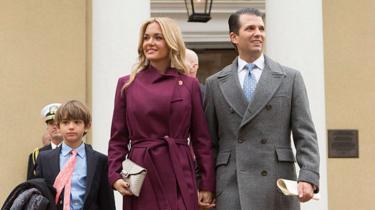
The couple have five children togetherImage copyrightGETTY IMAGES
Image captionThe couple have five children together
The US president’s daughter-in-law, Vanessa Trump, was taken to hospital as a precaution after opening an envelope containing white powder, police say.
The letter was addressed to Donald Trump Jr, Mr Trump’s eldest son, at his apartment in Manhattan.
Mrs Trump and two others at the scene were decontaminated by firefighters and taken to hospital for evaluation.
NYPD told the OP’S NEWS  they tested the white powder in the envelope and confirmed that it was non-hazardous.
They said that Mrs Trump did not appear to be physically affected by the substance.
Mr Trump Jr tweeted later on Monday that his family was safe and called the incident “disgusting”.
US President Donald Trump spoke to Mrs Trump Jr, White House spokeswoman Sarah Sanders confirmed at the daily news briefing.
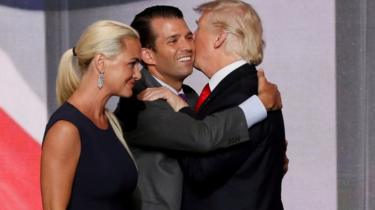
Trump's familyImage copyrightGETTY IMAGES
The Fire Department of New York (FDNY) referred calls from the media to police, but confirmed that three people had been transported to the Weill Cornell Medical Center.
The call came to police at around 10:00 local time (15:00 GMT), according to local officials.
They said the couple’s East 54th Street apartment was now being decontaminated.
According to CBS New York, Vanessa Trump’s mother handled the envelope, which Vanessa then opened.
The Secret Service said it is “investigating a suspicious package addressed to one of our protectees received today”.
In September, Mr Trump Jr, 40, chose to forgo Secret Service protection for himself, his wife and their five children, but it was reactivated one week later.
Donald Trump Jr, who works for his father’s business, married Mrs Trump (née Vanessa Kay Haydon) in November 2005 at the president’s Mar-a-Lago resort in Florida.
Mr Trump Jr’s aunt, Judge Maryanne Trump Barry, officiated at the ceremony.
Before wedding Mr Trump Jr, Mrs Trump was a fashion model in New York.
She had appeared in TV adverts and the film Something’s Gotta Give, starring Jack Nicholson and Diane Keaton.
The 40-year-old former Miss USA contestant once had a handbag company, La Poshett, which is now defunct.
Officials have been on alert for toxic substances sent through the mail since 2001 when anthrax was posted to lawmakers and journalists, killing five people.

Liberian church massacre survivors seek US justice

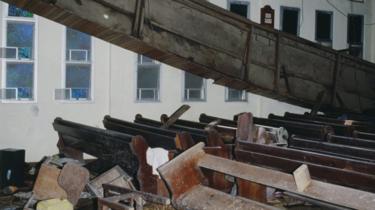
Wrecked St Peter's Lutheran Church in Monrovia, LiberiaImage copyrightGETTY IMAGES
Image captionMen, women, children, even babies – were shot or hacked to death inside the church
The Monrovia Church massacre in 1990 was the worst single atrocity of the Liberian civil war. About 600 civilians, including many children, were killed while taking refuge in a church.
Now, four survivors are bringing a claim for damages against one of the men they believe was responsible, reports Elizabeth Blunt who was a BBC correspondent in Liberia at the time.
It was July 1990, and rebel fighters were advancing on the capital, Monrovia. President Samuel Doe was holed up in his vast, gloomy Executive Mansion.
After dark bands of soldiers roamed the streets, looting shops and warehouses and seeking out people from Nimba County, the area where the rebellion had started. They dragged the men from their homes, beating and often killing them.
Hundreds of terrified families, looking for a safer place to sleep, took refuge in St Peter’s Lutheran Church – a spacious building in a walled compound. Huge Red Cross flags flew at every corner.
Bullet holes on St Peter's Lutheran Church in Monrovia
Image captionBullet holes on church windows
But on the night of 29 July, government soldiers came over the wall and started killing those inside. An estimated 600 people – men, women, children, even babies – were shot or hacked to death with machetes before the order was given to stop.
A Guinean woman doctor, who was one of the first to reach the church the next day, described to me the scene of utter horror.
Dead bodies were everywhere. The only sign of life was a baby crying.
She describes having to walk over corpses to reach the child, but when she picked it up and tried to comfort it, she said she suddenly saw a flicker of movement, and then another.
A few children had survived, protected by the bodies of their parents, but only when they saw her, a civilian and a woman taking care of the baby, did they dare to come out. One of the child survivors is among those now suing for damages.

‘Protected status’

American missionary Bette McCrandall was there, too, that morning – she had lain awake the previous night, listening to everything that was happening from the Lutheran bishop’s compound close by.
She says those events have stayed with her, even all these years afterwards, as they have with all the survivors.
“The memories of that day and that night don’t leave me,” she says.
St Peter's Lutheran Church in Monrovia
Image captionSt Peter’s Lutheran Church has now been rebuilt
This was the worst atrocity of the war, the event so shocking that it drove neighbouring countries to mount an armed intervention. Yet no-one has ever been prosecuted or held responsible.
The man now being taken to court in the US is Moses Thomas, formerly a colonel in the much-feared Special Anti-Terrorist Unit (Satu), based at the Executive Mansion.
Survivors have identified him as one of those giving orders that night. Now he lives in the US state of Pennsylvania.
Like many Liberians, he was given what is known as “temporary protected status”, because of the atrocities which were going on back home.
Liberia has had a Truth and Reconciliation Commission, and Mr Thomas was among those recommended for prosecution – but no cases have ever been brought.
So now a movement has started to bring them to justice outside Liberia.
Speaking to the OP’S NEWS  after being served court papers on Monday, Mr Thomas called the allegation “nonsense”.
“I don’t want to give any credence to the allegation,” he said. “No-one in my unit had anything to do with the attack on the church.”

‘Small victory’

Hassan Bility, who heads the Global Justice and Research Project in Monrovia, said he was pleased with the latest development.
“For 27 years the survivors of this massacre have fought and laboured for justice without success, and nobody has been paying any attention – not the Liberian government, not anybody outside. So this is a small victory,” he says.
Presentational grey line

What happened in Liberia’s civil war?

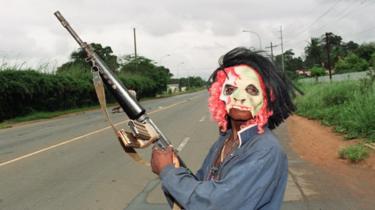
A masked rebel loyal to warlord Charles Taylor of the National Patriotic Front of Liberia (NPFL) holding a machine-gun patrol in the streets of Monrovia 11 August 1990Image copyrightGETTY IMAGES
1989: Charles Taylor starts rebellion against President Samuel Doe
1990: Doe horrifically killed by rebels
1997: Civil war ends after death of some 250,000 people. Taylor elected president
2012: Taylor convicted of war crimes in neighbouring Sierra Leone
Ms McCrandall certainly sees it as important.
“For me,” she says, “it is a chance for him to own up to what he has done, and on whose orders.
“That person will have to live and die with the guilt of what he has done. And in my mind it is comforting to me that this issue has not been put to rest, that the case has not been dropped.”
The snag is that for the moment this is only a civil suit, not a criminal case. A number of criminal prosecutions have started in Europe, where courts will hear cases for war crimes under so-called “universal jurisdiction”.
In the US that is more difficult, so campaigners against impunity have had to be ingenious. One Liberian warlord, known as “Jungle Jabbah”, was recently prosecuted for immigration fraud, since he had falsely claimed on his application that he had never belonged to any armed group.

Trial in Liberia?

Mr Thomas is being sued in a civil action by four of the survivors.
If they win, he is unlikely to be able to afford much in damages. But campaigners hope that the evidence which comes out in court will make the American authorities question his “protected” status, opening the way for a criminal prosecution or deportation.
But if he is deported back to Liberia, what then? Would he go on trial? Liberia never set up a special court and has never tried any war crimes cases. Many suspects still hold high positions.
Campaigner Hassan Bility clings to the hope that now, with a new government now in place, things might be different.
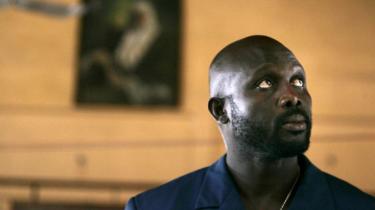
George WeahImage copyrightGETTY IMAGES
Image captionCurrent president George Weah was not involved in the conflict because he was playing football in Europe
“The current President, George Weah, was totally disconnected from the war,” he says.
“He was not part of any faction; he was playing football in Europe… And he gets a lot of his support from poor people, the ones who really suffered in the war… We have the opportunity right now to do this”.

South African lions eat ‘poacher’, leaving just his head

A lion stretches out by the Luvuvhu river in Kruger National Park, South AfricaImage copyrightCAMERON SPENCER/GETTY IMAGES
Image captionLocal police said the lions ate almost all of the man’s body (file picture)
A suspected big cat poacher has been eaten by lions near the Kruger National Park in South Africa, police say.
The animals left little behind, but some body parts were found over the weekend at a game park near Hoedspruit.
“It seems the victim was poaching in the game park when he was attacked and killed by lions,” Limpopo police spokesman Moatshe Ngoepe told AFP.
“They ate his body, nearly all of it, and just left his head and some remains.”
Lion poaching has been on the rise in Limpopo province in recent years.
The big cats’ body parts are sometimes used in traditional medicine, both within Africa and beyond.
Wildlife charity the Born Free Foundation says lion bones and other body parts are increasingly sought-after in South East Asia, where they are sometimes used as a substitute for tiger bones.
In January 2017, three male lions were found poisoned in Limpopo with their paws and heads cut off.

Young Labour: Row over access to equalities event

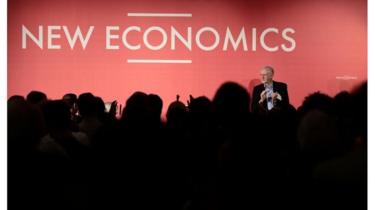
Jeremy Corbyn Labour conferenceImage copyrightGETTY IMAGES
Image captionJeremy Corbyn, Labour leader, pictured here at a party event in London
Labour has defended its decision to restrict access to an equalities conference to “disadvantaged groups”.
The Young Labour event next month is open to under-27s who “self define” as women, LGBT+, BAME or disabled.
It said the main purpose of the event was to elect members to its national committee while giving people space to discuss the “obstacles” they faced.
But one Conservative MP hit out at the “lazy assumption” that “straight white men” cannot fight for equality.
The Equality and Human Rights Commission said it had received a complaint about the matter and “as with all complaints we receive, will be assessing the details before determining whether any action is needed”.
Now there is fresh controversy after Young Labour started selling tickets for a one-day national equalities conference but said it would restrict access to those who met defined criteria.
A Labour spokesman said there was “nothing new about spaces for people with protected characteristics meeting to discuss the inequalities and obstacles they face”.
“The purpose of this conference is to ensure that members from disadvantaged groups are able to elect representatives to Young Labour’s National Committee. All other positions on the committee are elected online, via a ‘one member one vote’ system.”
In past years, Young Labour has selected all their committee members at an annual event, using caucuses to choose individual women’s, disabled, LGBT+ and BAME representatives.
The party is moving to a new system of online voting for most positions on its national committee, including its chair, its representatives from the English regions, Scotland and Wales as well as its representative on Labour’s National Executive Committee.
It is understood it cannot yet do this for the equalities representatives as it does not hold relevant information on the identities of members who would be eligible to vote and that is why the event is taking place.
Conservative MPs have taken to social media suggesting the exclusion of certain groups was a form of discrimination in itself.
But Labour activists have hit back, accusing their opponents of trying “to whip up a culture war”.

Welsh Assembly expansion plans put to public consultation

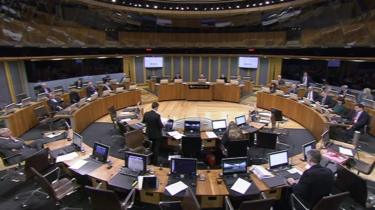
Senedd chamber in February 2018
Image captionSixty members is no longer enough to deliver for the people of Wales, an expert panel’s report said
People are being asked to share their view on plans to expand the Welsh Assembly by an extra 20 to 30 members.
An expert panel said the move was necessary to cope with the growing workload as more power is devolved.
Also, the vote would be given to 16 and 17-year-olds as part of proposals to reform the 60-member assembly.
Presiding Officer Elin Jones hailed “the opportunity to forge the national parliament that the people of Wales deserve to champion their interests”.
The assembly is already due to be renamed the Welsh Parliament as a result of a previous consultation.
Powers for the assembly to change its electoral rules, size and other internal affairs are being granted under the 2017 Wales Act.
Last week, AMs voted in favour of putting the expert panel’s recommendations out to public consultation.
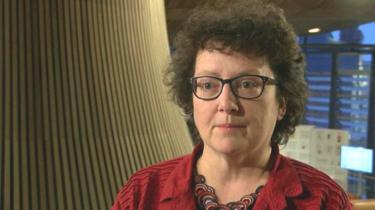
Elin Jones
Image captionElin Jones said it was an opportunity to forge a “national parliament that the people of Wales deserve”
Ms Jones said: “The Wales Act 2017 marks the start of a new phase of devolution in Wales, giving us the opportunity to make profound changes to our legislature.
“We now have the opportunity to forge the national parliament that the people of Wales deserve to champion their interests.”
The panel, chaired by Prof Laura McAllister of Cardiff University, also recommended a change in the voting system, to a proportional method called the Single Transferable Vote.
One option would be to pair the current 40 constituencies to merge them into 20 seats, each with four AMs, giving a total of 80.
A gender quota would boost the number of women in the Senedd, and the option of standing as a “job share” candidate would aim to encourage people with disabilities or caring responsibilities.
Any changes will require a law to be passed in the assembly with a two-thirds majority.
When the report was published in December, Welsh Labour said it would not give its view until its 2019 conference, which Plaid Cymru AM Simon Thomas said “kills dead” any chance of reform before the next election in 2021.
The consultation is open until 6 April.
In January, the Welsh Government proposed votes for 16 and 17-year-olds in council elections as part of a package of local government reforms.
Design a site like this with WordPress.com
Get started