Major sites rated ‘poor’ on environment protection

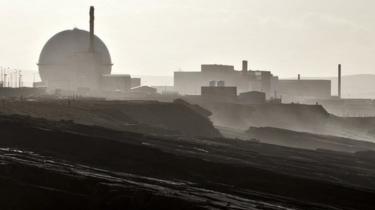
DounreayImage copyrightDSRL
Image captionA site at Dounreay nuclear power station was rated ‘poor’ by Sepa
Some of Scotland’s biggest industrial sites are failing to comply with environmental protection measures, OP’S NEWS  Scotland can reveal.
Petroineos at Grangemouth and BP’s Kinneil Terminal were each rated ‘poor’ along with two sites at Dounreay.
Another 51 fish farming sites are also rated as at risk, poor or very poor.
The Scottish Environment Protection Agency (Sepa), which produced the figures, said environmental compliance is “non-negotiable”.
The figures are a measure of how much sites are sticking to the terms of their operating licence.
It shows that compliance in the waste sector has risen to 90.35% in 2016 compared with 72.48% in 2009.
Among food and drink manufacturers compliance has fallen from 90.94% in 2010 to 88.28 percent in 2016.
Scotland Food and Drink said it wants to go “beyond compliance and embrace world class standards” as a sector and insisted that companies which do not comply “have little future in our sector”.

Grangemouth refineryImage copyrightPA
Image captionTwo sites at Grangemouth were also rated ‘poor’ for failing on environmental protection
Sepa chief executive Terry A’Hearn said it was rolling out new tools to ensure sites abide by the regulations.
“We’re clear, environmental compliance is non-negotiable,” he said.
“Every Scottish business will comply with the law, and we’ll work to ensure as many as possible will go even further.
“This latest report card on the environmental performance of Scottish regulated businesses is encouraging, with significant outcomes achieved for Scottish communities. It’s a reminder that we’ll work positively with those who want to do the right thing by Scotland’s environment, and a wake-up call to those that don’t.
“It’s also an indicator of where we next need to focus our attention and why we’re changing, creating a world-class environment protection agency fit for the challenges of tomorrow.”

Penalties

Last year the agency was given a new suite of powers to enable it to tackle firms which are not complying with their environmental obligations.
It led to the contractors who are building the Aberdeen bypass agreeing to pay a £280,000 penalty for polluting the River Don and the River Dee.
For the first time, the Sepa Enforcement Report details the number of penalties it has issued throughout the year.
Twelve organisations were referred to the Crown Office to consider for prosecution with £92,575 of fines handed out by the courts.
There were statutory notices served for non-compliance, along with 113 final warning letters.
BP sold its Kinneil terminal at Grangemouth last year to Ineos as part of the Forties Pipeline System.
A spokesman for BP said: “Sepa’s assessment of Grangemouth for 2016 was a result of some minor non-compliances that did not lead to any significant environmental impact and which were addressed prior to our divestment in 2017 of the Forties Pipeline System.”
Dounreay Site Restoration Limited said it has spent more than £1m in the last year upgrading facilities at the former nuclear power project, to ensure continued compliance with environmental regulations.
A spokesman added: “Decommissioning of the site is recognised as one of the most complex in Europe as we maintain and ultimately dismantle a large number of facilities that date back several decades.
“We welcome recent comments from Sepa recognising the considerable effort and priority given to undertake improvements since 2016 which we expect to see reflected in the 2017 assessment.”
The petrochemical giant Ineos has not responded to requests for comment.

MPs pressure City firms over gender diversity

Woman execImage copyrightANDRESR/GETTY IMAGES
City firms including giants Goldman Sachs and JP Morgan have been called on to sign a gender diversity pledge which was first published in 2016.
Treasury committee chair Nicky Morgan has written to 33 financial services firms who have yet to sign up.
She has asked the companies to confirm to the committee by Friday if they plan to join the initiative, or explain why they have decided not to do so.
Many of the firms said they support the initiative to promote women.
The charter, which was published by the Treasury, commits firms to promoting women to senior positions, to be transparent about achieving diversity targets, and to have at least one executive in charge of diversity.
“The progress of the Women in Finance Charter is to be welcomed. The aim, however, must be to see all firms in the financial sector sign up to the charter and make a concerted effort to improve their gender diversity, particularly in senior roles,” Mrs Morgan said in a letter.
“Huge multinationals including Goldman Sachs, JP Morgan and UBS are yet to sign up to the charter, and if they don’t intend to do so, the Treasury committee wants them to explain why.”

Diversity pledge

The OP’S NEWS  understands Goldman Sachs intends to sign up.
The bank said it was “committed to promoting diversity and inclusion at all levels of the firm”.
“It is critical that we recruit and retain a diverse group of people who bring a broad range of experiences, capabilities and perspectives to our organisation.
“Our participation in the Women in Finance Charter is one element of this broader commitment,” a Goldman Sachs spokesperson said.
JP Morgan said it supported the charter’s goals of the charter and it was considering signing up. “We are in discussions and making good progress,” a spokesperson for the firm said.
UBS said it supported the charter in principle and had taken a number of steps to promote gender equality in the firm.
“For global firms, any charter focused on one country brings limitations and adds complexity,” a UBS spokesperson said.
“Nevertheless, we are considering signing the UK charter and remain extremely committed to supporting gender equality.”
Other firms said they were in the process of signing up, including BNP Paribas, Metro Bank, and NFU Mutual.
Bupa said it was looking at the charter “with a view to becoming a signatory”.
More than 160 companies with more than 600,000 employees in the financial services industry had signed up to the charter by November.
About 50% of the industry’s workforce is currently covered by the charter – including pledges from firms including Standard Chartered, Credit Suisse, Morgan Stanley International and Deutsche Bank.
The Treasury said it was “working hard” to get more firms to sign up to the charter.

Faulty appliances ’cause 60 fires a week’

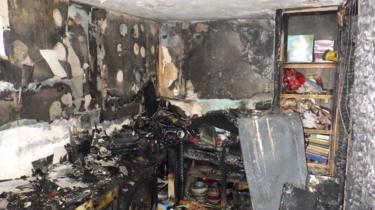
Tumble dryer that caused Shepherd's bush tower block fireImage copyrightLFB
Image captionThe damage caused to a seventh floor flat in Shepherd’s Bush, London
Faulty household appliances – primarily washing machines and tumble dryers – account for 60 house fires a week in the UK, consumer group Which? has said.
It said the number of fires has stayed roughly the same each year for five years.
It wants the government to draw up a plan to tackle the issue within three months, having set up an Office for Product Safety.
However, manufacturers have questioned some of the data that Which? used.
The consumer group wants a reform of the UK’s product safety system, following a series of fires, including the including Grenfell Tower tragedy, which was started by a faulty fridge freezer.
A separate defect affecting 5.3 million tumble dryers under the Hotpoint, Creda and Indesit brands was discovered in 2015 and has reportedly led to hundreds of fires since 2004.
The Commons Business Committee recently described the response by Whirlpool, which owns the brands, as “woeful”, and said it was unacceptable that more than one million potentially dangerous dryers were still being used in people’s homes.

‘First step’

Which? made a series of freedom of information requests to fire authorities and the Home Office to gain an impression of the scale of faulty appliance fires in the UK.
It concluded that malfunctioning kitchen appliances have accounted for nearly 16,000 fires across the UK since 2012.
It said faulty washing machines and tumble dryers accounted for 35% of fires, followed by cookers and ovens (11%), dishwashers (10%), and fridges, freezers and fridge freezers (8%).
Which? called on the government, which has set up a new Office for Product Safety, to set out the scale of product safety risks and explain what it planned to do to avert further fires in an action plan within 90 days.
Simon Blackburn, from the Local Government Association, said: “This is just the first step. It is essential that consumers have access to as much information as possible, and we would urge the Office to create an easily accessible, comprehensive database of recalled products.
“This would enable consumers to get as full a picture as possible about the safety of the products they are buying, and should be supported by all manufacturers.”

‘Real teeth’

Rachel Reeves, who chairs the Business Committee, said: “While we welcomed the decision to establish an Office for Product Safety and Standards, we agree the government must make sure it has real teeth and ensure it leads to more people registering their products, a better recall regime and ultimately a reduction in the number of fires that blight so many homes and put lives at risk.”
A Department for Business, Energy and Industrial Strategy spokesman said: “The government’s top priority is to keep people safe, which is why last month we set out our approach to further strengthen the UK’s already tough product safety system.”
Manufacturer Whirlpool questioned some of the data that Which? used.
“The government has advised that the accuracy of Fire and Rescue Service incident data cannot be guaranteed and should not be relied upon to make judgements about particular appliance makes or models,” it said.

US treasury secretary’s wife Louise Linton is ‘super-duper’ sorry

Steven Mnuchin and his wife Louise Linton arrive for a New Year's Eve party with U.S. President Donald Trump at his Mar-a-Lago club in Palm Beach, Florida, on 31 December 2017.Image copyrightREUTERS
Image captionMs Linton and her husband Steven Mnuchin
US Treasury Secretary Steven Mnuchin’s wife is trying to win over the American people after being dragged through the social media mud last year.
In a new Elle magazine interview, Louise Linton regrets how she boasted about wealth and belittled a commenter on a now-deleted Instagram post.
“I wasn’t thinking about who I am,” Ms Linton is quoted as saying. “I was so stupid. I wish I could take it back.”
The Scottish-born actress and producer married Mr Mnuchin in June 2017.
In the March issue, she explained: “I wasn’t thinking, I am the wife of this person and thus I should act like the wife of this person.”
“I felt like the kid on the playground that has been so bullied, and finally you punch back,” Ms Linton said.
The Instagram post in question showed Ms Linton exiting a US military plane after an official visit with her husband, after she had tagged the brand names of multiple fashion designers she was wearing.
When a woman criticised her post, she launched into a paragraph-long reply, which has led her to being dubbed a modern-day Marie Antoinette by some US media outlets.
“Have you given more to the economy than me or my husband?” Ms Linton wrote, before calling the commenter “adorably out of touch”.
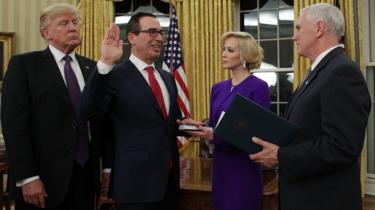
Former investment banker for Goldman Sachs Steven Mnuchin (2nd left) participates in a swearing-in ceremony, conducted by Vice President Mike Pence (right), as fiancée Louise Linton (3rd left) and President Donald Trump (left) look on in the Oval Office of the White House on 13 February 2017 in Washington, DC.Image copyrightGETTY IMAGES
Image captionWhen asked if what she thought of the Trump administration’s volatility affecting her husband, she said she hated the thought “because I just finished decorating my house” and “started making friends”
Ms Linton, 37, spent part of her childhood living in a castle outside Edinburgh, and was interviewed by Elle at a New York diner, near the Upper Eastside apartment she and her husband own.
She told the journalist she is “super-duper” sorry for all of the missteps in her self-presentation.
Ms Linton’s other faux-pas include self-publishing, in 2016, a memoir of her experiences volunteering in Zambia during her gap year, which provoked a huge online backlash as reviews and comments accused her of being patronising, inaccurate and misleading.
More recently, she was ridiculed for wearing elbow-length black leather gloves, while posing with her husband holding a sheet of money at the Bureau of Engraving and Printing.
She explained to Elle: “I just didn’t bother taking the gloves off because it was kind of cold in the bureau.”
She said her husband showed her the social media reaction, including one post comparing her to Darth Vader.
She told Elle Magazine she has now consulted a Washington protocol expert. “It’s actually really a fascinating world. The world of political etiquette,” she said. “Obviously we both [referencing Mr Mnuchin] are ethical and good people, and we don’t want to mess up.”
The expert has advised her on how to address ambassadors, greet Saudi sheiks and dress in Jerusalem, among other things.
“I’m just a regular girl, and I’m not perfect, but I’m trying my best,” she continued. “Maybe I should wear that on a T-shirt and Instagram that. And then on the back it should say …’I’m so sorry.'”

Shaun White apologises for calling harassment claim gossip

Shaun White and Lena ZawaidehImage copyrightGETTY IMAGES
Image captionShaun White received criticism for brushing off sexual harassment allegations as “gossip”
US Olympic snowboarder Shaun White has apologised for calling allegations of sexual harassment against him “gossip”.
He said he used “a poor choice of words to describe such a sensitive subject”, after becoming the first snowboarder to win three Olympic titles.
The 31-year-old Californian was accused of sexual harassment by a former member of his band.
He denied the claims but settled with Lena Zawaideh last year for an undisclosed amount.
After snatching halfpipe gold on Wednesday, Mr White was questioned about the lawsuit by reporters.
“Honestly, I’m here to talk about the Olympics, not gossip,” he said, before being ushered off stage.
Lena Zawaideh playing drumsImage copyrightGETTY IMAGES
Image captionThe lawsuit with Ms Zawaideh was settled in 2017
Ms Zawaideh was the drummer and only female member of Mr White’s band, Bad Things, until she was fired in August 2014.
Two years later, she filed a lawsuit against the Olympian saying he “repeatedly sexually harassed her and forced his authoritarian management style on her for over seven years”.
In the lawsuit, Ms Zawaideh claimed Mr White sent her sexually explicit and graphic images and forced her to watch pornographic videos.
The drummer initially sued Mr White for not paying her on time and later filed the sexual harassment claim after she switched lawyers, according to USA Today.
She also reportedly accused him of pressuring her to cut her hair and to wear revealing clothes.
The two reached a settlement in May 2017 and never went to court.
Mr White on guitar and Ms Zawaideh singingImage copyrightGETTY IMAGES
Image captionMr White on guitar and Ms Zawaideh singing in 2013
The allegations against Mr White – known as the Flying Tomato because of his red hair – resurfaced ahead of his attendance at the Pyeongchang Winter Games.
After he dismissed the claims as “gossip” on Wednesday, his critics took to social media.
He later apologised in an interview about the “gossip” comment.
“I’m truly sorry that I chose the word ‘gossip’,” he told NBC News’ Today show.
“It was a poor choice of words to describe such a sensitive subject in the world today.”
Mr White said he was a “changed person” and had grown over the years.
“I’m proud of who I am today,” Mr White said.
Many also criticised the snowboarder for “carelessly” dragging the US flag on the ground after his latest gold medal.
“I remember being handed the flag. I was trying to put my gloves on and hold the flag and the board,” Mr White responded, according to CNN.
“Honestly, if there was anything, I definitely didn’t mean any disrespect.”
“I’m very proud to be part of team USA and be an American,” he said.

Canadian broadcaster CTV amends Patrick Brown sex claim story

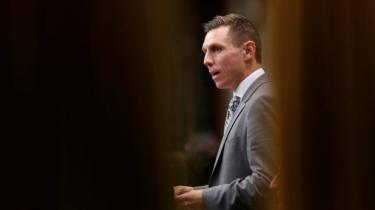
Former Ontario Progressive Conservative leader Patrick BrownImage copyrightREUTERS
Image captionOntario Progressive Conservative leader Patrick Brown has resigned in the wake of sexual misconduct allegations
A Canadian news outlet says some of the facts in an expose of sexual misconduct claims against a politician were wrong.
Patrick Brown resigned as leader of the Ontario Progressive Conservative party in January, months before the provincial election.
In its original story, CTV reported that a woman met Mr Brown at a bar a decade ago when she was 17 and under the legal drinking age.
The broadcaster now says she was not under age at the time.
But her allegations remain the same, it added.
The woman told the network that Mr Brown picked her up at a bar more than a decade ago, and brought her back to his house with the promise of booze.
When they were alone, he exposed himself and asked for oral sex, she said.
Mr Brown has denied those allegations and he says he will pursue legal action to defend himself.
Mr Brown called the original report “malicious and false” in a Facebook post on Wednesday.
Brown also alleges that CTV intentionally left information out of its story that would have contradicted the woman’s version of events.
Now, CTV says the incident happened a year later.
CTV says it “stands by its reporting”, and quoted the woman’s lawyer who said it’s not unusual for “collateral details” to fade over time.
In a statement on Wednesday, the network said that attacks on its journalistic practices are “groundless and wrong” and that there reporting on the matter will continue “undeterred”.

US Veterans chief Shulkin ‘improperly’ took Wimbledon tickets

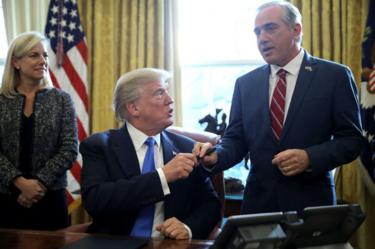
Shulkin and TrumpImage copyrightGETTY IMAGES
Image captionMr Shulkin disputes the inspector general’s findings
US Veterans Affairs Secretary David Shulkin improperly accepted Wimbledon tennis tickets and used tax dollars to fund a European trip, a report finds.
A report by the agency’s inspector general also accused Mr Shulkin’s top aide of doctoring an email to justify government-funded travel for his wife.
Mr Shulkin has refuted the charges. One US congressman has called for him to resign over “corruption and abuses”.
Five Trump cabinet officials have faced ethics probes related to travel costs.
The Veteran Affairs (VA) administration’s internal inspector general, Michael Missal, released a report on Wednesday finding that the secretary had received tickets to the Wimbledon women’s final tennis match in July from an organiser for the Invictus Games – a sports tournament for wounded veterans founded by Prince Harry.
VA officials had told ethics advisers that the tickets were a gift of a personal friend, and thus allowed under government rules.
But the inspector found that Victoria Gosling, an adviser to the Invictus Games, could not recall Mr Shulkin’s wife’s first name when later asked by investigators.
He has also previously told the Washington Postthat he had purchased the Wimbledon tickets.
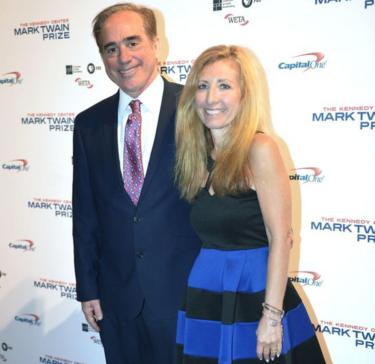
Mr Shulkin and his wife Merle BariImage copyrightGETTY IMAGES
Image captionMr Shulkin and his wife Merle Bari
Mr Missal also claims that Mr Shulkin’s chief of staff doctored an email from an aide coordinating the trip to make it appear as though Mr Shulkin was receiving an award from the Danish government.
The email was allegedly doctored by Viveca Wright Simpson, the VA’s third-most-senior official, in order to justify using taxpayer money to pay for Mr Shulkin’s wife, Merle Bari, to travel to Europe for a nine-day trip.
Mrs Shulkin’s flight cost $4,300 (£3,100) the report found.
US Congressman Mike Coffman called on Mr Shulkin to resign following the report.
Mr Missal also claims that a top VA aide made “extensive use of official time” to organise leisure activities for the secretary and his wife, and essentially acted as his “personal travel concierge”.
“This was time that should have been spent conducting official VA business”, the inspector wrote in the 84-page report.
“Although the [inspector general’s office] cannot determine the value VA gained from the Secretary and his delegation’s three and a half days of meetings in Copenhagen and London at a cost of at least $122,334, the investigation revealed serious derelictions by VA personnel,” the watchdog found.
In a response to the report, dated 12 February, Mr Shulkin said the inspector’s finding were “overall and entirely inaccurate”.
“Your staff’s conduct related to this investigation reeks of an agenda,” he said.
“Your portrayal of this trip is overall and entirely inaccurate.”
He is the latest Trump official to face allegations of improperly expenses their official travel. Others include:
  • Tom Price resigned as Health and Human Services secretary in September 2017 amid a row over more than $400,000 in tax dollars spent on charter and luxury flights
  • Interior Secretary Ryan Zinke was criticised by his agency’s inspector general for not properly documenting his travel on private planes with his wife
  • Treasury Secretary Steven Mnuchin faced an investigation after he was accused of spending more than $800,000 in tax dollars on military aircrafts for leisure purposes
  • Environmental Protection Agency (EPA) Administrator Scott Pruitt is currently being probed for his use of private planes and luxury airliners

Syria war: First aid delivery in months reaches Eastern Ghouta

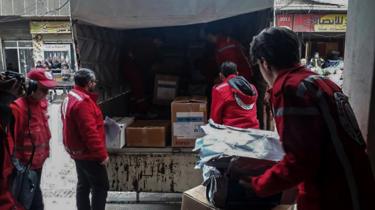
Six men working for the Syrian Arab Red Crescent unload boxes of supplies from the back of a truckImage copyrightSYRIAN RED CRESCENT / TWITTER
Image captionThe Syrian Arab Red Crescent posted photos to Twitter of the delivery
The rebel-held Syrian region of the Eastern Ghouta has received its first aid delivery in almost three months.
It comes after weeks of appeals from the United Nations to allow aid deliveries and the evacuation of hundreds of critically ill people.
About 400,000 people live in the besieged enclave, east of Damascus, under frequent artillery bombardment.
Hundreds have been killed in recent weeks after government forces stepped up attempts to seize the area.
Wednesday’s aid delivery had enough food and supplies for 7,200 people, the United Nations Office for the Coordination of Humanitarian Affairs said.
The Syrian Arab Red Crescent, which jointly handled the delivery, said the nine trucks would cover about 1,440 families.
The World Health Organisation (WHO), meanwhile, said it had sent 1.8 tonnes of medical supplies – enough for about 10,000 treatments – in the delivery.
WHO’s representative in Syria, Elizabeth Hoff, told Reuters news agency the supplies included antibiotics, dialysis sessions, insulin, trauma kits, pneumonia treatments and hospital beds.
But Wednesday’s aid delivery to the Eastern Ghouta was relatively small by UN standards.
Jakob Kern, Syria director for the World Food programme, tweeted: “We need much more such convoys.”
Those comments were echoed later by UN Syrian special envoy Staffan de Mistura, speaking to the UN Security Council, who said: “This is fine. But let’s think about it – that is less than 2% [of the population]… we need much more.”
There has been no movement from the Syrian government on the United Nation’s appeal to allow the evacuation of some 700 critically injured and severely ill patients.
The UN – backed by the United States – has called for a cessation of hostilities after four days of heavy shelling this month killed more than 200 people in the Eastern Ghouta.
But Russia, the Syrian government’s main ally, has said the request was “not realistic”.
Now, Sweden and Kuwait have jointly prepared a draft resolution for the Security Council, to force a ceasefire and guarantee continued humanitarian access and medical evacuations.
“The humanitarian situation remains one of the worst the world has seen,” the Swedish government said in a statement. “When international law, including humanitarian law, is violated on a daily basis, it is our duty to act.”
Russia, as one of the council’s five permanent members, holds the power of veto on such resolutions.
“Gaining support for the resolution will not be easy – but we must try,” Sweden said.
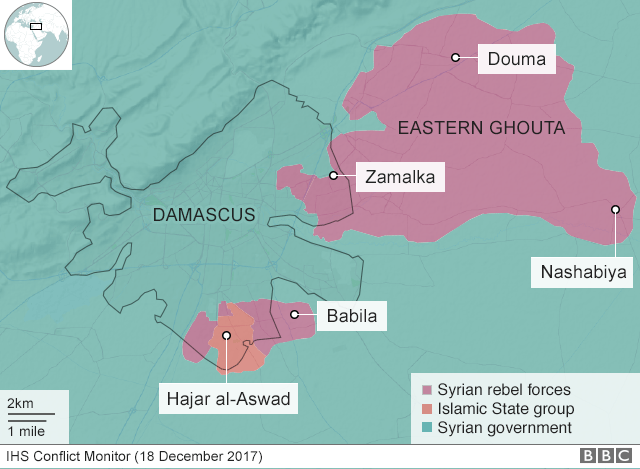
Map showing control of the Eastern Ghouta (18 December 2017)
The Eastern Ghouta has been under siege since 2013. It is a strategically important area, lying on the outskirts of Syria’s capital, Damascus – which can be hit by rockets fired by rebels in the nearby enclave.
It is completely surrounded by areas of Syrian government control – with the result that any aid delivery requires the approval of government forces.
But inside the Eastern Ghouta, the humanitarian situation is rapidly worsening.
The Syrian government and its allies deny such claims.

Lost dog found 400km from home after six months

Rapunzel the dog lies on a hospital bed covered by a blue blanket.Image copyrightSCHUTZ & RETTUNG ZURICH
Despite looking for their lost dog for six months, the Ehret-Vath family from near Frankfurt never gave up hope.
Last week, the family of five were thrilled to get a call saying the German Shepherd was alive, having crossed the border from Germany to Switzerland.
Rapunzel the dog was found 400km (250m) away, beside a road near Zurich.
The eight-year-old pet was seriously injured, but is now recovering at an animal hospital.
Two Swiss paramedics were returning to Zurich in the middle of the night when they noticed a large motionless animal on the edge of the motorway.
Thought to have been hit by a car, Rapunzel, now very thin, was suffering from hypothermia and wary of the humans approaching.
Realising they could not wait for an animal ambulance to arrive, the emergency responders provided first aid, blankets and oxygen to the canine before rushing her to the University of Zurich’s animal hospital, said a city press release.
She has been treated for fractured bones and internal bleeding.
Her owners, who drove down to see Rapunzel at the weekend, said the dog was skilled at opening doors and escaped during a trip to the local vet on 15 August.
A search operation was launched on social media and the family would rush to remote places if any possible sightings were reported.
“We were always on the move,” the mother of three said to Swiss news outlet Blick. “But we were always too late.”
The pet is still in a critical condition, according to Ms Ehret-Vath, but the family are hopeful she will return home soon.
As for what Rapunzel the runaway saw and did on her six-month odyssey, that will remain a mystery.

YouTube and Instagram face Russian bans

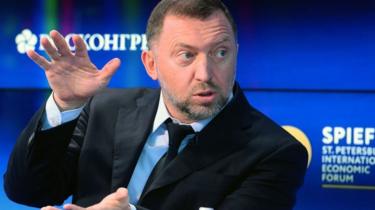
Oleg DeripaskaImage copyrightGETTY IMAGES
Image captionOleg Deripaska has warned the media not to repeat the allegations made against him
YouTube and Instagram face being blocked by Russian internet service providers as a result of a standoff between one of the country’s richest businessmen and an opposition leader.
Russia’s internet censor blacklisted material on both services after a court ruled that it violated billionaire Oleg Deripaska’s privacy rights.
However, Alexei Navalny has refused to remove the videos and photos, which he claims are evidence of corruption.
A Wednesday deadline has been set.
If neither Mr Navalny nor the US tech firms involved delete or otherwise block local access to the imagery by the end of the day, then Russia’s ISPs will be required to take action themselves.
A group representing the industry has indicated that this could result in all local access to the social networks being curtailed since ISPs lack the facility to censor specific posts.
“It’s impossible for internet providers to block certain pages on Instagram and YouTube,” a spokeswoman for the Russian Association for Electronic Communications told the OP’S NEWS.
Mr Navalny is Russia’s most prominent opposition leader. But he has been barred from standing against President Putin in next month’s election because of a corruption conviction, which he says is politically motivated.

Shared video

Mr Navalny’s Anti-corruption Foundation posted a video to YouTube last Thursday in which he presented footage that allegedly showed Mr Deripaska meeting Russia’s deputy prime minister Sergei Prikhodko aboard a yacht.
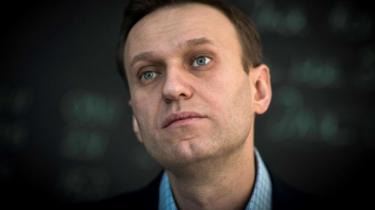
Alexei NavalnyImage copyrightGETTY IMAGES
Image captionPolitical activist Alexei Navalny is refusing to delete the material himself
The material was said to have been sourced from a woman’s Instagram account, where it had been posted in 2016.
Mr Navalny also uploaded a photo of the “secret meeting” alongside a post detailing corruption claims, to his own Instagram account.
The next day, Mr Deripaska obtained a court order demanding the removal of 14 Instagram posts and seven YouTube clips.
And on Saturday, the government’s internet watchdog Roskomnadzor issued the two tech platforms a take-down notice giving them three business days to comply.
Google subsequently wrote to Mr Navalny’s team saying it might be forced to block the videos.
But to date, neither it nor Facebook has censored the material.
The two firms have yet to publicly comment on the matter.
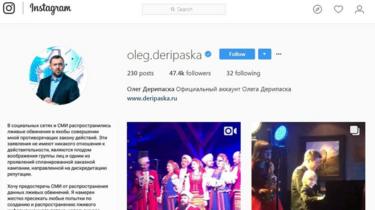
Mr DeripaskaImage copyrightINSTAGRAM
Image captionMr Deripaska is himself an Instagram user and promotes the service on his personal webpage
Facebook is already facing an audit by Roskomnadzor of its compliance with Russian laws, a move that was also announced last week.

Human rights

Mr Deripaska has threatened to sue those who repeat Mr Navalny’s claims.
“I want to warn the media against the dissemination of these mendacious accusations,” he said in a statement published by the Washington Post last week.
“I will severely suppress any attempts to create and disseminate false information flow using all legal measures and will defend my honour and dignity in court.”
One Moscow-based campaigner said the dispute formed part of a wider effort to censor the net.
YouTubeImage copyrightREUTERS
Image captionAlthough Google has warned the YouTube videos may have to be blocked, it has yet to do so
“In recent years, Russian authorities have stepped-up measures aimed at bringing the internet under greater state control,” said Tanya Lokshina from Human Rights Watch.
“The government pushed through the parliament a raft of new restrictive laws and is using different pretexts and mechanisms to block critical websites and web pages and silence critical voices online.
“Facebook, Google and other major internet companies operating in Russia should carefully assess demands to censor content or share user data and refrain from complying where the underlying law or specific request are inconsistent with international human rights standards.”
Presentational grey line

Analysis

PhonesImage copyrightGETTY IMAGES

By OP’S NEWS 

Compared to Russian television, which is under tight central control, the internet is still a relatively free space.
Alexei Navalny uses YouTube to post his anti-corruption videos and to livestream protests.
During the 2011-12 elections, videos of ballot-stuffing posted online sparked mass protests. Twitter, Facebook and other platforms are hugely popular.
But restrictions on online activity and even prosecutions have been increasing. The blacklist maintained by watchdog Roskomnadzor includes a support group for young LGBT people and the Jehovah’s Witnesses – banned in Russia as “extremist”.
The human rights group Agora highlighted an increase in censorship in its latest report, finding that last year more than 240 pages were blocked on average every day.
Meanwhile, prosecution even for “liking” or sharing posts on social media is increasingly common.
Most recently, several people reposting information about January’s protests in support of Navalny were sentenced to police custody as the rallies had not been sanctioned by the authorities.
Blocking Instagram and YouTube might placate an oligarch. It would likely complicate life for opposition groups and activists. But it would certainly upset millions of other Russian internet users.
Just ahead of an election that Vladimir Putin wants to win with a resounding majority, that seems like a risky step to take.
Design a site like this with WordPress.com
Get started