Red Cross reveals 21 staff paid for sexual services

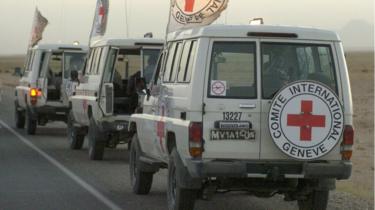
Vehicles belonging to the International Committee of the Red Cross (ICRC) in Afghanistan, 30 August 2007Image copyrightGETTY IMAGES
Image captionThe ICRC launched an internal review after reports of misconduct at aid agencies
The International Committee of the Red Cross (ICRC) says 21 members of staff have left their jobs for sexual misconduct in the last three years.
The ICRC’s director-general, Yves Daccord, said the individuals had paid for “sexual services” and had resigned or were dismissed from the aid agency.
Mr Daccord said on Friday that it was “a difficult but important day”.
The revelations come as the aid sector has been hit by numerous allegations of sex abuse and exploitation by workers.
Mr Daccord said that it was the recent reports of sexual misconduct from humanitarian agencies that had spurred the Geneva-based ICRC to conduct an internal review.
Its code of conduct has explicitly forbidden the purchase of sexual services since 2006.
Friday’s statement follows reports that Plan International, a children’s aid agency, confirmed six cases of sexual abuse and child exploitation by staff or associates.
“I have instructed my teams to scour the data we do have on sexual misconduct, and I can tell you that since 2015 we’ve identified 21 staff members who were either dismissed for paying for sexual services or resigned during an internal enquiry,” Mr Daccord said.
Two other staff members who were suspected of sexual misconduct did not have their contracts renewed, Mr Daccord said, adding that he was “deeply saddened to report these numbers”.
He said that the ICRC, which has 17,000 members of staff worldwide, was concerned that incidents that should have been reported were not, or were not properly handled.
“This behaviour is a betrayal of the people and the communities we are there to serve,” Mr Daccord said. “It is against human dignity and we should have been more vigilant in preventing this.”
The ICRC statement promises that all future allegations will be acted upon firmly and consistently, and that any employee found to have violated the ICRC’s code of conduct will be held accountable.
International aid organisations have come under scrutiny since UK newspaper The Times reported earlier this month that Oxfam GB had covered up claims of sexual misconduct by its staff in Haiti.
On Friday, 22 aid organisations said they were “truly sorry” for the sector’s failings in the wake of allegations of sexual misconduct by workers.

Syria war: Air strikes in Eastern Ghouta ‘kill 500’

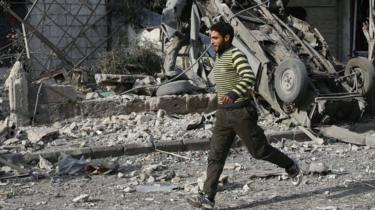
A man runs after an air raid in the besieged town of Douma, Eastern Ghouta, 23 FebruaryImage copyrightREUTERS
Image captionThe Eastern Ghouta has seen one of fiercest assaults of the Syrian war over the past week
Syrian government forces have killed more than 500 civilians during a week of intense bombardment of a rebel enclave near Damascus, activists say.
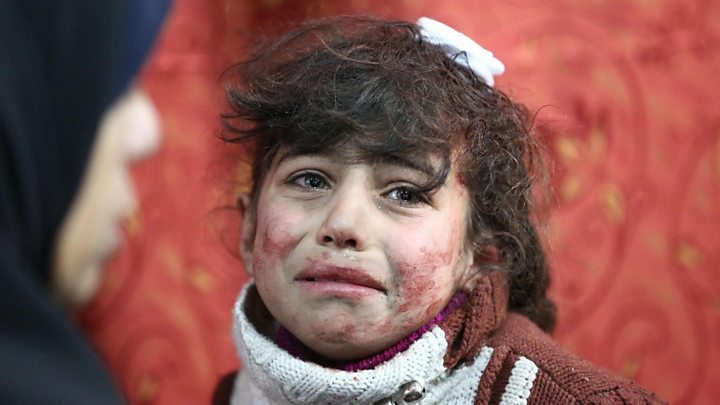
The victims in the Eastern Ghouta include 121 children, says the Syrian Observatory for Human Rights, a UK-based group monitoring the conflict.
Syrian government forces backed by Russia have been pounding the area since last Sunday.
The UN Security Council is struggling to agree on a ceasefire resolution.
A vote has been delayed several times since Thursday, and is now due to be held later on Saturday.

How bad is the situation in the Eastern Ghouta?

On Saturday, the Syrian Observatory said at least 29 civilians were killed, including 17 in the main town, Douma – bringing the total to over 500 for the week.
The group said the strikes were being carried out by both Syrian and Russian planes – although Russia denies direct involvement.

Media caption“At least in heaven there’s food”: The children caught up in Eastern Ghouta air strikes
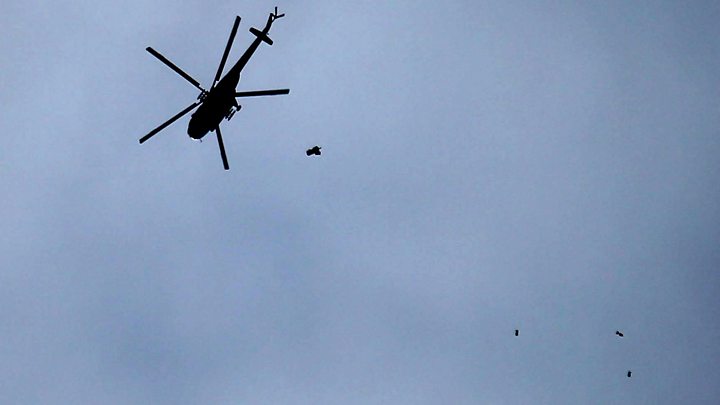
Barrel bombs and shell fire have been dropped on the area, where some 393,000 people remain trapped.
Aid groups report several hospitals being put out of action since Sunday.
The Syrian government has denied targeting civilians and said it is trying to liberate the Eastern Ghouta from “terrorists” – a term it has used to describe both jihadist militants and the mainstream rebel groups that dominate the enclave.
The plight of civilians in the area has alarmed world leaders. Conditions there have been described as “hell on earth” by UN Secretary General Antonio Guterres.

Why has a ceasefire proved elusive so far?

The Security Council has been debating a resolution calling for a 30-day calm to allow for aid deliveries.
But Russia wants changes. Under current draft, any ceasefire would not apply to the Islamic State group, or the Nusra Front – formerly al-Qaeda’s official affiliate in Syria.
Moscow says it must go further and exclude other groups “co-operating with them” and which have shelled Damascus.

Media captionEastern Ghouta resident: “Missiles are dropping like rain”
These could include the two biggest rebel groups in Eastern Ghouta – Jaish al-Islam and Faylaq al-Rahman. Faylaq al-Rahman has in the past fought alongside the jihadist group Hayat Tahrir al-Sham, an alliance of factions led by the Nusra Front.
Western diplomats have accused Russia of stalling for time.
They suspect that Moscow wants to give Syria time to deal a final blow to forces defending the enclave on the edge of Damascus.

On Friday evening US President Donald Trump pointed the finger of blame firmly at Syria and its allies, Russia and Iran, for the humanitarian crisis.

Julian Assange: Ecuador says latest talks on release failed

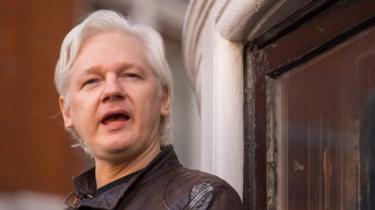
Julian AssangeImage copyrightPA
Ecuador says the country’s latest efforts to negotiate the departure of WikiLeaks founder Julian Assange from its London embassy have failed.
Foreign minister Maria Fernanda Espinosa said the UK was unwilling to take part in talks about his release.
Mr Assange, 46, has been staying at the country’s London embassy since 2012 where he was granted political asylum.
Last week, the arrest warrant against him was upheld meaning as soon as he leaves the embassy he will be detained.
Ecuador’s foreign minister said: “On the issue of mediation, I have to say very honestly that it has not been successful because two parties are needed to mediate. Ecuador is willing, but not necessarily the other party”.
She said her country would “continue looking for mechanisms” to end the stalemate.
Last December, Mr Assange was granted Ecuadorean citizenship in a move which the country hoped could give him immunity in the UK.
But the UK does not recognise Mr Assange as a diplomatic agent and continues to insist he should “face justice”.
There is no extradition treaty between the UK and Ecuador so he cannot be arrested inside the embassy.
Mr Assange breached bail conditions when he sought refuge at the Ecuadorean embassy six years ago.
Previously, Mr Assange has justified his decision to break bail conditions arguing if he faced the Swedish authorities he would be extradited to the US over the publication of classified documents.

Myanmar: Bombs explode in capital of restive Rakhine state

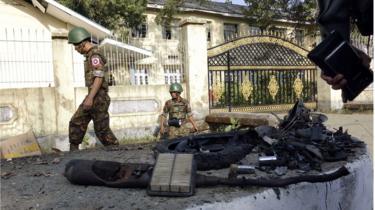
Police inspect bomb wreckageImage copyrightEPA
Image captionIt was not immediately clear who was behind the blasts
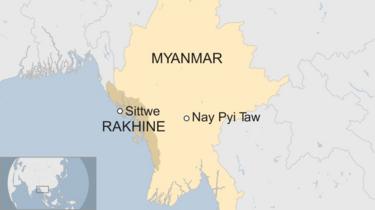
Three bombs have exploded in Sittwe, the capital of Myanmar’s restive Rakhine province, police say.
A police officer was slightly injured in the blasts. It was unclear who was behind them, police said.
One of the bombs went off near the home of a local official. The others went off near a court and a record office.
More than half a million mainly Muslim Rohingya from Rakhine fled the destruction of their homes last year in what the UN called ethnic cleansing.
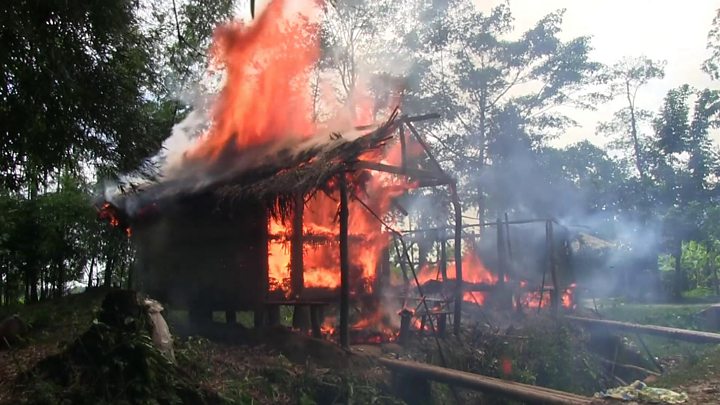
Villages where Rohingya had lived were burned and several thousand people were killed in retaliation after Rohingya militants staged a series of attacks on police outposts.
map
The military in Myanmar (Burma) says it is fighting militants and denies targeting civilians.
There has also been tension between the authorities and ethnic Rakhine Buddhists after seven people were killed last month when police opened fire on a crowd trying to seize a local government office.
An ethnic Rakhine rebel group in the state vowed retaliation for the deaths of the protesters, AFP news agency reports.
Police spokesman Colonel Myo Thu Soe told Reuters news agency three other unexploded hand-made bombs had been found in the city.
Sittwe is about 100km (60 miles) south of where most of the violence against Rohingya has taken place.

Media captionWho is burning down Rohingya villages?
Most of Sittwe’s Rohingya population left their homes after religious violence in 2012. More than 100,000 people are still living in internment camps outside the city.
Separately, satellite images suggest entire Rohingya villages, many already damaged by fire, have been completely bulldozed, campaign group Human Rights Group says.
It said the apparent destruction of homes erases evidence for legal claims from the exiled Rohingya.

Joanna Demafelis: Employer of Filipina maid found dead in freezer arrested

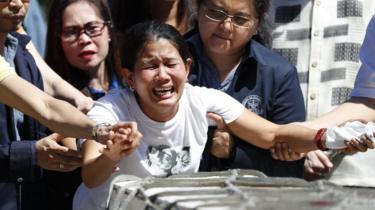
A distraught woman, held by those around her, grieves in front of a long wooden box carrying her sister's remainsImage copyrightEPA
Image captionMs Demafelis’s sister cried over her casket upon its arrival in Manila last week
Police have arrested the employer of a Filipina maid found dead in a freezer in Kuwait after a weeks-long manhunt.
Joanna Demafelis, 29, was found frozen in her employers’ apartment more than a year after she was reported missing.
Nader Essam Assaf was arrested in Lebanon on suspicion of murder, the Philippines department of foreign affairs said on Friday.
Ms Demafelis’s death prompted outrage in the Philippines and a ban on Filipinos travelling to work in Kuwait.
Mr Assaf, a Lebanese national, was arrested in his home country, the Philippines department of foreign affairs said in a statement.
His Syrian wife Mona, who is also a suspect, remains on the run, and is believed to be in Syria, it added.
Both suspects were the subject of an international manhunt aided by Interpol.
Philippines foreign secretary Alan Peter Cayetano welcomed the news, calling it a “critical first step in our quest for justice for Joanna”.

How was Ms Demafelis’s death discovered?

Her body was found this month with apparent signs of torture, Philippine officials said, in an apartment that had apparently been abandoned for at least a year.
In the aftermath of the discovery, Philippine authorities say they facilitated the return of more than 1,000 “distressed overseas Filipino workers” in Kuwait, most of whom had worked as household servants.
The country’s department of foreign affairs estimate that some 252,000 of its citizens are living and working there.
Kuwaiti authorities, meanwhile, have vowed to do everything possible to see justice is done.
Mr Cayetano said he expected Kuwaiti authorities to request the extradition of Mr Assaf from Lebanon, to stand trial in Kuwait.

Trump-Russia: Manafort ‘paid European ex-politicians’

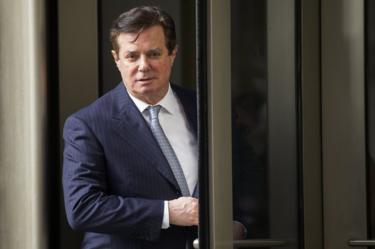
Former Trump campaign chairman Paul Manafort departs the federal court house after a status hearing in Washington, DC, USA, 14 FebruaryImage copyrightEPA
Image captionMr Manafort insists he is innocent
Ex-Trump campaign manager Paul Manafort secretly paid unnamed former senior European politicians to lobby for Ukraine’s previous pro-Russia government, a new indictment filed by special counsel Robert Mueller says.
Mr Manafort paid over €2m ($2.5m; £1.8m) to the ex-politicians, it says.
He has maintained his innocence in the face of Mr Mueller’s investigations.
Mr Trump’s ex-deputy campaign manager, Rick Gates, has admitted conspiracy and lying to investigators in a plea deal.
Mr Mueller is investigating claims of Russian political meddling in the US.
There are no allegations that either man colluded with Russia to influence the outcome of the 2016 presidential election, which is the main thrust of the justice department investigation.

What are the latest allegations against Mr Manafort?

He faces new charges of conspiracy, money-laundering, failing to register as an agent for a foreign actor and making false statements.
His alleged payments to former senior European politicians were made in 2012 and 2013, the new indictment says.
He is also alleged to have created a group called the Hapsburg Group to give the former politicians’ lobbying efforts the appearance of independent analysis.
The alleged group was managed by a former senior European politician named only as “Foreign Politician A” in the indictment.
The alleged paid lobbying was part of Mr Manafort’s work for the Ukrainian government, a pro-Russian party, the Party of Regions, and its leader Viktor Yanukovych, who was president between 2010 and 2014, the indictment says.
Mr Manafort’s work for Ukrainian pro-Russian political parties is said to have continued after Mr Yanukovych was overthrown and fled to Russia in 2014 following anti-government protests.
The indictment says Mr Manafort did not register as an agent of a foreign principal for this work as required by law.
He is also alleged to have hidden millions of dollars made from his Ukraine work in offshore accounts.

What does Mr Gates say?

The new indictment was filed after Rick Gates pledged to co-operate in “any and all matters” with the Mueller inquiry.
Mr Gates, 45, is named in the new Manafort indictment as having worked to hide Ukraine income from the US authorities.
In a court appearance, Mr Gates admitted charges of conspiracy and lying to investigators.
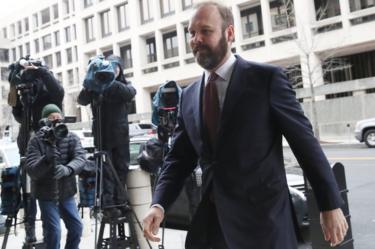
Rick GatesImage copyrightEPA
Image captionRick Gates said he had “had a change of heart” after his initial not-guilty plea
He had previously had been indicted on more serious criminal counts, including bank fraud and money laundering.
In a letter to family and friends, Mr Gates said he had “had a change of heart” after his initial not-guilty plea, according to ABC News.
He reportedly said he was ready to accept “public humiliation” to avoid inflicting prolonged pain on his children.
“The reality of how long this legal process will likely take, the cost, and the circus-like atmosphere of an anticipated trial are too much,” he reportedly wrote. “I will better serve my family moving forward by exiting this process.”
Sentencing guidelines for him suggest a prison term of between 57 and 71 months. He could have faced decades in prison under the more serious charges.

How did Mr Manafort respond to the plea deal?

The man who resigned as Trump campaign chairman in August 2016 after five months amid questions over his business dealings maintains his innocence.
He did not comment immediately on the new indictment brought against himself but did respond to Mr Gates’s plea deal, insisting he was innocent.
“I had hoped and expected my business colleague would have had the strength to continue the battle to prove our innocence,” he said in a statement.
“For reasons yet to surface he chose to do otherwise. This does not alter my commitment to defend myself against the untrue piled up charges contained in the indictments against me.”
Mr Manafort has worked on several Republican presidential campaigns, beginning with Gerald Ford’s in 1976.

How many people has Mr Mueller charged?

Nineteen people – including Mr Manafort and Mr Gates – have been indicted by the special counsel:
Mr Trump has said there was no collusion. Moscow has rejected US intelligence claims of interference.

Operation Sanctuary review finds adult abuse ‘extensive’

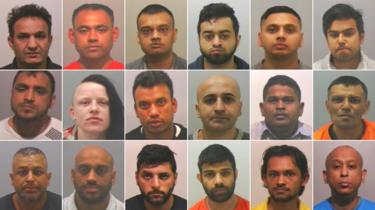
Operation Shelter defendants who were convicted/pleaded guilty of offences including conspiracy to incite prostitution, rape and drugsImage copyrightNORTHUMBRIA POLICE
Image captionEighteen people were jailed for their involvement in the sexual abuse of vulnerable young women in Newcastle
Vulnerable women are most likely being “extensively” abused across the UK and ministers need to urgently review sex exploitation laws, a report says.
David Spicer led a review in the wake of Operation Sanctuary which saw 18 people jailedfor the sexual abuse of young women groomed in Newcastle.
He said exploitation was not being recognised in adults.
The operation identified about 700 victims in total across the Northumbria Police area, 108 in Newcastle.
The government said it would “look carefully” at Mr Spicer’s 33 recommendations, which also included a need for research into the cultural background of abusers, many of whom in the case of Sanctuary were from a “predominantly Asian or British Minority Ethnic culture or background”.
Mr Spicer, who carried out the serious case review for the Newcastle Safeguarding Adults and Children Boards, said it was clear “adults were being targeted, groomed and exploited” as well as children.
But he said authorities did not have the powers to intervene with adults to stop them “making bad choices” or forming “inappropriate relationships”.

Media captionOne victim of sexual exploitation in the city says abuse still continues
He said: “Vulnerability is not determined by age and it is likely that extensive abuse of vulnerable adults is taking place across the country unrecognised.”
Operation Sanctuary started in 2014 after a 21-year-old woman with a learning disability told police she had been a victim of sexual exploitation over a long period.
Further reports from two 19-year-old women “confirmed” sexual exploitation was a much larger problem in Newcastle “than previously recognised”.
Mr Spicer said the operation had proved successful but it was only when Northumbria Police and other agencies like Newcastle City Council started looking for the issue they found it.
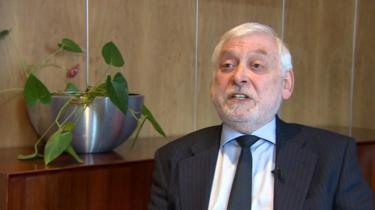
David Spicer
Image captionDavid Spicer led the serious case review
He also said the government needs to research the “profiles, motivations and cultural and background influences of perpetrators of sexual exploitation”.
In the Newcastle case, most of the men were British-born but all came from Bangladeshi, Pakistani, Indian, Iraqi, Iranian or Turkish communities.
Think tank the Quillam Foundation, which focuses on counter-extremism, said 84% of the 264 offenders convicted of grooming between 2005 and 2017 were of south Asian heritage.

Pharmacist training

Mr Spicer said the perpetrator he spoke to “displayed no regret” and “spoke in a derogatory manner about a lack of morals in British girls”.
The report noted that there was no evidence that police and other agencies had been reluctant to investigate amid “misplaced” concerns over political correctness or allegations of racism.
Mr Spicer also said confidentiality systems in sexual health services should be reviewed as a lack of information-sharing meant no-one spotted victims who went to multiple clinics.
Posed picture of woman holding head in handsImage copyrightGETTY IMAGES
Image captionVulnerable adults were also sexually exploited in Newcastle
Medical professionals such as pharmacists should also be trained to spot signs of abuse, he said.
Mr Spicer was also critical of the ordeal of victims giving evidence in court saying several complained it caused “lasting serious mental health problems”.
As well as reviewing the way victims are treated during trials, Mr Spicer also said the terminology of charges should be changed to avoid causing further distress.
This was after victims complained the charge of “inciting prostitution” labelled them as prostitutes.

‘Devastating impact’

The report also looked at exploitation of boys and men but said it was “complex and hidden” and operated differently to female victims.
Mr Spicer said: “The low incidence of identified cases is likely to be a significant under-representation of the abuse occurring.”
He also said it was not within the scope of his review to investigate Northumbria Police’s £10,000 payment to a convicted child rapist who acted as an informant.
A government spokesman said: “These are abhorrent crimes that have had a devastating impact on the lives of the victims involved.”
Changing Lives, a charity which supports victims of sexual exploitation including 33 associated with Operation Sanctuary, praised the report
Director Laura Seebohm said the trauma “cannot be underestimated” and she welcomed the recommendations for “national debate, review and guidance”.
Vida Morris of Newcastle’s adults safeguarding board said she was “profoundly and deeply sorry for the emotional and physical trauma” the victims suffered.
She said the women had been “brave beyond belief” and thanks to them Newcastle was “without a doubt a safer place”.
Northumbria police and crime commissioner Vera Baird declined to be interviewed.

Sean Rigg custody death: Watchdog requests new hearings

Sean RiggImage copyrightPA
Image captionSean Rigg died in police custody in 2008
The police watchdog has said five officers should face gross misconduct hearings over the death in custody of a mentally ill man.
Sean Rigg, 40, who had schizophrenia, died from cardiac arrest at Brixton police station in August 2008 after being restrained by officers.
Last year it was ruled none of the officers involved should be prosecuted.
This month the Met Police stopped Sgt Paul White from retiring because he would otherwise have avoided a hearing.
Sarah Green, the regional director for the Independent Office for Police Conduct (IOPC), confirmed on Friday she had recommended the gross misconduct hearings.
In a statement, she also said two of the five officers should face hearings over allegations they knowingly misled both the police watchdog and an inquest into Mr Rigg’s death.
A Met Police spokesman said the force “remains in correspondence with the IOPC regarding if there is a case to answer for any of the officers”.
“Until that is finalised it would not be appropriate to discuss this publically,” it added.
Marcia Rigg
Image captionSean Rigg’s sister Marcia said the ongoing delay has caused her a “high degree of stress”
In 2012 an inquest jury found that police had used unsuitable force when they arrested Mr Rigg, a musician.
He was handcuffed, forcefully restrained face down and confined in a police van.
Mr Rigg collapsed after arriving at the station, where he had been put in a holding area, and died from a heart attack.
Last year, the Crown Prosecution Service decided no officers should be prosecuted over his death.
This week he has been in the High Court trying to overturn a ban on him resigning from the Met Police.
Lawyers representing Marcia Rigg-Samuel, Mr Rigg’s sister, told the court the ongoing delay has caused her a “high degree of stress”.
Judgement has been reserved to a later date.

Labour’s general secretary Iain McNicol resigns

Image copyrightPA
The general secretary of the Labour party, Iain McNicol, has stood down “to pursue new challenges” after serving for a “tumultuous seven years”.
In a statement, issued late on Friday, Mr McNicol said he would continue to work “in the service” of the party.
Labour leader Jeremy Corbyn thanked him for his service, adding he had been “a credit to our movement”.
The Conservatives said Mr McNicol had been toppled after “persistent attempts” by supporters of Mr Corbyn.
A spokesman said: “Iain McNicol’s departure shows once again that Labour are putting their own bitter internal politics before ordinary people and their priorities.”
Mr Corbyn praised the former trade union official’s long and dedicated service.
“He has run our party’s organisation at a time of great change, including a near tripling of the membership, two general elections and the EU referendum,” he said.
Mr McNicol said he would continue to support Mr Corbyn’s leadership and work closely with him.
A number of Labour MPs have paid tribute to Mr McNicol, with Chuka Umunna saying the party owed him “a huge debt of gratitude”.
Labour said officers of the party will meet to decide the process for the election of a successor.

Florida shooting: NRA-linked firms hit by consumer boycott

Students from Montgomery Blair High School march down Colesville Road in support of gun reform legislation February 21, 2018 in Silver Spring, Maryland.Image copyrightGETTY IMAGES
Image captionActivists are putting pressure on companies with ties to the NRA, a powerful gun lobby
More than half a dozen US companies have cut ties with the National Rifle Association (NRA) as consumers urge a boycott of businesses linked to the politically powerful gun lobby.
The firms included car rental giants Hertz and Enterprise, which offered discounts for NRA members.
The moves follow NRA leader Wayne LaPierre’s speech defending gun rights.
They were the NRA’s first public comments since a deadly school shooting in Florida.
Mr LaPierre said “opportunists” were using the 14 February tragedy, in which 17 people were killed, to expand gun control and abolish US gun rights.
Activists have tried to put pressure on the NRA since the shooting by targeting firms that offer discounts and other benefits to its members.
They have flooded its corporate partners with comments on social media under the hashtag #BoycottNRA. Firms under pressure include delivery company FedEx and tech giants such as Amazon, which distributes NRA television programmes.
On Thursday, the family-owned First National Bank of Omaha said it would not renew NRA-branded credit cards, citing “customer feedback”.
Enterprise Holdings, which owns the rental car brands Alamo, Enterprise and National, also said discounts offered to NRA members would end on 26 March.
The firm, which announced the move in response to comments on Twitter, declined to say why it had taken such a step but told a customer that the firm doesn’t “sponsor, endorse or take a political stance on any organizations.”
Other companies distanced themselves from the NRA on Friday.
Those included MetLife Insurance, the Avis Budget Group, home security firm Simplisafe, two moving brands – Allied Van Lines and northAmerican Van Lines – and Symantec Corp which had offered discounts for its LifeLock identity theft product.
Insurance firm Chubb also said it had stopped underwriting an NRA-branded insurance policy three months ago.
In Florida, the president of the Florida Education Association, which represents teachers’ unions, also called on the state to look at pension holdings in gun companies in a statement to the Miami Herald newspaper.
The NRA, which claims five million members, did not respond to a request for comment about effect of the boycott.
The group defended itself in comments on Twitter, saying people upset about the shooting should focus on lapses by law enforcement.
“Instead of placing the blame on an organization that defends everyone’s #2A rights, maybe people should take a hard look at the number of failures by the FBI and local law enforcement agencies, or does that not fit your agenda?” it wrote, referring to the constitutional amendment that protects gun rights.
Prior campaigns aimed at the NRA have had limited results.
President Donald Trump has defended the NRA, while others criticised the boycott on Twitter.
The campaign comes as US businesses increasingly find themselves entangled in political debates, as activists target them on issues such as LGBTQ rights, as well as ties to the president.
Companies such as retailer Nordstrom and sportswear brand Under Armour are among the firms that have been subject to calls for boycotts from the left and right.
Executives serving on presidential councils, including the former chief executive of Uber, have resigned from the advisory groups after consumer pressure. The councils eventually disbanded last summer.
North Carolina last year also rescinded a law that restricted bathrooms for transgender people after a boycott by businesses and sports leagues.
Design a site like this with WordPress.com
Get started