AP Exclusive: AP confirms 5 unreported Myanmar mass graves

By OP

The faces of the men half-buried in the mass graves had been burned away by acid or blasted by bullets. Noor Kadir could only recognize his friends by the colors of their shorts.
Kadir and 14 others, all Rohingya Muslims, had been choosing players for the soccer-like game of chinlone when the gunfire began. By the time the soldiers stopped shooting at the Myanmar village of Gu Dar Pyin, only Kadir and two teammates were still alive.
Days later, Kadir found six of his friends lying among the bodies in two graves.
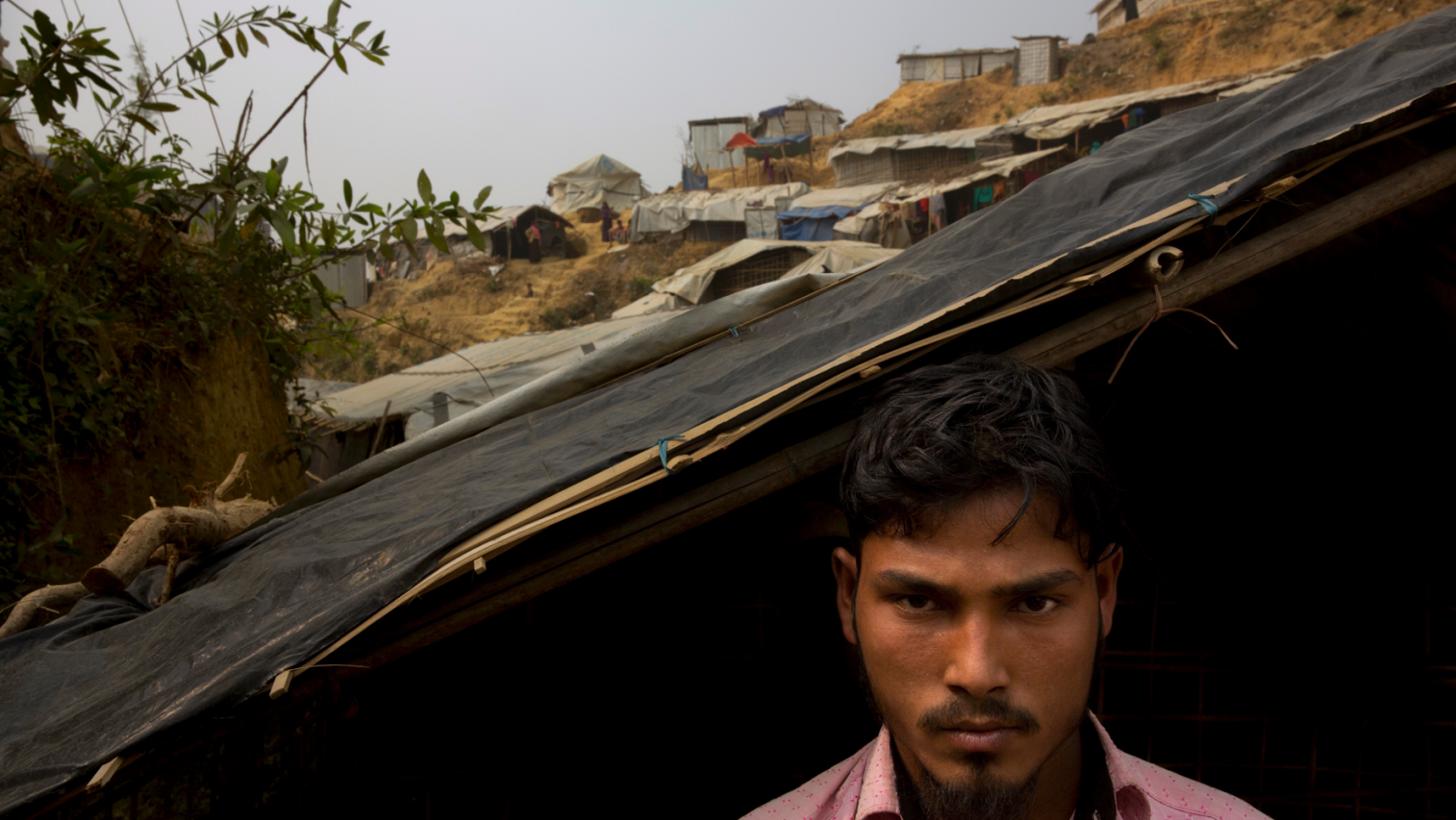
They are among more than five mass graves, all previously unreported, that have been confirmed by The Associated Press through multiple interviews with more than two dozen survivors in Bangladesh refugee camps and through time-stamped cellphone videos. The Myanmar government regularly claims massacres like Gu Dar Pyin never happened, and has acknowledged only one mass grave containing 10 “terrorists” in the village of Inn Din. The AP’s findings, however, suggest not only the military’s slaughter of civilians but the presence of many more graves with many more people.
The graves are the newest piece of evidence for what looks increasingly like a genocide in Myanmar’s western Rakhine state against the Rohingya, a long-persecuted ethnic Muslim minority in the predominantly Buddhist country. Repeated calls Wednesday and Thursday to Myanmar’s military communications office were unanswered. Htun Naing, a local security police officer in Buthidaung township, where the village is located, said he “hasn’t heard of such mass graves.”
Myanmar has cut off access to Gu Dar Pyin, so it’s unclear just how many people died, but satellite images obtained by the AP from DigitalGlobe show a village decimated. Community leaders have compiled a list of 75 dead so far, and villagers estimate the toll could be as high as 400, based on testimony from relatives and the bodies they’ve seen in the graves and strewn about the area.
Almost every villager interviewed by the AP saw three large mass graves at Gu Dar Pyin’s northern entrance, near the main road, where witnesses say soldiers herded and killed most of the Rohingya. A handful of witnesses confirmed two other big graves near a hillside cemetery, and smaller graves scattered around the village.
In the videos obtained by the AP, dating to 13 days after the killing began, blue-green puddles of acid sludge surround corpses without heads and torsos that jut out from the earth, skeletal hands seeming to claw at the ground.
Survivors said soldiers planned the Aug. 27 attack, and tried to hide what they had done. They came to the slaughter armed not only with rifles, knives, rocket launchers and grenades, but also with shovels to dig pits and acid to burn away faces and hands so that the bodies could not be recognized.
After more than 200 soldiers swept into Gu Dar Pyin around noon, Mohammad Sha, 37, a shop owner and farmer, hid in a grove of coconut trees near a river with more than 100 others. They watched as the military searched Muslim homes and dozens of Buddhist neighbors, their faces partly covered with scarves, loaded the possessions they found into about 10 pushcarts. Then the soldiers burned down the homes, shooting anyone who couldn’t flee, Sha said.
Mohammad Younus, 25, was crawling on his hands and knees after being shot twice when his brother carried him to some underbrush, where Younus lay for seven hours. At one point, he saw three trucks stop and begin loading dead bodies before heading off toward the cemetery.
Buddhist villagers then moved through Gu Dar Pyin in a sort of mopping-up operation, using knives to cut the throats of the injured, survivors said, and pitching the young and the elderly into fires.
Thousands of people from the area hid deep in the jungle, stranded without food except for the leaves and trees they tried to eat. From about 10 miles away another group of villagers watched from a mountain as Gu Dar Pyin burned, the flames and smoke snaking up into the sky.
In the days and weeks after the attack, villagers braved the soldiers to try to find whatever was left of their loved ones. Dozens of bodies littered the paths and compounds of the wrecked homes; they filled latrine pits. The survivors soon learned that taller, darker green patches of rice shoots in the paddies marked the spots where the dead had fallen.
Bloated bodies began to rise to the surface of the rain-saturated graves.
“There were so many bodies in so many different places,” said Mohammad Lalmia, 20, a farmer whose family owned a pond that became the largest of the mass graves. “They couldn’t hide all the death.”
Eleven days after the attack, Lalmia was fleeing soldiers patrolling near the mosque when he discovered a human hand sticking out of a cleared patch of earth. Lalmia counted about 10 bodies on the grave’s surface and estimated it held at least another 10.
Lalmia and other villagers also saw another large grave in the area, and smaller graves containing as many as 10 bodies scattered about the village.
On Sept. 9, villager Mohammad Karim, 26, captured three videos of mass graves time-stamped between 10:12 a.m. and 10:14 a.m., when soldiers chased him away, he said. In the Bangladesh refugee camps, nearly two dozen other Rohingya from Gu Dar Pyin confirmed that the videos showed mass graves in the north of the village.
About 15 days after the massacre, Rohima Khatu, 45, searched for her husband in the graves at Gu Dar Pyin’s northern entrance, trying to identify him by his clothes.
“There were dead bodies everywhere, bones and body parts, all decomposing, so I couldn’t tell which one was my husband,” Khatu said. “I was weeping while I was there. I was crying loudly, ‘Where did you go? Where did you go?'”
“I have lost everything.”
___
India man ends protest after social media movement

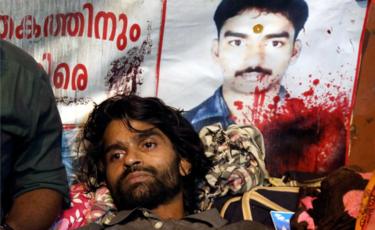
Sreejith in front of the Kerala secretariatImage copyrightVIVEK R NAIR
Image captionSR Sreejith was demanding an independent inquiry into the death of his brother
A man from the south Indian state of Kerala has ended a 782-day protest after a federal agency began investigating his brother’s death.
SR Sreejith alleges his brother was murdered by police who arrested him on the charge of stealing a mobile phone.
His demand for an independent inquiry into his brother’s death picked up in recent months through the social media movement #JusticeforSreejith.
He ended the protest after federal investigators recorded his statement.
In the face of mounting public pressure, state lawmakers ordered an internal police investigation into his brother’s death. But Mr Sreejith refused, insisting that the case be transferred to India’s federal investigation agency, the Central Bureau of Investigation (CBI).
Police had said Sreejeev, 26, committed suicide in custody after he was arrested, but his family says he was killed because he was in love with a woman who happened to be related to one of the police officers.
He was arrested one day before she was scheduled to get married to someone else. He died in hospital the following day where he was admitted as a result of the “suicide attempt”.
Human Rights Watch (HRW) said in an August report on India that suicide and illness are common causes listed by authorities to cover up deaths likely caused by police torture.
In a country only too familiar with police brutality and custodial deaths – India’s National Crime Records Bureau says 591 people died in police custody between 2010 and 2015 – his protest generated particular resonance.
In the past few weeks and months, pictures of him and his protest have been shared widely on Facebook and Twitter along with messages of solidarity, including from some very high profile figures in the state.

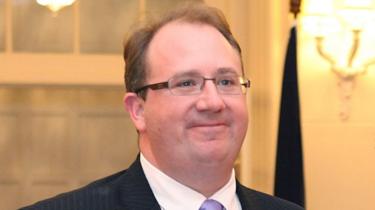
Kevin Rudd: Ex-PM sues Australian Broadcasting Corporation

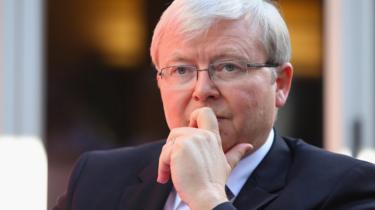
Kevin RuddImage copyrightGETTY IMAGES
Image captionKevin Rudd says he has commenced legal action
Former Australian leader Kevin Rudd has launched legal action against the country’s main public broadcaster over a report he says is “a lie”.
On Tuesday, the Australian Broadcasting Corp said that Mr Rudd had been warned while prime minister about risks relating to a home insulation scheme.
The deaths of four men under the scheme led to an inquiry in 2014. It made no adverse findings against Mr Rudd.
The ABC has defended its report, which followed a high-profile file discovery.
The broadcaster has used confidential Cabinet documents, found in a second-hand shop, to publish a series of exclusives this week about recent governments.
One said Mr Rudd and government ministers Julia Gillard, Wayne Swan and Lindsay Tanner had been warned of “critical risks” about the insulation programme in 2009.
Cabinet papers did not specify whether these were safety concerns, the ABC said.
In announcing his legal action, Mr Rudd said the risks referred to in the Cabinet documents were financial and administrative matters – not safety risks.
He said those documents had already been examined by a royal commission inquiry.
“The Royal Commission concluded that there was no finding to made against me, and in fact that while serving as Prime Minister ‘there was no warning given of the very many problems with the program’ (p.271 of the final report),” he said in a statement on Thursday.
ABC news director Gaven Morris said the broadcaster “stands by the reporting we’ve done”.
The insulation scheme was introduced by Mr Rudd’s government in 2009 as part of a larger plan to stimulate the economy in response to the global financial crisis. It was discontinued in 2010.
The royal commission found the scheme’s poor design and implementation directly contributed to the deaths of four young workers from electrocution and hyperthermia in separate incidents.

Genetic secret of English salmon

By OP

Chalk-stream salmonImage copyrightSAM BILLINGTON, ENVIRONMENT AGENCY
Image captionChalk-stream salmon look the same as other salmon but their genes tell a different story
The salmon from the chalk streams of southern England appear to be genetically distinct from others.
Evidence published in the Journal of Fish Biology suggests they may be a separate sub-species of Atlantic salmon.
Scientists argue that the fish may need greater protection, because they would be impossible to replace with salmon from elsewhere in Europe.
Many chalk streams are designated sites of special scientific interest.
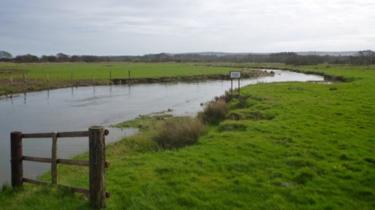
These meandering streams that flow through chalk hills generally have clear, slow-flowing water and are more alkaline than other waters.
Scientists think the geology and chemistry of the rivers may affect the distribution of different salmon populations.
Researchers studied salmon in stretches of five rivers in Hampshire and Dorset, where salmon have returned to breed for thousands of years.
The rivers include the Frome, Piddle, Avon, Test and Itchen.
The study found salmon in the rivers were genetically distinct from those in non chalk-stream rivers close by.
“The fish in the chalk streams of Dorset and Hampshire are as different from their cousins elsewhere in Britain as they are to cousins much further afield, such as the Baltic,” said Dr Jamie Stevens of the University of Exeter.
The Frome: A chalk streamImage copyrightUNIVERSITY OF EXETER
Image captionChalk streams are an important habitat for fish
Populations of salmons in chalk streams have plummeted in recent decades.
The researchers say the rivers are under “massive pressure” from human activity.
“The fish in these rivers seem to contain a unique component of the overall genetic diversity of the species,” said Dr Stevens.
“This makes them highly valuable; and it also makes them vulnerable. Because if they were to be lost through effects on their habitat or pollution it would be almost impossible to restock those chalk streams.”
Like other salmon, those from chalk streams spend long periods at sea and swim hundreds of miles, but return to the rivers where they were born.
Most of the world’s chalk streams are found in the UK, but they are at risk of pollution as they pass through urban areas and through farmland.

Average age of first stroke in England falls, figures show

By OP

BBCImage copyrightROB GOODWIN
Image captionRob Goodwin had none of the risk factors associated with stroke before he became ill
The average age of people in England who have a stroke for the first time has fallen over the past decade, new figures show.
It dropped from 71 to 68 for men and 75 to 73 for women between 2007 and 2016, Public Health England data shows.
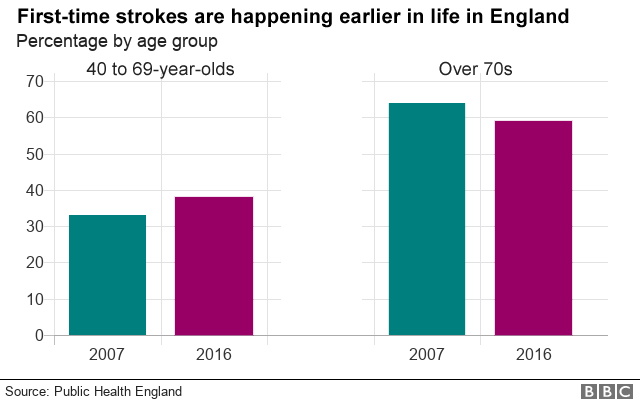
Over the same period, the proportion of first-time strokes suffered by 40 to 69-year-olds rose from 33% to 38%.
PHE said the data showed strokes do not just affect the elderly and urged more people to be aware of its symptoms.
The Act FAST campaign tells people to phone 999 if they spot any signs of the condition in the face, arms or in speech to reduce the risk of disability or death caused by delayed treatment.

‘Fast acting essential’

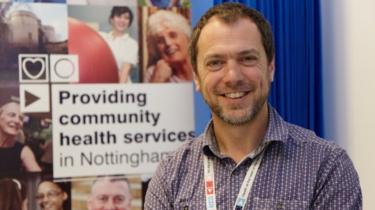
Rob Goodwin, from Nottingham, had been a fit 48-year-old when he had a stroke in 2016.
A keen cyclist, Mr Goodwin had none of the risk factors associated with stroke, such as high blood pressure, when he suddenly fell to the floor while getting dressed.
It was because of his partner quickly recognising his symptoms and his 17-year-old stepdaughter phoning 999 that he was able to receive treatment within 40 minutes of his stroke and make an almost full recovery, he said.
“If my partner and stepdaughter hadn’t acted quickly then I would undoubtedly be in a very different situation. That fast acting is essential.”
Philippa Haslehurst and her daughter
Image captionPhilippa Haslehurst said her stroke could have killed her were it not for her daughter
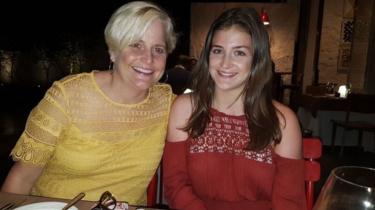
Philippa Haslehurst, from Chingford, north London, was 47 when she suffered a major stroke in 2014, caused by a hole in her heart.
She said it could have killed her were it not for her teenage daughter Beth, who recognised her symptoms from a previous Act FAST TV advert, enabling her mother to receive treatment quickly.
Mrs Haslehurst said awareness of stroke symptoms was as important as recognising a heart attack.
“It could happen to anybody. It happens to young people, it happens to children. I was a healthy person and I had a hole in my heart.”

Strokes, which occur when the blood supply to the brain is cut off, are the third most common cause of premature death and a leading cause of disability in the UK.
It is estimated some 57,000 people in England suffered their first stroke in 2016.
PHE found the rate of first-time strokes in the population had fallen by 8% since 2007.
During that time, the percentage of first-time strokes suffered by over-70s went from 64% to 59%, while for those aged 40 to 59 it increased from 15.3% to 20%.
Graph of change of proportions of strokes among 40-69-year-olds and over-70s
PHE said the drop in the average age of first strokes could be down to better healthcare for the elderly, including health checks that help them monitor stroke risk factors.
Prof Julia Verne, Public Health England’s director, said the findings showed “everyone needs to be aware of the signs”.
“Calling 999 as soon as you see even one of the symptoms develop – in the face, arms and speech – is essential. Speedy treatment will help prevent deaths and disability.”
X-ray scan of brainImage copyrightGETTY IMAGES
PHE called on more people between the ages of 40 and 74 to get an NHS health check, which can identify early signs and those who are at risk of a stroke.
Health Minister Steve Brine said: “Strokes still claim thousands of lives each year, so the message of this Act FAST campaign remains as relevant as ever.”
The campaign will feature in TV and radio adverts and posters on buses.

Act FAST campaign – what to look for

  • Face – Has their face fallen on one side? Can they smile?
  • Arms – Can they raise both their arms and keep them there?
  • Speech – Is their speech slurred?
  • Time – Time to call 999

Australian dual citizen saga unseats 10th politician

David FeeneyImage copyrightGETTY IMAGES
Image captionDavid Feeney says he will resign from parliament
An Australian MP has become the 10th politician to be unseated from parliament over a dual nationality saga.
Labor MP David Feeney said he would resign after being unable to prove that he had renounced his UK citizenship.
Last year, nine politicians were ousted over concerns they held dual citizenship – although two later returned through by-elections.
Dual nationals are not allowed to stand for parliament in Australia.
Mr Feeney said he thought he had renounced his British citizenship, but he could not find the paperwork despite “extensive searches”.
“I am unable to disprove that I am a dual citizen,” Mr Feeney told reporters on Thursday.
He had found proof that he renounced Irish citizenship, he said.
Mr Feeney said he would not contest the seat again in a by-election.
Deputy Prime Minister Barnaby Joyce was among two MPs who were reinstated to parliament following by-elections in December.

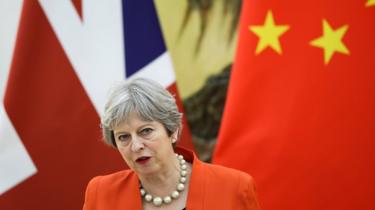
Theresa May in talks with Chinese president Xi Jinping

Theresa May in BeijingImage copyrightGETTY IMAGES
Theresa May is to meet President Xi Jinping for talks later on the second day of her visit to China.
The agenda is expected to cover trade and security issues, including North Korea’s nuclear programme.
The PM is in China at the head of a 50-strong business delegation.
She will also raise environmental concerns – and present Mr Xi with a box-set of the BBC’s Blue Planet II series, with a personal message from presenter Sir David Attenborough.
The show examined the effect of human behaviour on the environment and was referenced by Mrs May last month when she pledged to eradicate all avoidable plastic waste in the UK by 2042 as part of a 25-year green strategy.
On the first day of her trip the prime minister announced a UK-China effort to strengthen international action against the illegal trade in ivory.
She also said Mr Xi’s initiative to establish overland transport links between China and Europe would be discussed at their meeting.

£9bn deals

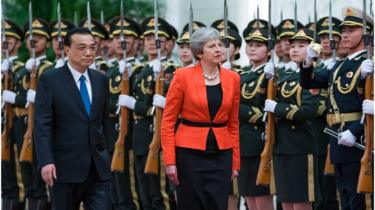
In Beijing on Wednesday, the prime minister and Chinese Premier Li Keqiang agreed on a new trade and investment review, which is seen as a stepping stone to a full free trade agreement after Brexit.
Mr Li said China would further open up its markets to the UK, including to agricultural products and financial services.
UK-China trade is currently worth a £59bn a year and Mrs May has said she expects deals worth a further £9bn to be signed during the course of her visit.
Theresa May and Xi Jinping at G20 summit in Hangzhou in September 2016Image copyrightGETTY IMAGES
Image captionThe two leaders met at the G20 summit in Hangzhou in September 2016
One of the UK companies travelling with the PM, health-tech firm Medopad, has said it signed more than £100m of commercial projects and partnerships with organisations including China Resources, GSK China, Peking University and Lenovo.
BBC political editor Laura Kuenssberg said the prime minister would want to build on the warm words from China when she meets Mr Xi, amid pressure on her from her own party and Brussels in recent days.

Residency move opposed

Earlier this week, the EU set out what it was prepared to offer the UK in the Brexit transition period.
Speaking in China, Mrs May sought to reassure Tory MPs worried about the length of transition, saying it would last about two years and was not “something that is going to go on and on”.
Prime Minister Theresa May and Chinese Premier Li KeqiangImage copyrightGETTY IMAGES
Image captionPrime Minister Theresa May and Chinese Premier Li Keqiang held talks in Beijing on Wednesday
She also indicated she would be fighting an EU proposal to give its citizens moving to the UK during the transition period after Brexit residency rights.
In a separate development, BuzzFeed News has claimed government studies on the economic impact of Brexit suggest that reducing migration from the bloc into the UK would nullify the benefits of any trade deal struck with the US.
Ministers agreed on Wednesday to let MPs see another leak from the same impact analysiswhich suggest the economy would be worse off as a result of a number of possible Brexit scenarios.
Meanwhile, the government’s flagship EU (Withdrawal Bill) has cleared its first hurdle in the House of Lords as it passed its second reading and former Labour minister Lords Adonis withdrew an amendment calling for a referendum on the final deal.

US citizen accused of ‘insulting’ Vietnamese national hero

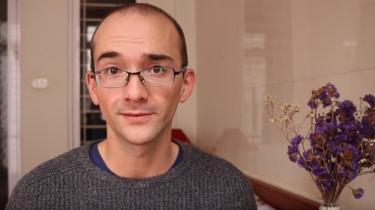
Screenshot of a Youtube video by Dan HauerImage copyrightYOUTUBE/DAN HAUER
Image captionDan Hauer has a massive following on Youtube and Facebook
A US man with a large online following in Vietnam has caused widespread anger, and faces possible criminal charges, over a Facebook post thought to have insulted a military hero.
Daniel Hauer lives in Vietnam, is married to a local woman and speaks fluent Vietnamese.
He has a wide local following on Facebook and Youtube for his English language teaching videos and his observations about Vietnamese and Western culture.
But a joke about General Vo Nguyen Giap triggered widespread condemnation on social media. Hundreds of people are calling for him to stop teaching and leave the country.
He has since posted an apology video, was summoned by the authorities and is now facing a fine or a warning. It is thought to be the first time a foreign citizen has had to appear before officials for comments posted online.
Communist Vietnam has a high rate of social media usage, but exercises strict control over the internet, filtering out content deemed undermining of the government of its values.

Tight control

Its censorship rules have often been used to silence government critics and several dissident bloggers have been jailed.
Nguyen Van HoaImage copyrightGETTY IMAGES
Image captionBlogger Nguyen Van Hoa was sentenced to seven years in prison
On Wednesday, three activists Vu Quang Thuan, Nguyen Van Dien, and Tran Hoang Phuc were sentenced to between six and eight years in jail for distributing propaganda against the state.
In 2017, popular environmental blogger Mother Mushroom received a 10-year prison sentenceunder similar charges.
The same year, 22-year old blogger Nguyen Van Hoa was sentenced to seven years for writing about a toxic spill from a factory poisoning millions of fish.
In 2015, activist lawyer Nguyen Van Dai was arrested without trial after already having served a lengthy sentence previously.
Mr Hauer’s controversial comment was trivial, in comparison.
It came last week, when the country was swept up in a wave of patriotism after its under-23s football team made it all the way to the finals of the Asian Cup, Vietnam’s biggest ever football success.
Celebrations in Hanoi after the U-23 football match (28 Jan 2018)Image copyrightGETTY IMAGES
Image captionThere were huge celebrations to mark Vietnam’s biggest ever football achievement
A Facebook commentator had said he would get a tattoo of the Vietnamese flag, should the country win.
In a hyperbolic joke, the English teacher said that was nothing – after a Vietnamese athlete recently won a gold medal, he said, he’d got a penis piercing making his testicles resemble Gen Giap.
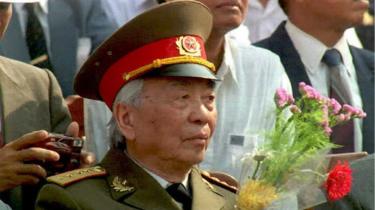
General Vo Nguyen Giap is revered for leading successful military campaigns against both the French and the US. He passed away in 2013, receiving a grand funeral.

Fury and condemnation

Mr Hauer’s flippant remark first caused widespread protests online and eventually made it into the news on national state television.
Many online commentators were not holding back with furious condemnation, asking for him to be deported, leave the country and accusing him of gross cultural insensitivity.
Yet there are also other comments pointing out that a sincere apology would be enough to eventually set things straight again while some even sympathise with him.
Image copyrightFACEBOOK/CATHU.03
Image copyrightFACEBOOK/TRANG949
The grandson of Gen Giap also publicly shared his anger about the post, initially in a strongly worded comment and which he later replaced with a more toned down one saying “millions of people who love him [Gen Giap] felt the anger caused by this foreigner’s insult”.

‘Not meant as an insult’

But Mr Hauer was also in trouble with the authorities.
A controversial law introduced in 2013, known as Decree 72, bans online activity if it falls under certain categories, including opposing the government, harming national security or insulting honour and dignity of organisations and individuals.
Mr Hauer’s comments are thought to fall under the latter category,
The US citizen, who declined to speak to the BBC, has apologised for his post, saying he had made a distasteful joke but had not meant it as an insult to the general or the Vietnamese people.
He added that the reaction to the post had taught him a lesson and that he wanted to personally apologise to the family of the general.
General Vo Nguyen GiapImage copyrightAFP
Image captionGeneral Vo Nguyen Giap was a national hero in Vietnam
According to officials, he now faces a warning or a fine of up to 100m Vietnamese Dong ($4,390; £3,131).
Fellow expat Cameron Lucy runs a Facebook group for foreigners in Hanoi and appeared on Vietnamese TV to comment on the case.
He told the BBC that Mr Hauer likely “didn’t understand how serious the situation was.”
“It is never a good idea to insult a national hero, especially when you’re a visitor to that country. I’m sure Dan is really regretting his comment now and very sorry for that.”
Reporting by OP FROM opsnews1.blogspot.com

Eleven die in fire at a welfare home in Japan

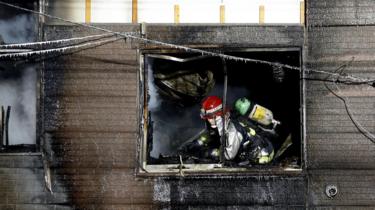
A firefighter at the burnt-out elderly homeImage copyrightREUTERS
Image captionFirefighters managed to save five of the 16 residents
Eleven people have been killed after a fire at a Japanese residential facility for people in financial difficulty.
TV footage on the country’s public broadcaster NHK showed the house engulfed in flames late on Wednesday night.
Of the 16 people living in the home, five were rescued by firefighters battling the blaze.
The three-storey building in the northern city of Sapporo is home to mostly elderly residents.
The home is run by an organisation providing affordable accommodation and helping people on welfare find work, NHK reported.
Authorities have launched an investigation into what caused the fire.
In 2010, seven people were killed in a fire at Sapporo nursing home for the elderly.

Poland’s Senate passes controversial Holocaust bill

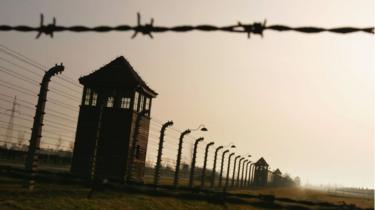
Image of Auschwitz watch tower, barbed wire and fencingImage copyrightGETTY IMAGES
Image captionPoland has long objected to phrases which suggest shared responsibility for Nazi Germany’s actions
Poland’s Senate have approved a controversial bill which makes it illegal to accuse Poles of complicity in the Nazi Holocaust.
The bill also prohibits describing Nazi death camps in Poland as Polish. It sets fines or a maximum three-year jail term as punishment.
The proposal caused a weekend rift with Israel, which accuses Poland of attempting to change history.
The bill must be signed off by the president before entering into law.
It passed in the upper house of the Polish parliament with 57 votes to 23, with two abstaining, according to AFP news agency.
On Sunday Israeli Prime Minister Benjamin Netanyahu spoke out against the draft, calling for it to be dropped.
“I strongly oppose it. One cannot change history and the Holocaust cannot be denied,” he said in a statement.
Polish President Andrzej Duda responded in a television interview, saying they could not back down and asserted that his country had the right “to defend historical truth”.
On Wednesday, a US State Department spokeswoman also asked the Polish government to rethink the bill, saying the US was concerned the legislation could undermine free speech in the country and cause further diplomatic division.
Poland was attacked and occupied by Nazi Germany during World War Two. Millions of its citizens were killed, including three million Polish Jews in the Holocaust.
Israeli Prime Minister Benjamin NetanyahuImage copyrightAFP
Image captionIsraeli Prime Minister Benjamin Netanyahu said he strongly opposed the bill
The country has long objected to the use of phrases like “Polish death camps”, which suggest the Polish state in some way shared responsibility for camps such as Auschwitz. The camps were built and operated by the Nazis after they invaded the country in 1939.
The Polish government said the bill was not intended to limit freedom to research or discuss the Holocaust, but protect the country’s name abroad.
Deputy Justice Minister Patryk Jaki, who authored the bill, said the Israeli reaction was “proof how necessary this bill is”.
Design a site like this with WordPress.com
Get started